The world has signed off on the Sustainable Development Goals. Goal 6 is the big water and sanitation goal and includes targets for water services and water resources: universal access to a safe and affordable water supply, but also targets for water quality, water use efficiency, water related eco systems and water resources.
Le monde s’est engagé sur des Objectifs de Développement Durable. L’Objectif 6 est le grand objectif pour l’eau et l’assainissement et inclue des cibles pour les services d’eau et les ressources en eau : accès universel à un approvisionnement en eau potable sûr et accessible financièrement, mais aussi des cibles sur la qualité de l’eau, l’usage efficient de l’eau, les écosystèmes reliés à l’eau et les ressources en eau.
by Jochen Rudolph, African Development Bank (AfDB)
Through its Rural Water and Sanitation Initiative (RWSSI) the African Development Bank (AfDB) was the first donor to support the Senegalese initiative “PEPAM” (Programme Eau Potable et Assainissement du Millénaire) in 2004 and has maintained the close partnership ever since. Looking back at the PEPAM experience, we find that strong and sustained commitment to improving rural water supply and sanitation in Senegal has resulted in more facilities than were originally budgeted for being installed and, as a result, has improved the health and quality of life for a large number of beneficiary villages.
RWSN is at Stockholm World Water Week. We are at stand B9 and we have discussions and interviews with key experts going on all week. We will keep an up to date schedule here, so keep checking back here through the week.
Wednesday 26 Aug
9am “Future proofing rural water systems” with Susan Davies (Improve International)
1pm “Human Right to Water handbook in the SDG era” with Virgina Roaf and Hannah Neumeyer
2pm “Handpump standardisation” with Jess MacArthur, iDE
3:30pm “Solar pumps and prepayment systems” with Craig Williams and Andre, Water Missions International
Thursday 27 Aug
11am “T-GroUP: Groundwater for the urban poor” with Dr Jenny Grönwall (SIWI)
2pm “Reflections on household water treatment and universal water access” Maria Besteman (Basic Water Needs”
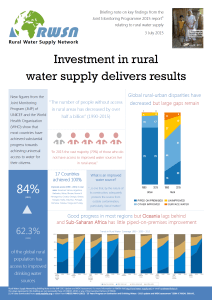
We have pulled together a 2-side briefing note that pulls out some of the headline figures and conclusion on rural water supply. Please download it from:
The new figures from JMP show that most countries have achieved substantial progress towards achieving universal access to water for their citizens.
84% of people living in rural areas now have access to a safe water source in 2015 (up from 62% in 1990)
“The number of people without access in rural areas has decreased by over half a billion” (1990-2015)
17 Countries achieved 100% improved access (1990 – 2015) in rural areas
Global rural-urban disparities have decreased but large gaps remain – 8 out of ten people without access to an improved water source live in rural areas
Good progress in most regions but Oceania lags behind and Sub-Saharan Africa has little piped-on-premises improvement
Find out more by downloading the briefing note – and guess which country made the biggest percentage gain in improved access for its rural population? I almost guarantee it won’t what you expected!
Groundwater is a valuable resource for communities, but accessing and maximising its potential can be difficult. Vincent Casey, WaterAid’s Technical Support Manager for Water Security, introduces a series of videos demonstrating good practice in borehole drilling.
Groundwater is a valuable resource for communities, but accessing and maximising its potential can be difficult. Vincent Casey, WaterAid’s Technical Support Manager for Water Security, introduces a series of videos demonstrating good practice in borehole drilling.
Good practice must be followed if groundwater development programmes are to reach their full potential. If certain steps are not taken, there is a high chance that boreholes will fail, investment will be wasted and people will remain un-served.
Vincent Casey, Technical Support Manager for Water Security
There is a lot of attention for monitoring, and rightfully so. New Information and Communication Technologies (ICT) have opened great possibilities to collect data, store data and visualise data on mobile phones. Maybe some of you already have used mobile phones for data collection. New ICT has brought national scale sector monitoring within reach. It has been done in Liberia, countries in Central America, Ghana, Nigeria, Mali, Ethiopia and many others.



 Rural Water Supply Network - blog