I recently attended the Colorado Water, Sanitation and Hygiene Symposium, hosted by the University of Colorado Boulder. The two-day regional gathering, intended primarily for students, faculty and local WASH professionals within greater Denver WASH community, attracted 130 attendees. A closely knit and cross-disciplinary group of graduate students did a fantastic job planning and hosting the event.
For those who aren’t aware – this included me before arriving on campus – the Colorado WASH community is thriving. The Denver area is home to a blend of international NGO’s like Water for People and iDE as well as local non-profit groups with a regional or country focus like El Porvenir. Add to the mix the energy created by a dynamic group of graduate students and academics engaged in the international WASH sector and the stage was set for an engaging discussion.
In Kanungu district of south western Uganda, the Technology Applicability Framework (TAF) work was used to assess the potential of solar powered water pumping in the country.The exercise involved representatives from the Ministry of Water and Environment, Technical Support Units (TSUs),Kanungu district local governments, local NGOs, research institutions, private sector enterprises and beneficially communities. The assessment was based on the following dimension: social acceptance of the technology in the community, environmental dimension, and affordability of the technology by community members, skills and knowhow.
Solar powered pumping for domestic supply has great potential in Uganda if the following issues are adequately addressed:
Scheme operators and beneficially communities should provide adequate security measures to protect solar panels from theft. In addition, communities using solar water powered pumps and bore holes should be able to access loans from banks or financial institutions for replacement of highly expensive scheme components in the event of…
Last week in Gammarth, Tunis the African Development Bank called a meeting, attended by about 160 sector experts and other government officials, to launch a new coordination mechanism for its flagship Rural Water Supply and Sanitation Initiative, or RWSSI. It was an interesting couple of days and through the various presentations, discussions, working groups and questions from the floor, a number of both key opportunities and challenges – fault lines even – were exposed to me as a relatively neutral participant.
Over 150 delegates including, ministers, CSO leaders and experts in water and sanitation have converged in the Tunisian capital Tunis for the meeting to launch the Regional Coordination Committee of the Rural Water Supply and Sanitation Initiative (RWSSI).
RWSSI was launched in 2003 by the African Development Bank with an overall goal of universal access to water supply and sanitation services for the rural populations by 2025 with an immediate target of 80 percent coverage by 2015.
Delegates at the conference going on at Ramada Plaza in Tunis heard from various dignitaries including Bai Mass Taal, the Executive Secretary for African Ministers Council on Water (AMCOW).
Taal noted that AMCOW had adopted RWSSI in recognition of the need to focus on this under-prioritized subsector.
While presenting the Terms of References for Regional Coordination Committee, Osward Mulenga Chanda, the Manager for Water and…
Of the 780 million people worldwide without an improved water source some 80% live in rural areas. In sub-Saharan countries some 35% of the rural water points are not functioning. A country with a remarkable and sustainable increase in rural water supply is Nicaragua. This country has 6 million people of which some 43% live in rural areas. With development aid an innovative low cost hand pump was introduced in 1987. By 1995 this pump became an integral part of rural water programmes of NGOs and government agencies. Rural water supply coverage between 1987 and 1995 doubled from approximately 27.5% to 54.8%. Of this 27.3%, rope pumps account for 23.6% (85% of the total increase). *
Now, 25 years later the situation is:
Over 70.000 rope pumps on boreholes and hand dug wells. Cost /pump 70-150 US$
Besides handpowered also pedal, horse, engine and wind powered models developed
Some 10 workshops produce the pumps and another 8 outlets sell the pump
10 to 20% of the pumps are used for communal supply, the rest for self supply
Even pumps that are given away in general remain working
The scaling up is also thanks to the government who made it a national standard pump
Most pumps are funded by Government or NGOs, some 30% is paid by private families
Over 90% of the all pumps are working (Evaluation of IRC) ** This high % is explained by its repairability. (Simplicity, Low cost, decentralised production, spares available )
The maintenance consist of replacement of the rope and pistons and oiling bushings
The shift from imported piston pumps like Indian Mark 2 to locally produced rope pumps increased the rural water supply 3 x faster than countries without the ropepump
The number of imported piston pumps has reduced to less than 2% of all hand pumps
The rope pump is now by far the most used technology for rural water supply
In some areas families now get piped systems or get electricity and buy an electric pump but most families will still use the rope pump for cattle watering or irrigation
A market for 200.000 more handpumps (study Water & Sanitation Program, Worldbank)
Even 8.000 $ boreholes of 70 meters deep are equipped with 140 $ rope pumps!
All this goes on since 1998 without any NGO or external advisors involved
A study of effects of water for rural families (5015 families studied) concluded
– a well increases incomes of small farmers with 30%
– a rope pump on that well increases again average incomes with $220/year **
The total investment in these pumps was USD1 million in training etc and some USD8million in pumps. The result is an increase of the GNP of USD100 million since 1990 due to family rope pumps. There is much to improve on both pump quality and installation and some workshops make bad pumps but the pumps work and generate income for producers and users. The development in the rural area is notable and rope pumps are a step on the water ladder.
Nicaragua is an example that, where water levels are less than 50 meters and low cost wells can be made, the rural water supply can increase drastically at investment costs of 5 to 15US$/capita. What is possible in Nicaragua seems possible in many other countries.
Rope pump for Self supply used for domestic use, cattle watering and garden irrigation
Ropepump for Communal supply on 60 mtr deep borehole of 8000US$. Used by 20 families
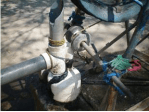
This rope pump for communal supply was installed near San Isidro in 1998.
It is repaired with basic tools and materials like rubber strips but after 15 years of communal use it still works fine.
A pole model rope pump installed in 1998. This family now has piped water but still uses the rope pump for cattle watering
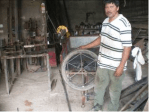
Taller Modesto in Somotillo. One of the 10 workshops in Nicaragua. He sold 600 pumps Workshops EM and AMEC sold some 20.000 pumps and the workshop Bomesa some 40.000
There is much difference in quality. Pumps with black steel pipes are corroded within 10 years. Models with galvanised pipes last 20 years or more
Where water quality is a problem people use a ceramic pot filter called Filtron. The Filtron factory in Nicaragua has produced over 100.000 filters
References
* Alberts, H. 2004 The rope pump: An example of technology transfer. Waterlines 22(3), 22–25.
* Alberts. H.,Zee. J van der (No date). A multi sectoral approach to sustainable rural water supply in Nicaragua: The role of the rope handpump. Available on www.ropepump.com. www.ropepumps.org
One of the challenges facing the Water sector in rural areas in Uganda is the non-functionality of hand pumps due unaffordable hand pump spare parts and limited financial base for paying the hand pump mechanics (HPM) and hence a major hindrance in the access to safe and clean water.
Francis Mujuni, Northern Region Coordinator, Uganda Water Sanitation and Hygiene Project, World Vision Uganda
Rural poverty, although not homogeneous, is deep and widespread. The widely cited “dollar-a-day” poverty measure conceals the fact that individuals in many rural Ugandan households handle cash sums much smaller than a dollar. Households and communities where income-generating opportunities are very limited simply cannot pay the tariffs required for hand pump operation and maintenance (O&M). Cash which is always scarce is used for very essential commodities like food and shelter but not for water which traditionally has always been seen as a “God given gift” to humanity to be enjoyed naturally by everyone, freely! Continue reading “Promising solutions for Operations and Maintenance in rural Uganda”
Reflection on last week’s Sustainability Forum in Washington DC
Just back from the WASH sustainability forum in Washington DC and as the dust settles, it is time to pick up on the blog I wrote in anticipation of the two days of discussion, reflection, and sharing. How did it all go? Did the earth move under our feet? Well, perhaps predictably the answer to that one is ‘no’ – very few one-off meetings or events are earth-shattering in that sense – but all in all, it was a good meeting and a good week.





 Rural Water Supply Network - blog