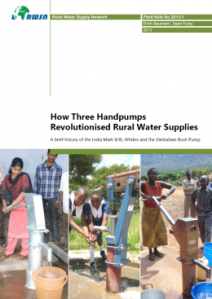
Unlike other handpumps used across the world, the Bush Pump has a long history. It was born in Zimbabwe in 1933, and designed by Tommy Murgatroyd, a Government Water Supply Officer in Matabeleland. Murgatroyd established the basic components of all later Bush Pumps – a wooden block, a strong pump stand and heavy-duty components. Continue reading “How three handpumps revolutionised Rural Water Supplies: the Zimbabwe Bush Pump”
reflections on Everyone, Forever and lifecycle costing in Honduras
Anyone who works in the water sector cannot have missed the various consultations and debates on the post-2015 goals for water and sanitation, with the official one taking place here, but also good online discussions, such as the one on The Broker online. At the same time, technical proposals have been developed by working groups on water, sanitation and hygiene, as nicely presented here by my colleague Catarina Fonseca. The consensus in both the technical proposals and the discussions around them is the vision of universal coverage. The difference lies in the time frame: can it be achieved in our life time? Or is that just wishful thinking? Over the past year, this blog has paid lots of attention to the “Forever” side of “Everyone, Forever”, as Water For People have so compellingly called it. For the coming period expect more posts here on the…
Sustainable WASH services can only be achieved if the technology used to provide services is sound enough for the specific context. Too often, however, water and sanitation services stop because the WASH technology no longer functions or is too complicated for the context which it’s in. New WASH technologies are promising successful solutions but are often not considered.
WASHTech, an action-research project, is developing and testing processes and tools to perform context-specific validations of potential WASH technologies. WASHTech also aims to successfully introduce the validated technologies into certain contexts such as countries, districts, or sub-districts.
Come and be part of this pre-launch on Friday 12 April 2013 from 09:30 – 11:00 hrs and learn how the “Technology Applicability Framework” and the “Technology Introduction Process” can help you achieve sustainable WASH services.
Transferring the Knowledge: Handpump Training with Erich Baumann and the Austrian Red Cross (Photo: S. Furey, 2012)
If you receive this newsletter, and if you routinely receive the latest RWSN Field Notes and other knowledge products, then you are, like me, one of the privileged few who is reasonably well (or very well) connected to internet and email. Assuming our workloads allow, we have wonderful opportunities to read and so access the experience and knowledge of water professionals and organisations around the world, and to use or adapt that knowledge to our own circumstances. But what about those who work in remote areas, with limited travel or conference budgets, and with poor or no electronic connectivity? Professionals who work for local Governments, local NGOs and CBOs, and the local private sector, who have very limited access to up-to-date experience and knowledge, either in their own country or beyond.
How should RWSN and other similar organisations communicate with and support such important workers? Is it simply a matter of extending internet connectivity and speed ever more widely? Or are there other things that we should be doing in the meantime to get better knowledge and ideas into the minds of local workers, so contributing to a greater level of professionalism at the ‘coal-face’? If you have ideas about this, do please write to me or to the Secretariat. Should we be producing different kinds of knowledge products, disseminating them in different ways, and helping our fellow workers assimilate and use them better? Do let us know what you think.
Professor Richard Carter Director, Richard Carter & Associates
Chair of the Rural Water Supply Network
An important debate: how much is the life cycle cost for sanitation (and water)
Water scarcity in some parts of Uganda has led to increased domestic violence in homes.
One of the worst affected is Bushenyi district in the southwestern region.
Wills Bashasha- the Bushenyi district chairperson says that the water shortage in the district had led to many women being beaten by their husbands, while others are allegedly raped as they travel far off places to collect water from shallow wells.
He now wants households with iron-roofed houses to construct water harvesting tanks as a measure to reduce on causes of domestic violence in homes.
Bashasha notes that it’s a shame to find people carrying jerry cans of water collected from far off wetlands and swamps despite the fact that such water could have been tapped during the downpour before flowing off to the wetlands.
He explains that the issue of lack of water in some homes has…
Recently I have been on a continent-hopping tour through a different range of meetings and events, from which I have seen a pattern emerging, or at least a series of questions in my own mind, as I carry out my work in the WASH sector at an international level.



 Rural Water Supply Network - blog