Author: RWSN Secretariat
Looking through GLAAS
by Johan Gély, Swiss Development Cooperation (SDC)
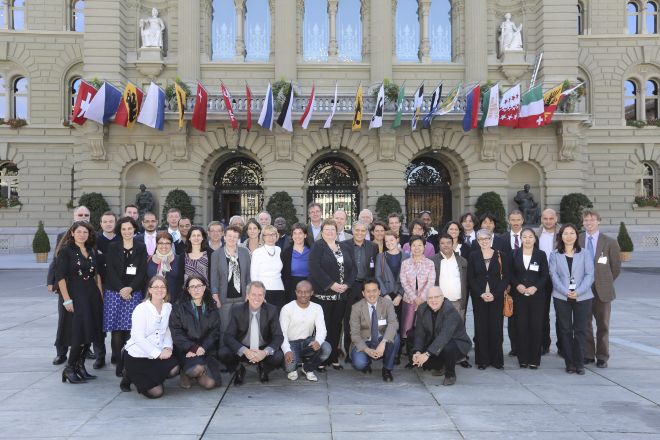
2nd UN-Water GLAAS Evaluation Meeting in Bern 2nd and 3rd October 2012
Background 
The UN-Water Global Analysis and Assessment of Sanitation and Drinking-water (GLAAS) monitors the inputs, and processes and their outputs (e.g. policies, investments, human resources) that influence the provision and sustainability of drinking-water, sanitation and hygiene (WASH) systems and services. Following publication of a proof-of-concept report in 2008, GLAAS published two full reports in 2010 and 2012 – the latter covering 74 countries and 24 external support agencies. GLAAS is generally acknowledged as having gained itself a specific niche within the global WASH monitoring landscape.
It is an important tool for the SDC Global program Water initiatives as it is part of an important and logical sequence of work/partnership which combine the global water and sanitation data acquisition (Joint Monitoring Program – JMP), the data analyze/assessment (GLAAS) and the sector global advocacy (Sanitation and Water for All – SWA).
Meeting Outcomes
1) It is a low cost and high quality global monitoring product and process.
2) It allows us to unify forces to lobby for a water goal in the Post 2015 goals.
3) Water Quality should be included in the future water goals and reported by JMP and GLAAS.
4) We should strengthen alignment with national monitoring systems.
5) We need to improve link with others global, regional and national monitoring systems.
6) The presence of new actors (from emerging states) should be reinforced in the future.
Documents
UN-Water GLAAS 2012 report – Approach and Main findings
UN-Water GLAAS – A brief history and rationale
For further information on GLAAS, please contact Bruce Gordon or Johan Gély.
Next week more than 200 practitioners and policy makers from government, civil society, private sector and donors will come together for the annual Joint Water and Environment Sector Review in Uganda to review progress and set-backs during the past year and discuss and decide on priorities for the coming year. For rural water Uganda is facing a situation where the expansion of coverage of rural water services is stagnating, functionality levels are not increasing and overall sector financing remains at its best stable.
View original post 526 more words
Experimenting with water service delivery
By Patrick Moriarty
Coming up with a convincing elevator pitch for our Sustainable Services at Scale (Triple-S) project has long been a challenge. Which, given the complexities of the rural water sector itself, is possibly not that surprising. Whether defining ourselves (at least in part) as a complexity informed water services development lab will help, remains to be seen – but for us it is progress!
View original post 1,239 more words
Next Post
Last week, we had our first Triple-S research seminar, discussing the first findings from the assessments of service provision around point sources in Ghana and Uganda. Although I had seen a sneak preview of some of the data, the consolidated results were shocking. After seeing them, I was tempted to declare community-based management (particularly of point sources) to be dead.
View original post 828 more words
Sustainability of solar water pumping in Uganda
Latest news from WASHTech project in Uganda: http://www.rural-water-supply.net/en/projekts/details/56
WASHTech, THE project (2011-2013)
This video highlights steps of using the Technology Applicability Framework (TAF) to assess the potential solar powered water pumping for domestic supply in Kanungu district of south western Uganda
Deuxième test du TAF : les acteurs du secteur eau et assainissement du Burkina passent les technologies d’assainissement : VIP et EcoSan à l’épreuve du TAF
News from Burkina Faso on the WASHTech project
WASHTech, THE project (2011-2013)
En sortie terrain du 05 au 09 septembre 2012, l’équipe du projet WASHTech Burkina font passer les technologies d’assainissement : VIP et EcoSan à l’épreuve du Technology Applicability Framework (TAF).
L’équipe de recherche a rencontré des partenaires étatiques (Direction Régionale de l’Agriculture et de l’hydraulique du Centre Ouest et l’ONEA), communales ( la commune urbaine de Koudougou) associatives (action Micro-barrage et agro action), des maçons, des artisans, des bénéficiaires de ces technologies, tous engagés qui dans le développement, qui dans la promotion des latrines EcoSan ou VIP.
View original post 330 more words
FLOWing data
By Patrick Moriarty –
I mentioned some cool new outputs from IRC’s Ghana programme in my previous post. These factsheets present a rich picture of water services and their governance based on a total survey in our three Triple-S focus districts in Ghana.
The fact sheets aren’t cool due to their content – which is actually rather depressing. What is cool is the technology used for the data collection, the way in which the indicators we used were developed, and the impact that the factsheets are having.
View original post 462 more words
Allocation of funds for district level WASH programmes: What is the ideal formula?
By Lydia Mirembe and Deirdre Casella in Lira, Uganda –
What started off as a commonplace lecture-like meeting in the Lira District Council Hall, ended up in a spirited discussion about a variety of issues around the delivery of water services in a decentralisation framework. Conditional grants for water and sanitation; mobile phones for water; as well as Hand Pump Mechanics Associations (HPMAs) were the key issues under consideration.
View original post 626 more words
What does it take to sustain sustainability?
As argued several times in this blog, post-construction support is one of the keys to sustainability of rural water supplies. One element of post-construction support is monitoring of aspects such as service levels and the performance of service providers, through which the support providers can better target their assistance. The last few years have seen a boom in efforts to set up information and monitoring systems of rural water supplies in many countries. Some were in first instance a one-off mapping exercise of all water points in a country; others were developed with the aim of regular updating for ongoing monitoring purposes. Particularly, cellphone technology has been instrumental in speeding up this process, as it is used in systems like FLOW (Field Level Operations Watch). A key question that comes back in the discussions on the topic (see for example the excellent discussion on the Rural Water Supply Network’s
View original post 923 more words