Funding opportunity – Water Security

Happy New Year!

Let’s start 2016 with a bang:  a call for expressions of interest (EOIs) for ‘Catalyst Grants’ which are commissioned under the REACH programme.

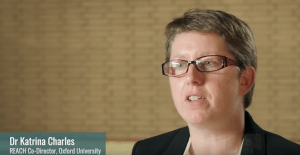
Dr Katrina Charles explains the REACH Catalyst Grant process
Dr Katrina Charles explains the REACH Catalyst Grant process (click picture to see YouTube video)

These Catalyst Grants of between £10,000 and £50,000 each are designed to explore novel approaches to water security and poverty research and policy that complement the core research conducted by the REACH programme. These grants will promote the co-production of effective tools and technologies relevant for and adopted by policy makers, practitioners, civil society organisations and enterprise.

There are three themes for this call:

  1. Water security for vulnerable people
  2. Water security risk science
  3. Water security partnerships.

Continue reading “Funding opportunity – Water Security”

Problems need problem-solvers

Capacity Development is one of those buzz-phrases that gets used and abused almost as much as Sustainable Development. Capacity has various definitions, but for me, one of the clearest is:

“Capacity is the ability of individuals, groups, institutions and organizations to identify and solve problems over time”

(Morgan, P. 1993 quoted on p.7 of Capacity development for improved water management, UNESCO-IHE 2009)

A shortage of capacity – the ability to identify and solve problems – is found in rural water supply across the world, from issues like pump corrosion, to lifecycle cost recovery to making the Human Right to Water a reality.

Problems become a lot easier where there are competent champions or – even better – strong teams who are able and willing to do a good job, even in adverse circumstances.

That’s why I have come to the annual meeting of UNDP Cap-Net, – at the invitation of its director, Dr Themba Gumbo. Cap-Net is a global network of capacity development networks that support capacity development in the water sector by providing technical and match-funding support to water-related training courses. The meeting was hosted by the Spanish cooperation agency, AECID, at their exceptional training facility in Cartagena, Colombia.

The main theme of the week was to explore how to use online and ICT methods to deliver courses and support learners. The centre-piece is Cap-Net’s Virtual Campus. The first three courses, which ran successfully earlier this year, were:

The courses work in similar way to a Massive Open Online Course (MOOC), but requires a bit more commitment and if you want to join you have to submit a short CV and letter explaining why you want to do the course.

The meeting was also an opportunity to meet coordinators from some of  Cap-Net’s 22 regional and country networks from all over the world and to explore ideas for developing face-to-face training events. From this I got a lot of ideas and contacts to explore further.

There were other partners there as well, including CAWST, Water Integrity Network (WIN), Global Water Partnership (GWP), Sustainable Energy for All, the UNDP Water Governance Facility at SIWI, Water for People, and SDC Global Programme Water Initiatives so it was good to meet them and find out about the interesting work they are doing.

Another topic, was the potential of serious games, and two examples were presented:

  • Diana Rojas (SDC) presented an mobile game called Aventura Yaku for helping children (and grown-ups!) understand water and ecosystems services.
  • Gareth Lloyd (DHI) presented an online game called Aqua Republica, and we had a group competition on a version developed specifically for Cap-Net. Aiming at an audience of 13-18 year olds, behind the attractive graphics and game play is a direct link to detailed hydrological models in Denmark.

While great for introducing new audiences to the importance of water resources, don’t expect an RWSN game app for rural water any time soon. I’m not convinced that is it the right solution for what we want to do, but I like these initiatives very much.

Over the course of the rest of the week there were presentations and discussions on the importance of innovating and keeping up with the fast evolving ways of engaging new audiences through communications technology – whilst not forgetting the importance of hands-on, face-to-face learning.

As the week ended, I concluded that here are a group of people – and organisations – that RWSN should collaborate with if we are to fulfil our mission of raising the level of quality and professionalism of rural water supply services.

Watch this space…


Sanitation and Water for All? a view from the SWA partner meeting

SWAThis week, I attended the Sanitation & Water for All (SWA), partnership meeting in The Hague, Netherlands.

Skat Foundation is a member of the Research & Learning constituency of SWA and I was there, among other things, to represent RWSN, both to raise relevant issues from our network with SWA partners, but also to find out what SWA is doing that is relevant for those working in rural water services.

Continue reading “Sanitation and Water for All? a view from the SWA partner meeting”

The closer you are, the more sustainable it gets

by Jochen Rudolph, African Development Bank (AfDB)

Through its Rural Water and Sanitation Initiative (RWSSI) the African Development Bank (AfDB)  was the first donor to support the Senegalese initiative “PEPAM” (Programme Eau Potable et Assainissement du Millénaire) in 2004 and has maintained the close partnership ever since. Looking back at the PEPAM experience, we find that strong and sustained commitment to improving rural water supply and sanitation in Senegal has resulted in more facilities than were originally budgeted for being installed and, as a result, has improved the health and quality of life for a large number of beneficiary villages.

Continue reading “The closer you are, the more sustainable it gets”

Investment in rural water supply delivers results – NEW RWSN briefing note on the new JMP report

jmp2015
Find out how rural water supplies have changed around the world since 1990

The Joint Monitoring Programme (JMP) of UNICEF and the World Health Organisation (WHO) have just released a new report: 25 Year Progress on Sanitation and Drinking Water – 2015 Update report and MDG Assessment

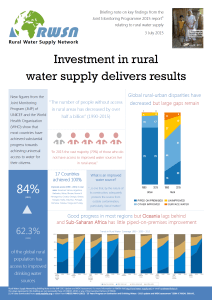
We have pulled together a 2-side briefing note that pulls out some of the headline figures and conclusion on rural water supply. Please download it from:

http://www.rural-water-supply.net/_ressources/documents/default/1-674-2-1435935827.pdf   (0.9 MB)

The new figures from JMP show that most countries have achieved substantial progress towards achieving universal access to water for their citizens.

84% of people living in rural areas now have access to a safe water source in 2015 (up from 62% in 1990)

  • “The number of people without access in rural areas has decreased by over half a billion” (1990-2015)
  • 17 Countries achieved 100% improved access (1990 – 2015) in rural areas
  • Global rural-urban disparities have decreased but large gaps remain – 8 out of ten people without access to an improved water source live in rural areas
  • Good progress in most regions but Oceania lags behind and Sub-Saharan Africa has little piped-on-premises improvement

Find out more by downloading the briefing note – and guess which country made the biggest percentage gain in improved access for its rural population?  I almost guarantee it won’t what you expected!

http://www.rural-water-supply.net/_ressources/documents/default/1-674-2-1435935827.pdf

If you want to air your thoughts then join the discussion on our LinkedIn group: https://www.linkedin.com/grp/home?gid=3935951

A New Rural Water Partnership Between The U.S. And Tanzania

Guest announcement by Rebecca Gianotti, Ph.D., Consultant, Global Water Initiative, The Ohio State University

Deputy Vice Chancellor Shabaan Mlacha of the University of Dodoma signed a letter of intent with leaders at the Ohio State University to develop capacity building programs in rural Tanzania for the entrepreneurial sectors surrounding water (food, energy, health, sanitation).
1
Deputy Vice Chancellor Shabaan Mlacha of the University of Dodoma met with team members of the Global Water Initiative at Ohio State University as well as Tanzanian graduate students studying at Ohio State through another capacity building effort based at Sokoine University of Agriculture (Tanzania).

A new initiative at the Ohio State University that takes a systems approach to rural water development is launching pilot projects in Tanzania. Dubbed Wells to Wellness, the effort combines capacity building and tiered water point rehabilitation activities to provide scalable, sustainable systems solutions to water resource issues. In April, the university signed a letter of intent with the University of Dodoma in Tanzania to develop undergraduate programming that will strengthen the workforce in the entrepreneurial sectors surrounding water (food, energy, health, sanitation). The partnership between the two universities follows the announcement of a 55-MW solar array—the largest ever at a university—to be built by U.S.-based Hecate Energy at Dodoma in 2016. The new training and academic programs at the University of Dodoma will support both the budding renewable energy sector in rural Tanzania as well as a water point rehabilitation project also under Wells to Wellness. This effort will initially retrofit 125 inoperable wells as well as support health, sanitation and economic development with a systems approach incorporating a new franchising model for operations and maintenance as well as key collaborations with existing NGOs in Tanzania. Upon successful completion of the 125-well pilot, the Tanzanian government has provisionally committed to funding rehabilitation of thousands of additional wells by scaling up the model.
Continue reading “A New Rural Water Partnership Between The U.S. And Tanzania”

Sustainable water resources management in Sri Lanka: present situation and way forward

by Senevirathne,   Assistant General Manger (Sociology), Sociology Section, NWSDB

Sustainable Water Resource Management

Sustainable water resource management has become a crucial factor for the socio-economic development of Sri Lanka that faces seasonal variation and competition among water users. One of the biggest concerns for our water-based resources in future is the sustainability of the current and even future water resource allocation. The latter part of this paper describes the current practices taken for water resource management with a view to updating sustainable strategies and putting them into practice.

It is true that making the sustainable development of our water resources is a challenge in Sri Lanka when considering the climatic changes, pressures from economic growth, the rising population, and increasing water consumption. The combination of these factors commonly results in increased water use, competition and pollution. Therefore, attention and concern must be given to collect, compile and gain knowledge from consumption, pollution and generate data of experimental value. This paper describes the main aspects of what has been learned in the process of supporting sustainable water resources management. Continue reading “Sustainable water resources management in Sri Lanka: present situation and way forward”

Out today: Addressing arsenic and fluoride in drinking water – Geogenic Contamination Handbook

by Dr Annette Johnson and Anja Bretzler, Swiss Federal Institute of Aquatic Science and Technology (Eawag) – www.wrq.eawag.ch

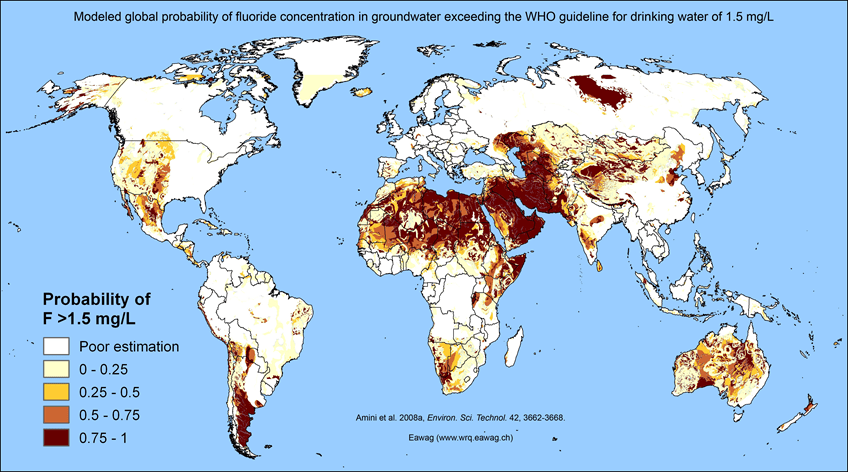
Researchers at Eawag have been involved in finding technological solutions for arsenic-contaminated drinking water over the last decades. When we also started looking at fluoride contamination in drinking water we soon came to realise how enormous the problem was and how that challenges to long-term mitigation were the same irrespective of contaminant.
Continue reading “Out today: Addressing arsenic and fluoride in drinking water – Geogenic Contamination Handbook”