For the last six years or so, primarily through our WASHCost and Triple-S initiatives, IRC has engaged deeply with the challenges of what it takes to provide sustainable water, sanitation and hygiene services. We think that we’ve identified many parts of the puzzle (and so have many others working in the same direction – we’re keenly aware that we’re not the only show in town) and we’ve been sharing these regularly through our websites, papers and blogs. But, what does it take for these piecemeal findings to be taken up and to lead to wholesale change: ensuring that the post-MDG goals of universal access with sustainable WASH services can be achieved by 2030?
Small towns and peri-urban areas are by definition found in the grey area in between the truly urban and the truly rural. Also in terms of water supply, fifty shades of grey are found in these types of settlements. People living here often fall in between the cracks of urban utilities and rural water committees. Their water supplies have characteristics of both these service delivery models – though not necessarily the best of those two worlds.
Community rural water supply (RWS) in India is an orphan of partially implemented demand responsive sector reforms on the one hand and unsuccessful decentralisation on the other. Historically, rural water supply in India has been outside the sphere of governments (NRDWP 2013). The 73rd and 74th constitutional amendment (Act 1992) made drinking water and sanitation a constitutional mandate of the three tier system of Panchayat Raj Institutions (PRIs). Even after two decades, the decentralisation process is an unaccomplished dream lying between de-concentration and devolution. In many states the progress is either stalled or reversed.
By: Tyhra Kumasi, Senior Research Officer, Triple-S Ghana
Dora is a 33 year old teacher living in Agbedrafo in the Akatsi South District. She depends on the only handpump in the community for her daily domestic chores; however she laments the difficulties in getting access to fetch water. According to Dora “even though fetching is on a first-come-first-serve basis, people bring very big receptacles and containers that makes it difficult, if not impossible, for others to get the opportunity to fetch. Because of this I am sometimes unable to fetch enough. In such a situation I borrow from a neighbour and replace later”. The problem with the borehole is that, after fetching the first few buckets it becomes difficult and hard to pump, one has to wait for a while, about 15 minutes to resume pumping for water. This is worse in the dry season, when she has to…
Stef Smits summarises some key points arising from the webinar and the discussion that followed:
Handpumps have still a role to play in 1) small dispersed rural communities [of less than let’s say 2000 people], and in 2) bigger or more dense communities as a complementary or back-up source to piped supplies. They are and will remain an important source of supply and need to have proper management arrangements. These arrangements should – as much as possible – follow arrangements for other communal supplies, or even drawing on good practices from urban management and when they are located close to a town they could even be managed by an urban provider under a “service area” approach
Professional management arrangements exist, but they do cost. The case of Vergnet comes down then to about 3 US$/family/month or 36 US$/family/year. This is in line with the WASHCost findings, which showed that all minor O&M ánd capital maintenance would be about 3 US$/person/year, or some 15 US$/family/year. But if you add the costs of professional support to that (e.g. in the form of handpump mechanics, or local government support), another 15 US$/family/year should be added, summing to about 30 US$/family/year. So, if we accept that this figure gives the right of order magnitude, rightfully the question may be asked on who pays for what.
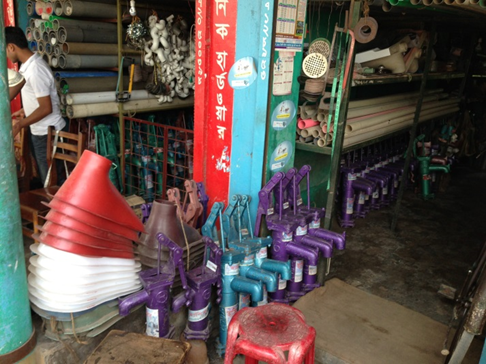
Shops like this one satisfy local demand for new pumps and replacement parts. Pumps, like ipods, come in a range of colors! (photo: J. Annis, 2013)
by Jonathan Annis is a sanitation and innovation specialist with the USAID-funded WASHplus project (www.washplus.org). His views do not represent those of USAID or the U.S. Government.
I recently traveled to southeastern Bangladesh to support WASHplus’s local implementing partner WaterAid as it begins a multi-year project in the coastal belt. The coastal belt is a marshy delta formed by Himalayan sediments transported thousands of miles by an extensive river network that settle as they reach the Bay of Bengal. Surface water is ubiquitous, and flooding—from tidal flows, excessive rainfall, or cyclones—is an annual event. I had never been in an environment so waterlogged. Continue reading “Self-Supply at Scale: Lessons from rural Bangladesh”
I suspect that some of you, readers of this blog, are equal water nerds as I am, and that you also take your professional interest along on holiday. At least, I cannot resist visiting the odd water works or taking photographs of the local water and sanitation facilities during my holidays. This summer holiday I not only had the opportunity to take photos, but to live for a week the type of rural water situation, that I write about so much, but rarely experience in reality. As I spent my vacation on a family visit to my brother, who is managing a farm in the Moldovan rural village of Cuhureştii de Jos, I got some first-hand experience of the common problems around rural water supply and realized that some of the myths around it, are myths indeed.
“Comimos toda la carne; sólo nos quedan los huesos” (we ate all the meat; there are only bones to chew on now”, said Luis Romero of CONASA (the water and sanitation policy making body in Honduras), in response to the graphs below, when we presented these as part of the sharing of the results of the life-cycle costs analysis in Honduras.
Editor’s Note:This guest blog was authored by Dr. Kerstin Danert, water and sanitation specialist at the Swiss-based Skat Foundation. Kerstin discusses country-led monitoring and why it’s important for developing country governments to lead the WASH monitoring process. An online community is being formed around country-led monitoring efforts. If you’d like to learn more about it, you may contact country_led_monitor@dgroups.org.
In April 2013, I had the privilege of facilitating six sessions on country-led monitoring at the Monitoring Sustainable WASH Service Delivery Symposium in Addis Ababa. This blog is a reflection on the papers, presentations, and discussions from that event.
International statements such as the Paris Declaration, the Busan Partnership, and the New Deal for Fragile States call for country-led development. The statements also promote results-based development and highlight the importance of monitoring — specifically monitoring that is country-led.


 Rural Water Supply Network - blog