Self-Supply at Scale: Lessons from rural Bangladesh

Image
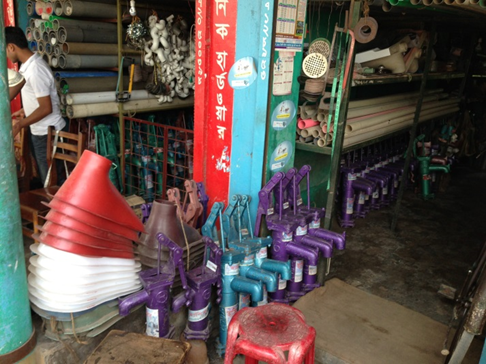
Shops like this one satisfy local demand for new pumps and replacement parts. Pumps, like ipods, come in a range of colors! (photo: J. Annis, 2013)

by Jonathan Annis is a sanitation and innovation specialist with the USAID-funded WASHplus project (www.washplus.org). His views do not represent those of USAID or the U.S. Government.

I recently traveled to southeastern Bangladesh to support WASHplus’s local implementing partner WaterAid as it begins a multi-year project in the coastal belt. The coastal belt is a marshy delta formed by Himalayan sediments transported thousands of miles by an extensive river network that settle as they reach the Bay of Bengal. Surface water is ubiquitous, and flooding—from tidal flows, excessive rainfall, or cyclones—is an annual event. I had never been in an environment so waterlogged.   Continue reading “Self-Supply at Scale: Lessons from rural Bangladesh”

Still or sparkling? Lessons from a WASH holiday

Rural water challenges are not just an African issue…

Stef Smits's avatarwater services that last

I suspect that some of you, readers of this blog, are equal water nerds as I am, and that you also take your professional interest along on holiday. At least, I cannot resist visiting the odd water works or taking photographs of the local water and sanitation facilities during my holidays. This summer holiday I not only had the opportunity to take photos, but to live for a week the type of rural water situation, that I write about so much, but rarely experience in reality. As I spent my vacation on a family visit to my brother, who is managing a farm in the Moldovan rural village of Cuhureştii de Jos, I got some first-hand experience of the common problems around rural water supply and realized that some of the myths around it, are myths indeed.

View original post 775 more words

“We ate all the meat; there are only bones to chew on now”

analysis of life cycle costs in Honduras

Stef Smits's avatarwater services that last

“Comimos toda la carne; sólo nos quedan los huesos” (we ate all the meat; there are only bones to chew on now”, said Luis Romero of CONASA (the water and sanitation policy making body in Honduras), in response to the graphs below, when we presented these as part of the sharing of the results of the life-cycle costs analysis in Honduras.

View original post 1,012 more words

Country-led Monitoring of Rural Water Supplies — Is It Just a Dream?

re-blogged from WASHfunders.org

Editor’s Note:This guest blog was authored by Dr. Kerstin Danert, water and sanitation specialist at the Swiss-based Skat Foundation. Kerstin discusses country-led monitoring and why it’s important for developing country governments to lead the WASH monitoring process. An online community is being formed around country-led monitoring efforts. If you’d like to learn more about it, you may contact country_led_monitor@dgroups.org. 

In April 2013, I had the privilege of facilitating six sessions on country-led monitoring at the Monitoring Sustainable WASH Service Delivery Symposium in Addis Ababa. This blog is a reflection on the papers, presentations, and discussions from that event.

International statements such as the Paris Declaration, the Busan Partnership, and the New Deal for Fragile States call for country-led development. The statements also promote results-based development and highlight the importance of monitoring — specifically monitoring that is country-led.

Read more ==>


Flying the flag – but breaking the pump?

A thoughtful post on whether flag waving by donors undermines their own cause as well as causing confusion over ownership of WASH assets

Stef Smits's avatarwater services that last

One of the topics of discussion during this week’s Triple-S annual meeting was around harmonization of approaches to rural water supply between donors and governments. Presenting the experiences in Ghana, Vida Duti presented this nice map, showing which donors operate in which part of the country. One could interpret this map in a positive way; probably donors have come to some division of labour, all working in different parts of the country – even though some areas are quite crowded with donors, and this is even excluding NGOs. However, the real problem lies not so much in the presence of so many donors; but ensuring that they all follow the same – or at least similar – approaches, that align well with the ones developed by the government.

Picture1

Source: IRC Ghana 

View original post 726 more words

A bit short of a miracle …

The “Everyone Forever” is gaining traction

editor's avatarwater services that last

By Patrick Moriarty and John Sauer

What is it that IADB’s Max Valasquez Matute in Honduras finds ‘only a bit short of a miracle’?  The decision by seven INGOs to align their programming in Honduras in support of an Everyone Forever movement aimed at delivering full coverage in sustainable rural water, sanitation and hygiene services.

Whether there was divine intervention or not, the meeting we attended on the 24 May between the assembled board members of the Millennium Water Alliance and the Mesa de Cooperantes (the donor coordination platform) of the Honduran WASH sector was pretty unusual – and very exciting.

View original post 630 more words

Planning for impact

A very useful update on the Triple-S project

editor's avatarwater services that last

By Patrick Moriarty

Back in June and July of 2012, Triple-S underwent a mid-term assessment (MTA) by an excellent team led by Dr. Ben Ramalingam. The MTA was a hugely useful exercise, allowing the Triple-S team and our partners to take some time out from our day to day work to reflect on how we were doing. The MTA team held up a mirror to us as a project and process – in much the same way that Triple-S seeks to hold up a mirror to the rural water sector – allowing us to have a long hard look at ourselves.

View original post 397 more words