Piped water systems provide a better service than handpumps, at a lower cost. This conclusion is derived from the in-depth study of the water provision in four rural growth centres (2500 to 7500 people), in Sahel, the poorest region of Burkina Faso (Pezon, 2013).
Small towns and peri-urban areas are by definition found in the grey area in between the truly urban and the truly rural. Also in terms of water supply, fifty shades of grey are found in these types of settlements. People living here often fall in between the cracks of urban utilities and rural water committees. Their water supplies have characteristics of both these service delivery models – though not necessarily the best of those two worlds.
Community rural water supply (RWS) in India is an orphan of partially implemented demand responsive sector reforms on the one hand and unsuccessful decentralisation on the other. Historically, rural water supply in India has been outside the sphere of governments (NRDWP 2013). The 73rd and 74th constitutional amendment (Act 1992) made drinking water and sanitation a constitutional mandate of the three tier system of Panchayat Raj Institutions (PRIs). Even after two decades, the decentralisation process is an unaccomplished dream lying between de-concentration and devolution. In many states the progress is either stalled or reversed.
On returning from the Christmas and New Year break, I found a package on my desk from a publisher in the US. Inside was a copy of “Groundwater for the 21st: A Primer for Citizens of Planet Earth” by Dr John A. Connors. Full disclosure: they asked for a review and a blog post in return. As RWSN is all about promoting better understanding and use of groundwater, I don’t see a problem with this, so here we go:
My first question is why does this book exist? Groundwater is a critically important resource and one that is poorly understood. When I started my career as a young water resources officer in the UK, I was constantly amazed that even quite learned folk imagined great caverns and rivers underground. Yes, you do get pretty, karstic limestone caves full of water, but that is a tiny fraction of the world’s groundwater resource.
By: Tyhra Kumasi, Senior Research Officer, Triple-S Ghana
Dora is a 33 year old teacher living in Agbedrafo in the Akatsi South District. She depends on the only handpump in the community for her daily domestic chores; however she laments the difficulties in getting access to fetch water. According to Dora “even though fetching is on a first-come-first-serve basis, people bring very big receptacles and containers that makes it difficult, if not impossible, for others to get the opportunity to fetch. Because of this I am sometimes unable to fetch enough. In such a situation I borrow from a neighbour and replace later”. The problem with the borehole is that, after fetching the first few buckets it becomes difficult and hard to pump, one has to wait for a while, about 15 minutes to resume pumping for water. This is worse in the dry season, when she has to…
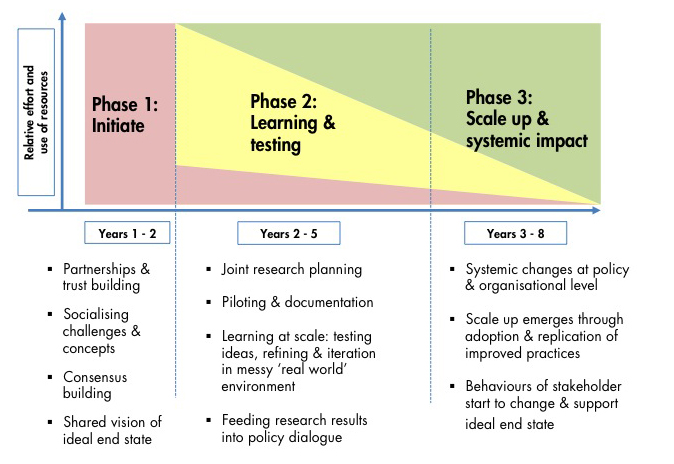
This webinar introduces two new tools that will help to select water, sanitation and hygiene (WASH) technologies that keep working. The first, the Technology Applicability Framework (TAF), has been extensively tested and is now available on www.washtechnologies.net. A second, complementary tool, the Technology Introduction Process (TIP) provides guidance on the roles and activities needed for successful scaling up of technologies.
The TAF manual, questionnaires, Technology Introduction Process guidelines and other key publications are provided as public domain and can be accessed through www.washtechnologies.net. This resource base also provides a platform for sharing experiences on the application of the TAF after completion of the WASHTech project in December 2013.
Programme
Evolution of key tools- the Technology Applicability Framework and the Technology Introduction…
Stef Smits summarises some key points arising from the webinar and the discussion that followed:
Handpumps have still a role to play in 1) small dispersed rural communities [of less than let’s say 2000 people], and in 2) bigger or more dense communities as a complementary or back-up source to piped supplies. They are and will remain an important source of supply and need to have proper management arrangements. These arrangements should – as much as possible – follow arrangements for other communal supplies, or even drawing on good practices from urban management and when they are located close to a town they could even be managed by an urban provider under a “service area” approach
Professional management arrangements exist, but they do cost. The case of Vergnet comes down then to about 3 US$/family/month or 36 US$/family/year. This is in line with the WASHCost findings, which showed that all minor O&M ánd capital maintenance would be about 3 US$/person/year, or some 15 US$/family/year. But if you add the costs of professional support to that (e.g. in the form of handpump mechanics, or local government support), another 15 US$/family/year should be added, summing to about 30 US$/family/year. So, if we accept that this figure gives the right of order magnitude, rightfully the question may be asked on who pays for what.
After this year’s ‘Water & Health’ conference at UNC, I visited some organisations along the East Coast of the US. On Wednesday 23rd October, I visited the headquarters of charity: waterin New York. The largely open-plan office was quietly buzzing with activity.
charity: water was founded in 2006 by a young night club promoter, Scott Harrison, who decided to put his considerable influencing and networking skills to a new, more productive (as he saw it) purpose. His idea has been to tap into a different demographic than is usual for charitable donations – those below the age of 40, who have grown cynical of what charities actually achieve. To do this they use social media and celebrity endorsement (charity: water is currently the featured charity of Depeche Mode’s latest tour). Their hook is a 100% model where all money donated goes directly to projects, implemented by established NGO partners such as Water For People, Water For Good (ICDI), Splash and World Vision. The completed projects are shown on the website, as part of proving that work has been done.
This year I was fortunate enough to attend the ‘Water & Health Conference’ at UNC, North Carolina, USA again. I was running a side event on WASHTech, and my partner in crime was Andrew Armstrong, Water Missions’ community development programs manager who gave a great presentation on the experiences of Water Missions in introducing solar water pumping and water pre-payment systems in Uganda.
On Monday 21st October, after the conference, I was in Charleston, South Carolina, standing in large a naval dockyard surrounded by towering steel cranes and fat oil depot tanks. On one side of the sparse car park was a sizeable array of solar panels and opposite was long, low warehouse on which the name “Water Missions International” was emblazoned in precise, blue lettering.
I was shown around the Water Missions International facility by Andrew. There are 27 staff based in this location and numerous volunteers. The building acts an office, workshop, storage area and display area, the latter being open to groups to visit and find out about their work.
Water Missions was created in 1998 in the wake of Hurricane Mitch, which devastated much of Central America, particularly Honduras and Nicaragua. After running operations out of their environmental engineering firm for a few years, the founders sold their company in 2001 and set up the charity and today they work in Belize, Indonesia, Malawi, Mexico, Uganda, Haiti, Kenya, Tanzania, Peru and Honduras.
A few months remain before the end of the WASHTech project in Burkina Faso. The project team composed of the Burkina Faso Offices of Intergovernmental Panafrican agency Water and Sanitation for Africa (WSA) of Water-Aid and IRC, steps on the accelerator to finalize the remaining activities before the end of the project in December 2013.
Among the key activities at the end of the project, there’s the organization of a national training workshop for actors in the WASH sector that will be driven by the the Department of Studies and Information one Water (DEIE). The objective of this workshop is to present the achievements of the project including tools Technology Assessment Framework (TAF) Technology Introduction Process (TIP) and strengthen their capacity to use these tools. The impacts of the project in Burkina Faso after three years of implementation will be presented. This national workshop is scheduled to take place in…