India rural water supply: an orphan of reforms?

dietvorst's avatarwater services that last

By V. Kurian Baby, India Country Director, IRC

Community rural water supply (RWS) in India is an orphan of partially implemented demand responsive sector reforms on the one hand and unsuccessful decentralisation on the other. Historically, rural water supply in India has been outside the sphere of governments (NRDWP 2013). The 73rd and 74th constitutional amendment (Act 1992) made drinking water and sanitation a constitutional mandate of the three tier system of Panchayat Raj Institutions (PRIs). Even after two decades, the decentralisation process is an unaccomplished dream lying between de-concentration and devolution. In many states the progress is either stalled or reversed.

View original post 468 more words

Islands of success

Evaluation of a Water For People intervention in partnership with local government India

Stef Smits's avatarwater services that last

Sagar is an island at the mouth of the river Ganges where it meets the Bay of Bengal. Every year in January, about half a million pilgrims visit the island to worship at the holy Ganges. The hundreds of mobile toilet units standing on the empty festival terrain during the rest of the year are witness to the island’s authority’s efforts to ensure that the pilgrim’s stay on the island is as comfortable, hygienic and safe as possible. But the authorities also don’t forget about the 200.000 permanent inhabitants when it comes to sanitation. Together with the NGO Water For People (WFP) and other partners, it seeks to achieve full coverage in sanitation and water supply in the next few years.

View original post 1,146 more words

How three handpumps revolutionised Rural Water Supplies: the India Mark II

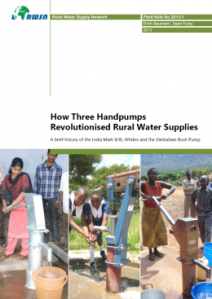
How Three Handpumps Revolutionised Rural Water Supply1974: UNICEF reviewed their water supply programme in India. The results were shocking: of the tens of thousands of wells drilled over the previous seven years, 75% were not supplying water.

In the new publication “How Three Handpumps Revolutionised Rural Water Supplies” from RWSN, Erich Baumann explains how three handpumps, the India Mark II, the Afridev, and the Zimbabwe Bush Pump were developed and Sean Furey explores what lessons can be learned for scaling up WASH technologies today.

In the mid 1960s, drought ravaged India, and the Government of India asked UNICEF for help with improving access to water through borehole drilling. In the following years, the emergency drilling campaign evolved into a broader national programme to improve rural water supplies, but the attention was focused on the drilling and the boreholes. No one gave the hand-pumps that went on them much thought. That all changed in 1974.

Continue reading “How three handpumps revolutionised Rural Water Supplies: the India Mark II”