Handing over Self-supply


André Olschewski will be leaving Skat and handing over his role as Theme Leader for Accelerating Self-supply (ACCESS) to Matthias Saladin. André reflects on the last five years:

Dear all,

There is widespread recognition that many people particularly rural dwellers improve their water supplies with their own investments. This was barely part of the discourse when RWSN launched the Self-supply theme and term in 2004 under the leadership of Dr. Sally Sutton, supported by WSP and UNICEF. As with any innovations, taking the concept of Self-supply from the periphery towards mainstream development has not been simple or an easy journey.

Continue reading “Handing over Self-supply”

My Water, My Business

activities as part of World Water Day 2015 events, 19-20 March 2015, Addis Ababa

Sustainable development of water requires fresh thinking and new innovation. Ethiopia is pioneering new approaches in water, sanitation and hygiene (WasH) that draw upon the resources of local people, communities and entrepreneurs to further improve water security, food security and wealth. ‘My Water, My Business’ is a series of linked events organised as part of the 2015 World Water Day celebrations to bring attention to these household-level efforts. The events will connect sector policy-makers, development partners, professionals and engaged local governments and communities. The overall message is that to complement the efforts of utilities, woredas and other traditional service providers, households can do a lot themselves to improve their water and sanitation facilities and related hygiene practices. You can improve your own water supply, sanitation and hygiene.

WaSH product fair starts Thursday 19 March

Continue reading “My Water, My Business”

Self-Supply at Scale: Lessons from rural Bangladesh

Image
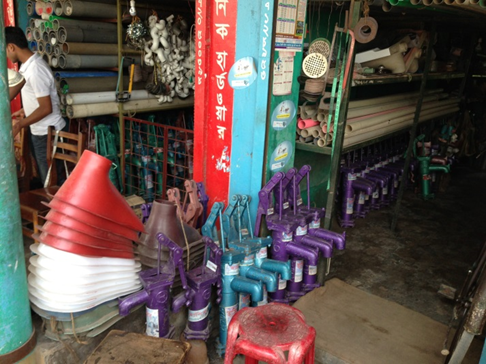
Shops like this one satisfy local demand for new pumps and replacement parts. Pumps, like ipods, come in a range of colors! (photo: J. Annis, 2013)

by Jonathan Annis is a sanitation and innovation specialist with the USAID-funded WASHplus project (www.washplus.org). His views do not represent those of USAID or the U.S. Government.

I recently traveled to southeastern Bangladesh to support WASHplus’s local implementing partner WaterAid as it begins a multi-year project in the coastal belt. The coastal belt is a marshy delta formed by Himalayan sediments transported thousands of miles by an extensive river network that settle as they reach the Bay of Bengal. Surface water is ubiquitous, and flooding—from tidal flows, excessive rainfall, or cyclones—is an annual event. I had never been in an environment so waterlogged.   Continue reading “Self-Supply at Scale: Lessons from rural Bangladesh”

Still or sparkling? Lessons from a WASH holiday

Rural water challenges are not just an African issue…

Stef Smits's avatarwater services that last

I suspect that some of you, readers of this blog, are equal water nerds as I am, and that you also take your professional interest along on holiday. At least, I cannot resist visiting the odd water works or taking photographs of the local water and sanitation facilities during my holidays. This summer holiday I not only had the opportunity to take photos, but to live for a week the type of rural water situation, that I write about so much, but rarely experience in reality. As I spent my vacation on a family visit to my brother, who is managing a farm in the Moldovan rural village of Cuhureştii de Jos, I got some first-hand experience of the common problems around rural water supply and realized that some of the myths around it, are myths indeed.

View original post 775 more words

Providing drinking water is not enough to end poverty

by Francis Mujuni, World Vision Uganda

Francis Mujuni, World Vision, Uganda

In his blog post, Henk Holtslag highlighted that muitple use of water is very critical in ending poverty. I have already shown in my earlier discussions that provision of safe drinking water is not enough. In the developing countries where agriculture employs the bulk of the poor people, availability of water for families, their animals and crops is very essential. When we talk of “provision” the quick question is by who? Self supply then becomes the ideal solution. But how many of our governments, Communities and development agencies are promoting this concept? Do they know much about it? Do they know it exist and it is very feasible?

Continue reading “Providing drinking water is not enough to end poverty”

Sustainable water services take ‘Water & Health’ Conference by storm

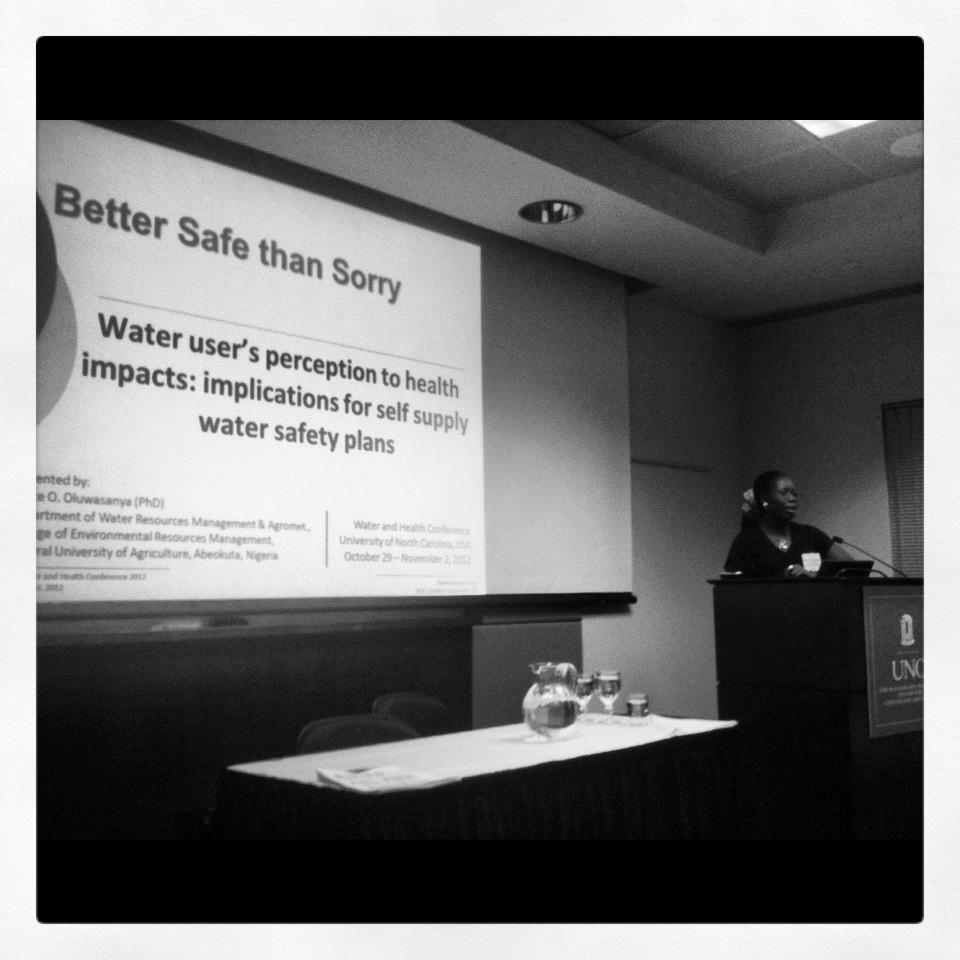
Dr Grace Oluwasanya, Federal University of Agriculture, Nigeria presenting on “Water User’s Perception to Health Impacts: Implications for Self Supply Water Safety Plans”

I was lucky enough to attend this year’s Water & Health Conference at the University of North Carolina. I was even luckier to make it as the skirts of Hurricane Sandy swept up the Atlantic coast before crashing into the American North East.

It was a great opportunity to meet, face-to-face, many RWSN members who have been communicating with online and meet a whole bunch of new people. It was really inspiring to hear their stories and find out more about their organisations and research. Here are just some of my highlights from the event:
Continue reading “Sustainable water services take ‘Water & Health’ Conference by storm”