Everyone together for everyone forever: changing the whole system in practice

Sarah Carriger's avatarwater services that last

by Patrick Moriarty and Harold Lockwood

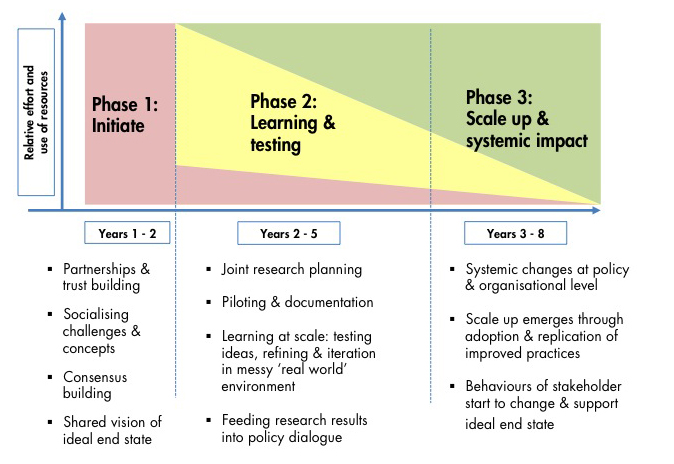
In the first post in this series, we explained why we believe that a paradigm shift is needed in the WASH sector: moving beyond the construction of physical hardware to the universal provision of safe drinking water (and sanitation) services worthy of the name.

Because of the number of activities and actors involved, water and sanitation service delivery is inherently complex. And as much as we may be drawn to the idea of straightforward technological or market-based solutions, this complexity means such solutions will never get us all the way to sustainable services for everyone – particularly for the poorest people in the hardest to reach and most remote areas.

It is not enough that one individual or organisation begins to perform better or that an improvement is made in some technical aspect of service delivery. The whole system of individuals, organisations, technologies and…

View original post 1,220 more words

Changing the whole system to provide water, sanitation and hygiene services that last

editor's avatarwater services that last

By Patrick Moriarty and Harold Lockwood –

For the last six years or so, primarily through our WASHCost and Triple-S initiatives, IRC has engaged deeply with the challenges of what it takes to provide sustainable water, sanitation and hygiene services. We think that we’ve identified many parts of the puzzle (and so have many others working in the same direction – we’re keenly aware that we’re not the only show in town) and we’ve been sharing these regularly through our websites, papers and blogs. But, what does it take for these piecemeal findings to be taken up and to lead to wholesale change: ensuring that the post-MDG goals of universal access with sustainable WASH services can be achieved by 2030?

View original post 1,251 more words

The performance of piped water systems versus handpumps in growing rural growth centres (2500 to 7500 people)

Carmen da Silva Wells's avatarwater services that last

By  Dr. Christelle Pezon, IRC

Piped water systems provide a better service than handpumps, at a lower cost. This conclusion is derived from the in-depth study of the water provision in four rural growth centres (2500 to 7500 people), in Sahel, the poorest region of Burkina Faso (Pezon, 2013).

View original post 461 more words

Who serves the in-betweeners?

Stef Smits's avatarwater services that last

By: Marieke Adank, IRC

Small towns and peri-urban areas are by definition found in the grey area in between the truly urban and the truly rural. Also in terms of water supply, fifty shades of grey are found in these types of settlements. People living here often fall in between the cracks of urban utilities and rural water committees. Their water supplies have characteristics of both these service delivery models – though not necessarily the best of those two worlds.

View original post 578 more words

India rural water supply: an orphan of reforms?

dietvorst's avatarwater services that last

By V. Kurian Baby, India Country Director, IRC

Community rural water supply (RWS) in India is an orphan of partially implemented demand responsive sector reforms on the one hand and unsuccessful decentralisation on the other. Historically, rural water supply in India has been outside the sphere of governments (NRDWP 2013). The 73rd and 74th constitutional amendment (Act 1992) made drinking water and sanitation a constitutional mandate of the three tier system of Panchayat Raj Institutions (PRIs). Even after two decades, the decentralisation process is an unaccomplished dream lying between de-concentration and devolution. In many states the progress is either stalled or reversed.

View original post 468 more words

Users perception of rural water services in Ghana: A case of satisfaction or dissatisfaction?

Stef Smits's avatarwater services that last

By: Tyhra Kumasi, Senior Research Officer, Triple-S Ghana

Dora is a 33 year old teacher living in Agbedrafo in the Akatsi South District. She depends on the only handpump in the community for her daily domestic chores; however she laments the difficulties in getting access to fetch water. According to Dora “even though fetching is on a first-come-first-serve basis, people bring very big receptacles and containers that makes it difficult, if not impossible, for others to get the opportunity to fetch. Because of this I am sometimes unable to fetch enough. In such a situation I borrow from a neighbour and replace later”. The problem with the borehole is that, after fetching the first few buckets it becomes difficult and hard to pump, one has to wait for a while, about 15 minutes to resume pumping for water. This is worse in the dry season, when she has to…

View original post 1,274 more words

December 11, 2013 Webinar – Introducing and scaling up sustainable water and sanitation technologies

dietvorst's avatarWASHTech, THE project (2011-2013)

TAF website logo v3The WASHTech Consortium is organising a webinar to introduce the WASHTech’s tools and launch the online resource base

Wednesday 11 December, 12.30-13.30 pm CET

Register here

Background

This webinar introduces two new tools that will help to select water, sanitation and hygiene (WASH) technologies that keep working. The first, the Technology Applicability Framework (TAF), has been extensively tested and is now available on www.washtechnologies.net. A second, complementary tool, the Technology Introduction Process (TIP) provides guidance on the roles and activities needed for successful scaling up of technologies.

The TAF manual, questionnaires, Technology Introduction Process guidelines and other key publications are provided as public domain and can be accessed through www.washtechnologies.net. This resource base also provides a platform for sharing experiences on the application of the TAF after completion of the WASHTech project in December 2013.

Programme

  • Evolution of key tools-  the Technology Applicability Framework and the Technology Introduction…

View original post 53 more words

WASHTech Burkina Faso : The final sprint has begun!

also visit the new TAF website: http://www.washtechnologies.net

aimesawadogo's avatarWASHTech, THE project (2011-2013)

A few months remain before the end of the WASHTech project in Burkina Faso. The project team composed of the Burkina Faso Offices of Intergovernmental Panafrican agency Water and Sanitation for Africa (WSA) of Water-Aid and IRC, steps on the accelerator to finalize the remaining activities before the end of the project in December 2013.

Among the key activities at the end of the project, there’s the organization of a national training workshop for actors in the WASH sector that will be driven by the the Department of Studies and Information one Water (DEIE). The objective of this workshop is to present the achievements of the project including tools Technology Assessment Framework (TAF) Technology Introduction Process (TIP) and strengthen their capacity to use these tools. The impacts of the project in Burkina Faso after three years of implementation will be presented. This national workshop is scheduled to take place in…

View original post 372 more words