Understanding the invisible: Uganda’s efforts to increase access to detailed groundwater data

This is the second in a series of four blogs entitled Professional Borehole Drilling: Learning from Uganda written by Elisabeth Liddle, and a RWSN webinar in 2019 about professional borehole drilling. It draws on research in Uganda by Liddle and Fenner (2018). We welcome your thoughts in reply to this blog below. [Note: The original blog was revised on 03 April 2019 to correct an inaccurate representation of the situation].

While access to improved water sources has steadily increased across rural sub-Saharan Africa, several studies have raised concerns over the extent to which these sources are able to provide safe and adequate quantities of water over the long term (Foster et al., 2018; Kebede et al., 2017; Owor et al., 2017; Adank et al., 2014). Borehole design and siting are essential to ensure that the subsequent water point will continue to provide safe and adequate quantities of water. Access to detailed and accurate groundwater information can greatly aid siting and borehole design (UNICEF/Skat, 2016; Carter et al., 2014).

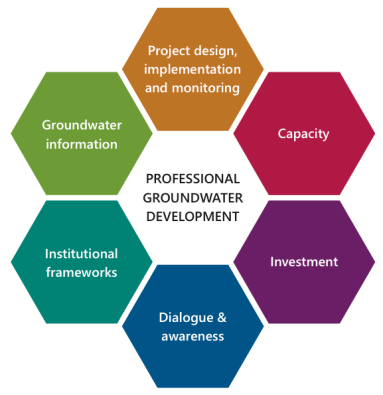
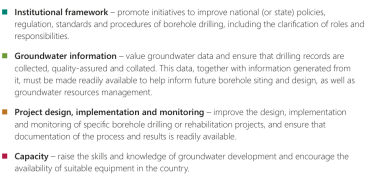
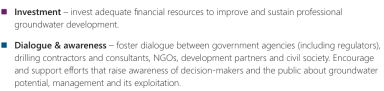
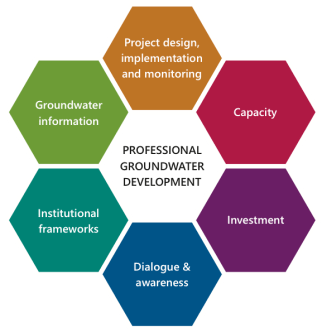
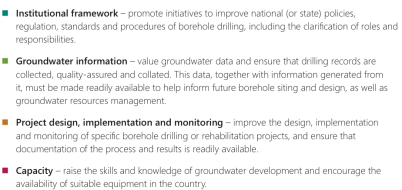
Skat Foundation and UNICEF have been key advocates for increasing access to detailed groundwater data including the recent guidance note which pointed out that ‘groundwater information’ is essential when seeking to improve the quality of borehole implementation in low- and middle-income countries (see Figure 1; UNICEF/Skat, 2016). In this blog I provide some insights into the ways in which Uganda has sought to increase access to groundwater data is recent years.

pic1

pic2

pic3

Fig. 1: Six areas of engagement for increasing drilling professionalism (Skat/UNICEF, 2016).

Groundwater resource mapping in Uganda

Significant steps have been taken in recent years to increase access to detailed groundwater data in Uganda. Much of this began in 2000 when the Directorate of Water Resources and Management (DWRM) within the Ministry of Water and the Environment (MWE) began a nationwide groundwater mapping project. Using data sourced from the borehole completion reports that drilling contractors are required to submit every quarter, DWRM has developed are series of maps for each district. These include:

  1. Water source location map, underlain by a geology map.
  2. Recommended water source technology map (technology recommendation is based on main water strike depth and yield information).
  3. Hydrogeological condition map – includes 4 sub-maps:
    • inferred first water strike depth[1],
    • inferred main water strike depth[2],
    • inferred thickness of overburden[3], and
    • inferred static water level depth[4].
  4. Groundwater quality map: highlights areas where water quality is expected to be problematic.
  5. Groundwater potential – Drilling success rate map: combines expected yield success rate[5] coupled with expected water quality conditions.

Tindimugaya (2004) explains these maps in greater detail, along with the ways in which such maps can help the implementation process. An example of these maps for Kibaale district is available on the MWE’s website.

This mapping work is ongoing, however, by May 2017 DWRM had mapped 85% of Uganda’s districts. The magnitude of these maps and the level of detail they capture is remarkable. These maps have become a great asset for district local governments, non-governmental organisations, and others responsible for water point siting and construction.

Ongoing challenges

While Uganda has made remarkable progress in recent years with their groundwater mapping efforts, there have been several challenges along the way (Liddle and Fenner, 2018), mostly related to data accuracy. When interviewing those in Uganda for this research, there were reports that in some (but not all) cases, inaccurate data is submitted. When looking at why inaccurate data is sometimes submitted, two key issues were noted:

  1. There often isn’t a qualified consultant on site full-time for drilling supervision. While it is the drilling contractor’s responsibility to have a member of staff recording the drilling log, an independent supervisor should also keep a log and check the driller’s log for accuracy before this is submitted to DWRM. Without full-time supervision, however, this cannot happen. Furthermore, even with full-time supervision, if the supervisor is not a hydrogeologist, it is unlikely that they will be keeping accurate and detailed logs.
  2. The lump sum no-water-no-pay payment terms via which Ugandan drillers are often paid (see blog “Turnkey contracts for borehole siting and drilling”). When these contract terms are used, to be paid, drillers need to prove that they have drilled a successful borehole; as a result, there were reports of drillers exaggerating a given borehole’s yield in order to be paid. Skewing data in this way is concerning, as not only will these boreholes struggle to provide adequate quantities of water post-construction, but this high-yield data is then entered into the drilling log database and used to produce the hydrogeological maps. Increasing the quality of drilling supervision and ensuring data is not skewed in this way is essential if the accuracy of DWRM’s maps is to increase going forward.

Overall, Uganda has made remarkable progress over the past two decades in increasing the level of groundwater information available in-country. There are very few examples in the African continent comparable to what Uganda has achieved! As noted above, the resultant maps have become a great asset for district local governments, non-governmental organisations, and others responsible for water point siting and construction.

Increasing the accuracy of borehole completion reports is an essential next steps for Uganda. Furthermore, other countries should be aware of these challenges as they embark on their own mapping exercises and ensure necessary measures are in place to prevent these problems in their own contexts.

What do you think?

So what do you think? Do you have experiences of collecting and collating groundwater data, or using groundwater maps? Is this something that should be started in your country? You can respond below by posting in the reply below, or you can join the live webinar on the 14th of May (register here).

[1]‘Expected first water strike depth’ = the depth at which a driller is likely to first encounter groundwater. In most cases the driller will need to continue drilling past this point if the borehole is to be able to provide sufficient quantities of water for users.

[2] ‘Expected main water strike depth’ = the depth at which a driller is likely to find the main aquifer that will be able to provide sufficient quantities of water for users.

[3] Overburden refers to the unconsolidated material that overlays the bedrock. The ‘expected overburden thickness’ map highlights the expected depth of this unconsolidated material across Uganda.

[4] ‘Expected static water level’ = the expected groundwater depth without any pumping disturbance.

[5] ‘Yield success’ refers to a borehole being able to sustain a pumping rate of 500 litres/hour. If a borehole can sustain this pumping rate, it is considered successful in regards to yield.

References

Adank, M., Kumasi, T.C., Chimbar, T.L., Atengdem, J., Agbemor, B.D., Dickinson, N., and Abbey, E. (2014). The state of handpump water services in Ghana: Findings from three districts, 37th WEDC International Conference, Hanoi, Vietnam, 2014, Available from https://wedc-knowledge.lboro.ac.uk/resources/conference/37/Adank-1976.pdf

Carter, R., Chilton, J., Danert, K. & Olschewski, A. (2014) Siting of Drilled Water Wells – A Guide for Project Managers. RWSN Publication 2014-11 , RWSN , St Gallen, Switzerland, Available from http://www.rural-water-supply.net/en/resources/details/187

Foster, T., Willetts, J., Lane, M. Thomson, P. Katuva, J., and Hope, R. (2018). Risk factors associated with rural water supply failure: A 30-year retrospective study of handpumps on the south coast of Kenya. Science of the Total Environment,, 626, 156-164, Available from https://www.sciencedirect.com/science/article/pii/S0048969717337324

Kebede, S., MacDonald, A.M., Bonsor, H.C, Dessie, N., Yehualaeshet, T., Wolde, G., Wilson, P., Whaley, L., and Lark, R.M. (2017). UPGro Hidden Crisis Research Consortium: unravelling past failures for future success in Rural Water Supply. Survey 1 Results, Country Report Ethiopia. Nottingham, UK: BGS (OR/17/024), Available from https://nora.nerc.ac.uk/id/eprint/516998/

Liddle, E.S. and Fenner, R.A. (2018). Review of handpump-borehole implementation in Uganda. Nottingham, UK: BGS (OR/18/002), Available from https://nora.nerc.ac.uk/id/eprint/520591/

Owor, M., MacDonald, A.M., Bonsor, H.C., Okullo, J., Katusiime, F., Alupo, G., Berochan, G., Tumusiime, C., Lapworth, D., Whaley, L., and Lark, R.M. (2017). UPGro Hidden Crisis Research Consortium. Survey 1 Country Report, Uganda. Nottingham, UK: BGS (OR/17/029), Available from https://nora.nerc.ac.uk/id/eprint/518403/

Tindimugaya, C. (2004). Groundwater mapping and its implications for rural water supply coverage in Uganda. 30th WEDC International Conference, Vientiane, Lao PDR, 2004. Available from https://wedc-knowledge.lboro.ac.uk/resources/conference/30/Tindimugaya.pdf

UNICEF/Skat (2016). Professional water well drilling: A UNICEF guidance note. St Gallen, Switzerland: Skat and UNICEF. Available from http://www.rural-water-supply.net/en/resources/details/775

Acknowledgements

This work is part of the Hidden Crisis project within the UPGro research programme – co-funded by NERC, DFID, and ESRC.

The fieldwork undertaken for this report is part of the authors PhD research at the University of Cambridge, under the supervision of Professor Richard Fenner. This fieldwork was funded by the Ryoichi Sasakawa Young Leaders Fellowship Fund and UPGro: Hidden Crisis.

Thank you to those of you from Makerere University and WaterAid Uganda who provided logistical and field support while I was conducting the interviews for this report (especially Dr Michael Owor, Felece Katusiime, and Joseph Okullo from Makerere University and Gloria Berochan from WaterAid Uganda). Thank you also to all of the respondents for being eager and willing to participate in this research.

Photo: “Groundwater Supply Technology Options map on display in the Kayunga District Water Office” (Source: Elisabeth Liddle).

Comprendre l’invisible: les efforts de l’Ouganda pour améliorer l’accès aux données détaillées sur les eaux souterraines

Il s’agit du second d’une série de quatre blogs intitulée ‘Le forage professionnel de puits d’eau: Apprendre de l’Ouganda” de Elisabeth Liddle et d’un webinaire en 2019 sur le forage de puits professionnel. Cette série s’appuie sur les recherches menées en Ouganda par Liddle et Fenner (2018). Nous vous invitons à nous faire part de vos commentaires en réponse à ce blog ci-dessous. [Note : Le blog original a été révisé le 3 avril 2019 pour corriger une représentation inexacte de la situation].

Si l’accès à des sources d’eau améliorées a augmenté de manière progressive dans l’ensemble de l’Afrique subsaharienne rurale, plusieurs études ont soulevé des problèmes concernant la capacité de ces sources à fournir des quantités d’eau sûres et adéquates à long terme (Foster et al., 2018 ; Kebede et al., 2017 ; Owor et al., 2017 ; Adank et al., 2014). La conception et l’emplacement des forages sont essentiels à ce que le point d’eau continue à fournir des quantités d’eau sûres et adéquates. L’accès à des informations détaillées et précises sur les eaux souterraines peut grandement faciliter le choix du site et la conception des forages (UNICEF/Skat, 2016 ; Carter et al., 2014).

La Fondation Skat et l’UNICEF ont été les principaux défenseurs d’un accès plus répandu à des données détaillées sur les eaux souterraines, y compris la récente note d’orientation qui souligne que “l’information sur les eaux souterraines” est essentielle à l’amélioration de la qualité de la mise en œuvre des forages dans les pays à revenus faible et intermédiaire (voir Figure 1 ; UNICEF/Skat, 2016). Dans ce blog, je donne un aperçu de la manière dont l’Ouganda a cherché à améliorer l’accès aux données sur les eaux souterraines ces dernières années.

Screen Shot 2019-04-01 at 4.58.03 PMScreen Shot 2019-04-01 at 4.57.43 PM

Fig. 1: Six domaines d’engagement pour l’exploitation professionnelle des eaux souterraines (Skat/ UNICEF, 2018)

La cartographie des ressources en eaux souterraines en Ouganda

Des mesures importantes ont été prises ces dernières années pour améliorer l’accès aux données détaillées sur les eaux souterraines en Ouganda. La plupart de ces activités ont débuté en 2000 lorsque la Direction de la gestion des ressources en eau du Ministère de l’eau et de l’environnement a lancé un projet de cartographie des eaux souterraines à l’échelle nationale. À l’aide de données tirées des rapports d’achèvement des forages que les entrepreneurs de forage doivent soumettre chaque trimestre, la Direction de la gestion des ressources en eau a élaboré une série de cartes pour chaque district. Il s’agit notamment des cartes suivantes :

  1. Carte de localisation des sources d’eau, avec carte géologique à l’appui.
  2. Carte des technologies recommandées par source d’eau (la recommandation de la technologie se base sur la profondeur de l’impact de l’aquifère principal et les données sur le rendement).
  3. Carte des conditions hydrogéologiques – elle comprend 4 sous-cartes : Profondeur présumée du premier impact avec l’eau[1],  la profondeur présumée de l’impact avec l’aquifère principal[2], l’épaisseur présumée des morts-terrains[3], etla profondeur statique présumée du niveau d’eau[4].
  4. Carte de la qualité des eaux souterraines : celle-ci met en évidence les zones où la qualité de l’eau pourrait poser problème.
  5. Potentiel des eaux souterraines – Carte du taux de réussite du forage : combine le taux de réussite prévu du rendement [5] et les conditions prévues de la qualité de l’eau.

Tindimugaya (2004) donne plus de détails sur ces cartes, ainsi que les façons dont elles peuvent faciliter le processus de mise en œuvre. Un exemple de cartes pour le district de Kibaale est disponible sur le site Web du Ministère de l’Eau et de l’Environnement.

Ce travail de cartographie est en cours, cependant, en mai 2017, la Direction de la gestion des ressources en eau avait cartographié 85% des districts de l’Ouganda. L’ampleur de ces cartes et le niveau de détail qu’elles contiennent sont remarquables. Ces cartes ont rendu service aux collectivités locales de district, aux organisations non gouvernementales et  autres responsables de l’implantation et de la construction des points d’eau.

Des défis persistents

Bien que l’Ouganda ait fait des progrès remarquables au cours des dernières années grâce à ses efforts de cartographie des eaux souterraines, plusieurs défis persistent (Liddle et Fenner, 2018), liés pour la plupart à l’exactitude des données. Lors d’entretiens avec les personnes interrogées en Ouganda dans le cadre de nos recherches, on nous a signalé que dans certains cas (mais pas tous), des données inexactes ont été fournies. Lorsqu’on examine les raisons pour lesquelles des données inexactes sont parfois fournies aux autorités, deux poins clés ont été relevés :

  1. Souvent, il n’y a pas de consultant qualifié sur place à temps plein pour la supervision du forage. Bien qu’il incombe à l’entrepreneur de forage de faire consigner le journal de forage par un membre du personnel, un superviseur indépendant devrait également tenir un journal et vérifier l’exactitude du journal du foreur avant de le soumettre à la Direction de la gestion des ressources en eau. Cependant, sans supervision à temps plein, cela n’est pas possible. De plus, même avec une supervision à temps plein, si le superviseur n’est pas un hydrogéologue, il est peu probable qu’il tiendra des registres précis et détaillés.
  2. Les conditions de paiement forfaitaires “pas d’eau, pas de paiement”, selon lesquelles les foreurs ougandais sont souvent payés (voir le blog “Contrats clés en main pour l’implantation et le forage des puits d’eau“). Ces modalités de paiement exigent des foreurs qu’ils prouvent qu’ils aient foré avec succès un point d’eau pour être payés; par conséquent, certains foreurs auraient exagéré le rendement d’un forage donné afin d’être payés. Les données faussées ainsi obtenues sont préoccupantes, car non seulement ces forages auront du mal à fournir des quantités adéquates d’eau après construction, mais les données liées à leur haut rendement sont ensuite saisies dans la base de données des journaux de forage et utilisées pour produire les cartes hydrogéologiques. Il est essentiel d’améliorer la qualité de la supervision des forages et de veiller à ce que les données ne soient pas faussées de cette façon si l’on veut que les cartes de la Direction de la gestion des ressources en eau soient plus précises à l’avenir.

Dans l’ensemble, l’Ouganda a fait des progrès remarquables au cours des deux dernières décennies en augmentant le niveau d’information sur les eaux souterraines disponible dans le pays. Il y a très peu d’exemples sur le continent africain comparables à ce que l’Ouganda a accompli ! Comme indiqué plus haut, les cartes qui en résultent représentent un grand avantage pour les autorités locales de district, les organisations non gouvernementales et les autres responsables de l’implantation et de la construction des points d’eau.

Il est essentiel pour l’Ouganda d’améliorer la précision des rapports d’achèvement des forages. En outre, d’autres pays pourront prendre conscience de ces défis lorsqu’ils entreprennent leurs propres exercices de cartographie et veiller à ce que les mesures nécessaires soient en place pour prévenir ces problèmes dans leur contexte.

Qu’en pensez-vous?

 Alors, qu’en pensez-vous? Avez-vous de l’expérience en matière de collecte ou gestion de données sur les eaux souterraines? Cela devrait-il être entrepris dans votre pays? Vous pouvez répondre ci-dessous en postant un commentaire, ou vous pouvez participer au webinaire en direct le 14 mai (inscriptions ici)

[1] Profondeur présumée du premier impact avec l’eau : la profondeur à laquelle un foreur est susceptible de rencontrer des eaux souterraines pour la première fois. Dans la plupart des cas, le foreur devra poursuivre le forage au-delà de ce point pour que le trou de forage puisse fournir suffisamment d’eau aux utilisateurs.

[2] Profondeur présumée de l’impact avec l’aquifère principal : la profondeur à laquelle un foreur est susceptible de trouver l’aquifère principal qui sera en mesure de fournir des quantités suffisantes d’eau aux utilisateuCarte de la qualité des eaux souterraines : celle-ci met en évidence les zones où la qualité de l’eau pourrait poser problème.

[3] Les morts-terrains désignent les matériaux non consolidés qui recouvrent le substratum rocheux. La carte de l’épaisseur prévue des morts-terrains met en évidence la profondeur prévue des matériaux non consolidé dans l’ensemble de l’Ouganda.

[4] Profondeur statique présumée du niveau d’eau = la profondeur d’eau souterraine attendue sans perturbation de pompage.

[5]   Le ” taux de réussite du rendement ” fait référence à un forage capable de supporter un débit de pompage de 500 litres/heure. Si un forage peut maintenir ce taux de pompage, il est considéré comme une réussite en ce qui concerne le rendement.

Références

Adank, M., Kumasi, T.C., Chimbar, T.L., Atengdem, J., Agbemor, B.D., Dickinson, N., and Abbey, E. (2014). The state of handpump water services in Ghana: Findings from three districts, 37th WEDC International Conference, Hanoi, Vietnam, 2014, Available from https://wedc-knowledge.lboro.ac.uk/resources/conference/37/Adank-1976.pdf

Carter, R., Chilton, J., Danert, K. & Olschewski, A. (2014) Siting of Drilled Water Wells – A Guide for Project Managers. RWSN Publication 2014-11 , RWSN , St Gallen, Switzerland, Available from http://www.rural-water-supply.net/en/resources/details/187

Foster, T., Willetts, J., Lane, M. Thomson, P. Katuva, J., and Hope, R. (2018). Risk factors associated with rural water supply failure: A 30-year retrospective study of handpumps on the south coast of Kenya. Science of the Total Environment,, 626, 156-164, Available from https://www.sciencedirect.com/science/article/pii/S0048969717337324

Kebede, S., MacDonald, A.M., Bonsor, H.C, Dessie, N., Yehualaeshet, T., Wolde, G., Wilson, P., Whaley, L., and Lark, R.M. (2017). UPGro Hidden Crisis Research Consortium: unravelling past failures for future success in Rural Water Supply. Survey 1 Results, Country Report Ethiopia. Nottingham, UK: BGS (OR/17/024), Available from https://nora.nerc.ac.uk/id/eprint/516998/

Liddle, E.S. and Fenner, R.A. (2018). Review of handpump-borehole implementation in Uganda. Nottingham, UK: BGS (OR/18/002), Available from https://nora.nerc.ac.uk/id/eprint/520591/

Owor, M., MacDonald, A.M., Bonsor, H.C., Okullo, J., Katusiime, F., Alupo, G., Berochan, G., Tumusiime, C., Lapworth, D., Whaley, L., and Lark, R.M. (2017). UPGro Hidden Crisis Research Consortium. Survey 1 Country Report, Uganda. Nottingham, UK: BGS (OR/17/029), Available from https://nora.nerc.ac.uk/id/eprint/518403/

Tindimugaya, C. (2004). Groundwater mapping and its implications for rural water supply coverage in Uganda. 30th WEDC International Conference, Vientiane, Lao PDR, 2004. Available from https://wedc-knowledge.lboro.ac.uk/resources/conference/30/Tindimugaya.pdf

UNICEF/Skat (2016). Professional water well drilling: A UNICEF guidance note. St Gallen, Switzerland: Skat and UNICEF. Available from http://www.rural-water-supply.net/en/resources/details/775

Remerciements

Ce travail fait partie du projet Hidden Crisis du programme de recherche UPGro – cofinancé par le NERC, le DFID et l’ESRC.

Le travail de terrain entrepris pour ce rapport fait partie de la recherche doctorale des auteurs à l’Université de Cambridge, sous la supervision du Professeur Richard Fenner. Ce travail sur le terrain a été financé par le Ryoichi Sasakawa Young Leaders Fellowship Fund et UPGro : Hidden Crisis.

Merci à ceux d’entre vous de l’Université de Makerere et de WaterAid Ouganda qui m’ont apporté un soutien logistique, y compris sur le terrain, pendant que je menais les entretiens pour ce rapport (en particulier le Dr Michael Owor, Felece Katusiime et Joseph Okullo de l’Université Makerere et Gloria Berochan de WaterAid Uganda). Merci également à tous les répondants d’avoir été enthousiastes et disposés à participer à cette recherche.

Photo: “Carte des technologies recommandées par source d’eau souterraine dans la division Eau du bureau du district de Kayunga” (Source: Elisabeth Liddle).


La Journée mondiale de l’eau / World Water Day – stay inquisitive, keep learning

Amongst the flurry of activity related to World Water Day, we would like to highlight A guide to equitable water safety planning prepared by the WHO. This tool offers step-by-step guidance and good practice examples of how to consider equity through the WSP process to help achieve safe water for all. 

We also would like to encourage you to sign up for the new RWSN webinar series dedicated to the 2019 Theme “Leave no one behind” in rural water supply, running every Tuesday from April 16th, 2019 until June 04th, 2019, in English, French and/or Spanish. Click here to register for the webinar series in English and find more information here. Finally, keep up to date with your rural water supply knowledge through our new RWSN Talks. Be sure to subscribe to the playlist to be notified as we post new presentations from our rich archive of webinar recordings.

Finally, keep up to date with your rural water supply knowledge through our new RWSN Talks. Be sure to subscribe to the playlist to be notified as we post new presentations from our rich archive of webinar recordings.

Parmi les nombreuses activités liées à la Journée mondiale de l’eau, nous aimerions souligner le guide pour une planification équitable de la sécurité de l’eau préparé par l’OMS. Cet outil offre des conseils étape par étape et des exemples de bonnes pratiques sur la façon de tenir compte de l’équité dans le cadre du processus du planification pour la sécurité de l’eau afin d’assurer la salubrité de l’eau pour tous.

Nous aimerions également vous encourager à vous inscrire à la nouvelle série de webinaires du RWSN consacrés au thème « Ne laisser personne de côté » dans l’approvisionnement en eau en milieu rural, qui auront lieu chaque mardi du 16 avril 2019 au 04 juin 2019 en anglais, en français et/ou en espagnol. Cliquez ici pour vous inscrire aux webinaires en français et trouvez plus d’informations ici.

Enfin, restez au courant de vos connaissances en matière d’approvisionnement en eau en milieu rural grâce à nos nouveaux RWSN Talks – en français

Turnkey contracts for borehole siting and drilling

This is the first in a series of four blogs entitled Professional Borehole Drilling: Learning from Uganda written by Elisabeth Liddle, and a RWSN webinar in 2019 about professional borehole drilling. It draws on research in Uganda by Liddle and Fenner (2018). We welcome your thoughts in reply to this blog below.

Drilling under a ‘turnkey contract’ has become increasingly common across sub-Saharan Africa. Recent research in Uganda by Liddle and Fenner (2018) found turnkey contracts to be the most common contract type when the private sector provides new rural handpump-boreholes, although this has not always been the case. In this blog we provide an overview of what turkey contracts are, why they are being used in Uganda, and the benefits and challenges associated with their use in Uganda.

What is a turnkey contract they and why are they being used in Uganda?

Under a turnkey contract a drilling contractor is responsible for both the siting and the drilling/installation work. Turnkey contracts are paid via ‘lump sum no-water-no-pay’ payment terms. If the borehole is successful, the driller will be paid the full lump sum price, regardless of the costs incurred on-site. If, however, the borehole is unsuccessful (dry or low-yielding), the driller will not be paid at all.

Turnkey contracts rose to prominence in Uganda in the mid-2000s as implementing agencies (District Local Governments and Non-Governmental Organisations) became increasingly frustrated with the number of unsuccessful boreholes that were being drilled when consultants were conducting the siting work. Because the consultant was telling the driller where to drill, if the borehole was unsuccessful, the implementing agency had to pay the driller for all the work done and materials used, i.e. according to a Bill of Quantities (BoQ). Unsuccessful boreholes were blamed on the quality of the consultants’ siting work, with briefcase consultants (meaning those with no formal geology or hydrogeology training) having flooded the market. Because of the low prices they offered, coupled with a lack of regulation, these consultants were gaining siting contracts.

Paying for unsuccessful boreholes was challenging and it was becoming difficult for District Local Governments to meet their targets for new safe water sources. Project managers were being made to look inept. Moreover, political leaders failed to understand that some unsuccessful boreholes were a common part of drilling, hence, if a driller was paid for an unsuccessful borehole, politicians saw this as corrupt. Some district water officers were even threatened with jail.

The solution found was to remove the consultant and hand over all of the responsibility for finding water to the driller. If the driller then drilled an unsuccessful borehole, they would not be paid as they were the ones responsible for siting the borehole. The risk of finding water of an inadequate yield fell squarely on the driller.

Benefits and challenges of turnkey contract use

Turnkey contracts have greatly simplified the procurement and contract management process for project managers in Uganda. Under turnkey contracts, implementing agencies only need to procure and manage a drilling contractor. Furthermore, as the amount the drilling contractor will be paid if the borehole is successful is determined during the tender process, there are no surprise costs for the implementing agency. Additionally, under the no water, no pay payment terms, agencies do not have to directly spend any money on unsuccessful boreholes; money is only being spent on boreholes that are declared successful.

While turnkey contracts have notable benefits, several concerns were raised among those interviewed in Uganda as to the quality of the work:

  • Siting based on ease of finding water: under turnkey contracts, drilling contractors need to find sufficient water in order to be paid. Consequently, it was widely reported that drilling contractors are siting boreholes where it is easy to find water, for example, in valleys, or near swamps or riverbanks. Not only are drilling contractors extremely likely to find water in these areas, hence be paid, but they will often drill to a much shallower depths than their lump sum cost estimate was based on. A greater margin can therefore be made in these areas. Boreholes situated in such areas, however, are vulnerable to pollution. While a borehole may pass water quality tests immediately after drilling, the water may be unsafe for human consumption in the rainy months as surface pollutant transport and leaching rates increase or in several years’ time as pollutants accumulate in these areas. Furthermore, community access may be limited, especially in rainy months when these areas may be vulnerable to flooding.
  • Short-cuts on-site: under no-water-no-pay payment terms, drilling contractors need to save money wherever possible so they can recover the losses that they make on unsuccessful boreholes. To save money, it was reported that certain drilling contractors in Uganda are known for:
  • Using low quality and/or hydrogeologically inappropriate materials, for example, galvanised iron rising mains rather than stainless steel in acidic groundwaters. Galvanised iron rising mains are 4-5 times cheaper than stainless steel. When galvanised iron rising mains are used in acidic groundwaters (which are common in Uganda), red/brown coloured water, unfit for human consumption is extremely likely (Casey et al., 2016).
  • Using inappropriate materials for the borehole design, for example, using 5″ casing when a 6/6.5″ open-hole borehole[1] has been drilled as 5″ casing is cheaper than 6/6.5″. To prevent the 5″ casing from falling into the 6/6.5″ open-hole, drilling contractors heat the base and stretch this to fit on top of the open area. 42% of drilling contractors interviewed (n = 14) admitted to this practice. While some see this as a clever trick, others were concerned that silt will accumulate in these boreholes over time, due to gaps between the casing and the consolidated rock and/or cracks that form in the thinly stretched areas of the casing. Such siltation will not only wear the handpump parts down, but it may also lead to appearance problems from the users’ perspective as this silt enters the water supply.
  • Stopping drilling at the first water strike. A great deal of money can be saved here; in Ethiopia, for example, drilling to 50 metres instead of 60 metres reduces the drilling cost by 13% (Calow et al., 2012). If the borehole does not penetrate the main aquifer, however, the quantity of water available post-construction may be problematic, even if the borehole passes the pumping test.
  • Skewing the pump test data or cutting the pump test time short to mask low-yielding, unsuccessful sites. These boreholes will inevitably be low-yielding post-construction, or in worst case, dry.

The need for drilling contractors to take the above shortcuts in Uganda is exacerbated by the fact that, in many cases, the lump sum contractors are paid for drilling a successful borehole is too low in the first instance. Furthermore, supervision by a trained hydrogeologist is rare.

Where to from here for turnkey contracts?

Opinions on whether turnkey contracts should continue to be used in Uganda differ among different actors: the majority of implementing agencies in Uganda believe the use of turnkey contracts should continue, while consultants and the Ministry of Water and the Environment (MWE) believe that they should cease, given the quality of work concerns outlined above.

MWE went so far to release a directive in January 2017 discouraging the use of turnkey contracts, instead stating that split contracts, one for siting (awarded to a hydrogeologist/consultant) and one for drilling/installation (awarded to a drilling contractor) be used going forward. Opinions among drilling contractors themselves seemed impartial; most do not mind working under turnkey contracts, they simply ask that the lump sum prices implementing agencies are willing to pay for successful boreholes increase in the future so they are not forced to take shortcuts on-site.

What do you think?

So what do you think? Do you have experiences of turnkey contracts for borehole drilling, or other practices that you would like to share. You can respond below by posting in the reply below, or you can join the live webinar on the 14th of May (register here).

References

Calow, R., MacDonald, A., and Cross, P. (2012). Corruption in rural water supply in Ethiopia. In J. Plummer (Ed.), Diagnosing Corruption in Ethiopia: Perceptions, realities and the way forward for key sectors (pp 121-179). Washington DC, USA: World Bank. Available from https://www.odi.org/sites/odi.org.uk/files/odi-assets/publications-opinion-files/8555.pdf

Casey, V., Brown, L., Carpenter, J.D., Nekesa, J., and Etti, B. (2016). The role of handpump corrosion in the contamination and failure of rural water supplies. Waterlines, 35(1), 59-77. Available from https://www.developmentbookshelf.com/doi/full/10.3362/1756-3488.2016.006

Liddle, E.S. and Fenner, R.A. (2018). Review of handpump-borehole implementation in Uganda, Nottingham, UK: BGS (OR/18/002). Available from https://nora.nerc.ac.uk/id/eprint/520591/

[1] Boreholes may be ‘fully-cased’ or ‘open-hole’. If a borehole is ‘fully-cased’ the entire vertical is cased, with screens in the water bearing layers. If the borehole is ‘open-hole’, however, only the unconsolidated areas of the vertical borehole are cased – the remaining consolidated rock is left ‘open’ (no casing or screens).

Acknowledgements

This work is part of the Hidden Crisis project within the UPGro research programme – co-funded by NERC, DFID, and ESRC.

The fieldwork undertaken for this report is part of the authors PhD research at the University of Cambridge, under the supervision of Professor Richard Fenner. This fieldwork was funded by the Ryoichi Sasakawa Young Leaders Fellowship Fund and UPGro: Hidden Crisis.

Thank you to those of you from Makerere University and WaterAid Uganda who provided logistical and field support while I was conducting the interviews for this report (especially Dr Michael Owor, Felece Katusiime, and Joseph Okullo from Makerere University and Gloria Berochan from WaterAid Uganda). Thank you also to all of the respondents for being eager and willing to participate in this research.

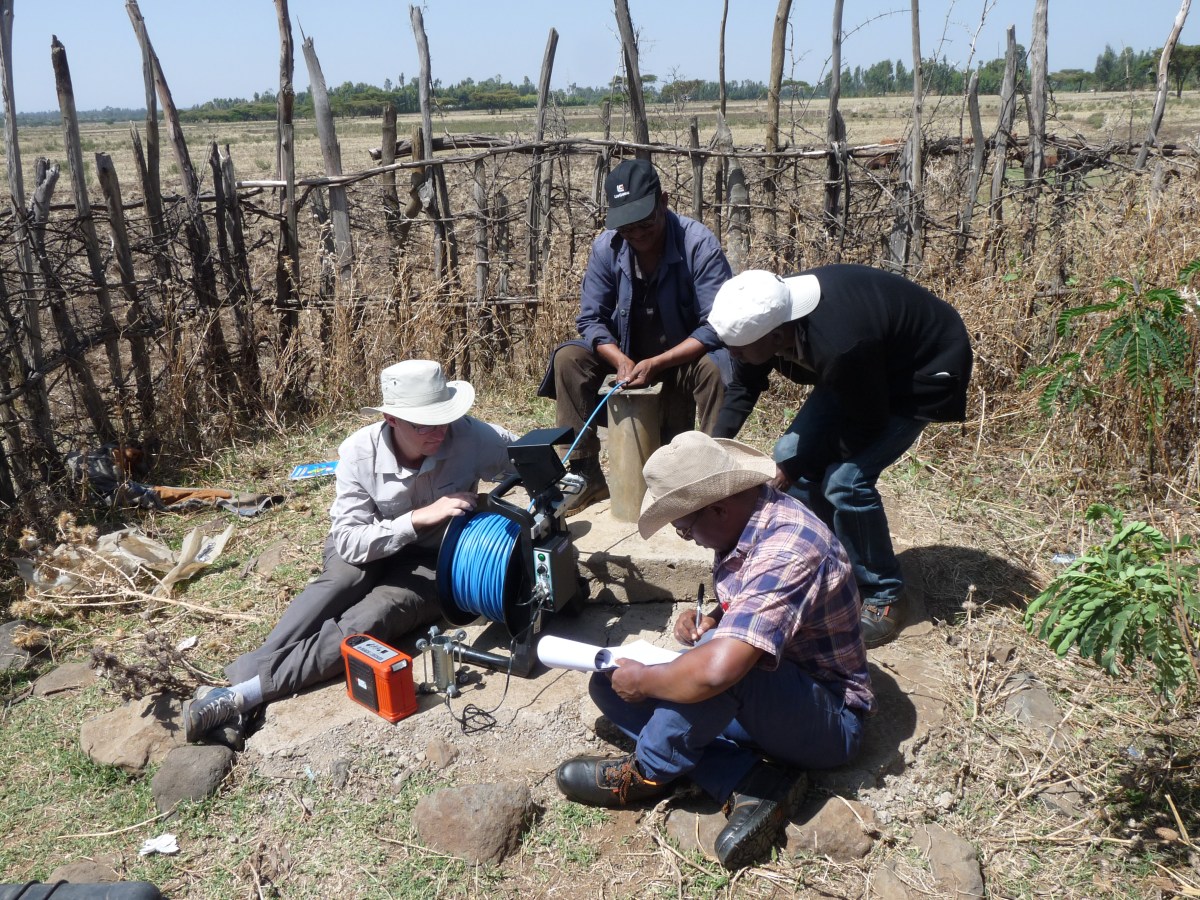
Photo: “Hidden Crisis team members using a CCTV camera to undertake downhole observations of the borehole construction of a community borehole” (Source: ‘BGS © NERC. UPGro Hidden Crisis Project.’)

Les contrats clés en main pour l’implantation et le forage de puits d’eau

Il s’agit du premier d’une série de quatre blogs intitulée ‘Le forage professionnel de puits d’eau: Apprendre de l’Ouganda” de Elisabeth Liddle et d’un webinaire en 2019 sur le forage de puits professionnel. Cette série s’appuie sur les recherches menées en Ouganda par Liddle et Fenner (2018). Nous vous invitons à nous faire part de vos commentaires en réponse à ce blog ci-dessous.

Les forages réalisés dans le cadre d’un “contrat clé en main ” sont devenus de plus en plus courants dans toute l’Afrique subsaharienne. Des recherches récentes menées en Ouganda par Liddle et Fenner (2018) ont montré que les contrats clés en main sont le type de contrat le plus courant lorsque le secteur privé fournit de nouveaux forages pour des pompes manuelles en milieu rural, bien que cela n’ait pas toujours été le cas. Dans ce blog, nous donnons un aperçu de ce que sont les contrats clé en main, pourquoi ils sont utilisés en Ouganda, et les avantages et les défis associés à leur utilisation en Ouganda.

Qu’est-ce qu’un contrat clé en main et pourquoi ces contrats sont-ils utilisés en Ouganda ?

Dans le cadre d’un contrat clé en main, un entrepreneur en forage est responsable à la fois de l’implantation et des travaux de forage et d’installation. Les contrats clés en main sont payés par le biais de modalités de paiement au forfait, c’est-à-dire “pas d’eau, pas de paiement “. Si le forage est fructueux, le foreur recevra la totalité du prix au forfait, quels que soient les coûts engagés sur place. Toutefois, si le forage est infructueux (forage à sec ou à faible rendement), le foreur ne sera pas payé du tout.

Les contrats clés en main ont pris de l’importance en Ouganda au milieu des années 2000 lorsque les agences d’exécution (autorités locales de district et Organisations Non Gouvernementales) devenaient de plus en plus frustrées par le nombre de forages infructueux réalisés lorsque les consultants effectuaient les travaux d’implantation de forages. Comme le consultant indiquait au foreur l’endroit où forer, si le forage échouait, l’agence de mise en œuvre devait payer le foreur pour tous les travaux effectués et les matériaux utilisés, c’est-à-dire selon un cahier des charges. L’échec des forages était imputé à la qualité du travail d’implantation des consultants ; de fait, les « consultants à mallette » (c’est-à-dire ceux qui n’avaient pas de formation officielle en géologie ou en hydrogéologie) avaient inondé le marché. En raison des bas prix qu’ils offraient et de l’absence de réglementation, ces consultants parvenaient à remporter des contrats d’implantation de forage.

Payer pour des forages infructueux était donc un problème, et il était devenu difficile pour les autorités locales de district d’atteindre leurs objectifs en matière de nouvelles sources d’eau potable. Les chefs de projet passaient pour incompétents. De plus, les responsables politiques ne comprenaient pas qu’un nombre de forages infructueux faisait partie intégrante du travail de forage ; par conséquent, si un foreur était payé pour un forage infructueux, les responsables politiques le considéraient comme corrompu. Certains responsables des services de l’eau au niveau du district ont même été menacés de prison.

La solution trouvée a été de retirer le consultant et de confier toute la responsabilité de la recherche de l’eau au foreur. Si le foreur forait alors un puits infructueux, il ne serait pas payé, car c’est lui qui était responsable de l’implantation du trou de forage. Le foreur prenait également tous les risques associés à un rendement d’eau inadéquat.

Avantages et défis de l’utilisation de contrats clés en main

Les contrats clés en main ont grandement simplifié le processus de passation de marché et de gestion de contrat pour les responsables de projets en Ouganda. Dans le cadre de contrats clés en main, les maitres d’ouvrage n’ont qu’à sélectionner et gérer un entrepreneur en forage. En outre, étant donné que le montant payé à l’entrepreneur si le forage est fructueux est déterminé au cours du processus d’appel d’offres, il n’y a pas de coûts imprévus pour le maitre d’ouvrage. De plus, en vertu des modalités de paiement « pas d’eau, pas de paiement », les organismes n’ont pas à dépenser directement de l’argent pour des forages infructueux ; l’argent n’est dépensé que pour des forages qui sont déclarés fructueux.

Bien que les contrats clés en main présentent des avantages notables, les chercheurs se sont entretenus avec plusieurs personnes en Ouganda qui se sont dites préoccupées par la qualité du travail :

  • Le choix du site est fonction de la facilité à trouver de l’eau: Dans le cadre de contrats clés en main, les entrepreneurs de forage doivent trouver suffisamment d’eau pour être payés. De multiples entretiens ont confirmé que les entrepreneurs en forage forent des puits là où il semble plus facile de trouver de l’eau, par exemple dans les vallées ou près des marécages ou des rivières. Non seulement les entrepreneurs de forage sont extrêmement susceptibles de trouver de l’eau dans ces zones, donc d’être payés, mais ils forent souvent à des profondeurs beaucoup moins profondes que celles sur lesquelles leur estimation forfaitaire de coûts était basée. Une marge plus importante peut donc être réalisée dans ces conditions. Les forages situés dans ces zones sont toutefois vulnérables à la pollution. Bien qu’un forage puisse passer les tests de qualité de l’eau immédiatement après avoir été foré, l’eau peut être impropre à la consommation humaine pendant les mois pluvieux en raison de l’augmentation du transport des polluants de surface et des taux de lixiviation ou, après plusieurs années, du fait de l’accumulation des polluants dans ces zones. En outre, l’accès des communautés à ces puits peut être limité, en particulier pendant les mois pluvieux où ces zones peuvent être vulnérables aux inondations.
  • Le bricolage pour faire des économies: En vertu des modalités de paiement « pas d’eau, pas de paiement »,, les entrepreneurs de forage doivent économiser dans la mesure du possible afin de pouvoir amortir les pertes qu’ils ont subies. Pour économiser de l’argent, il a été rapporté que certains entrepreneurs de forage en Ouganda sont connus pour les pratiques suivantes :
  • L’utilisation de matériaux de mauvaise qualité et/ou qui ne sont pas appropriés qux conditions hydrogéologiques, par exemple, des conduites montantes en fer galvanisé plutôt qu’en acier inoxydable dans les eaux souterraines acides. Les conduites montantes en fer galvanisé sont 4 à 5 fois moins chères que l’acier inoxydable. Lorsque des conduites montantes en fer galvanisé sont utilisées dans les eaux souterraines acides (qui sont courantes en Ouganda), une eau de couleur rouge/brune impropre à la consommation humaine est fort probable (Casey et al., 2016).
  • L’utilisation de matériaux inappropriés pour la conception du forage, par exemple, l’utilisation d’un tubage de 5 pouces lorsqu’un forage ouvert de 6/6,5 pouces[1] a été foré, car le tubage de 5 pouces est moins cher que celui de 6/6,5 pouces. Pour éviter que le tubage de 5 pouces ne tombe dans le trou ouvert de 6/6,5 pouces, les foreurs en chauffent la base et l’étirent pour l’ajuster au dessus de la zone ouverte. 42 % des entrepreneurs en forage interrogés (n = 14) ont admis avoir recours à cette pratique. Alors que certains y voient une bonne astuce, d’autres craignent que de la vase ne s’accumule dans ces forages avec le temps, en raison de l’espace entre le tubage et la roche consolidée et/ou des fissures qui se forment dans les zones les plus tendues du tubage. Un tel envasement use non seulement les pièces de la pompe à main, mais peut également entraîner des problèmes d’apparence du point de vue de l’utilisateur lorsque la vase pénètre dans l’alimentation en eau potable.
  • Arrêter de forer lorsqu’on rencontre de l’eau pour la première fois: On peut économiser beaucoup d’argent ainsi ; en Ethiopie, par exemple, forer à 50 mètres au lieu de 60 mètres réduit le coût du forage de 13% (Calow et al., 2012). Toutefois, si le forage ne pénètre pas dans l’aquifère principal, la quantité d’eau disponible après la construction peut être problématique, même si le forage passe l’essai de pompage.

3) Interférer avec les données d’essai de la pompe ou raccourcir le temps d’essai de la pompe

Cela permet de masquer les sites à faible rendement et les sites infructueux. Ces forages seront inévitablement à faible rendement après construction ou, dans le pire des cas, à sec.

La nécessité pour les foreurs d’avoir recours aux pratiques ci-dessus en Ouganda est exacerbée par le fait que, dans de nombreux cas, le forfait auquel les foreurs sont payés pour un forage réussi n’est pas assez élevé. De plus, la supervision par un hydrogéologue qualifié est rare.

Que faire en ce qui concerne les contrats clés en main ?

Les contrats clés en main devraient-ils continuer à être utilisés en Ouganda ? Les avis diffèrent d’un acteur à l’autre : la majorité des maitres d’ouvrage en Ouganda estiment que le recours aux contrats clés en main devrait se poursuivre, tandis que les consultants et le Ministère de l’eau et de l’environnement estiment qu’ils devraient cesser, au vu des problèmes de qualité des travaux décrits ci-dessus.

Le Ministère de l’eau et de l’environnement est allé jusqu’à publier une directive en janvier 2017 décourageant l’utilisation de contrats clés en main, et préconisant plutôt que les contrats subdivisés, un pour le choix du site (attribué à un hydrogéologue/consultant) et un pour le forage et l’installation (attribué à un entrepreneur en forage) soient dorénavant utilisés. Les opinions des foreurs eux-mêmes semblent impartiales ; la plupart d’entre eux ne s’opposent pas à l’idée de travailler dans le cadre de contrats clés en main ; ils demandent simplement à ce que les prix forfaitaires que les maitres d’ouvrage soient prêts à payer pour des forages réussis augmentent dans le futur, pour qu’ils ne soient pas obligés de prendre de bricoler pour faire des économies sur place.

Qu’en pensez-vous?

 Alors, qu’en pensez-vous? Avez-vous de l’expérience en matière de contrats clés en main pour forer des puits d’eau, ou d’autres pratiques que vous aimeriez partager ? Vous pouvez répondre ci-dessous en postant un commentaire, ou vous pouvez participer au webinaire en direct le 14 mai (inscriptions ici)

Références

Calow, R., MacDonald, A., and Cross, P. (2012). Corruption in rural water supply in Ethiopia. In J. Plummer (Ed.), Diagnosing Corruption in Ethiopia: Perceptions, realities and the way forward for key sectors (pp 121-179). Washington DC, USA: World Bank. Available from https://www.odi.org/sites/odi.org.uk/files/odi-assets/publications-opinion-files/8555.pdf

Casey, V., Brown, L., Carpenter, J.D., Nekesa, J., and Etti, B. (2016). The role of handpump corrosion in the contamination and failure of rural water supplies. Waterlines, 35(1), 59-77. Available from https://www.developmentbookshelf.com/doi/full/10.3362/1756-3488.2016.006

Liddle, E.S. and Fenner, R.A. (2018). Review of handpump-borehole implementation in Uganda, Nottingham, UK: BGS (OR/18/002). Available from https://nora.nerc.ac.uk/id/eprint/520591/

[1] Les trous de forage peuvent être ” entièrement tubés ” ou ” ouverts “. Si un trou de forage est ” entièrement tubé “, toute la partie verticale est tubée, avec des grilles dans les couches d’eau. Toutefois, si le trou de forage est ” ouvert “, seules les zones non consolidées du forage vertical sont tubées – le reste de la roche consolidée est laissé à l’état “ouvert ” (pas de tube ni de grilles).

Un pouce équivaut à 2,54 cm (note du traducteur).

Remerciements

Ce travail fait partie du projet Hidden Crisis du programme de recherche UPGro – cofinancé par le NERC, le DFID et l’ESRC.

Le travail de terrain entrepris pour ce rapport fait partie de la recherche doctorale des auteurs à l’Université de Cambridge, sous la supervision du Professeur Richard Fenner. Ce travail sur le terrain a été financé par le Ryoichi Sasakawa Young Leaders Fellowship Fund et UPGro : Hidden Crisis.

Merci à ceux d’entre vous de l’Université de Makerere et de WaterAid Ouganda qui m’ont apporté un soutien logistique, y compris sur le terrain, pendant que je menais les entretiens pour ce rapport (en particulier le Dr Michael Owor, Felece Katusiime et Joseph Okullo de l’Université Makerere et Gloria Berochan de WaterAid Uganda). Merci également à tous les répondants d’avoir été enthousiastes et disposés à participer à cette recherche.

Photo: ” Les membres de l’équipe Hidden Crisis utilisent une caméra de CCTV pour l’observation du fond de puits de la construction d’un forage communautaire ” (Source: ‘BGS © NERC. UPGro Hidden Crisis Project.’)


An Empowering Drop in the Bucket – A women’s journey on International Women’s Day

Author: Sara Ahrari, Programme Manager at Simavi. 

March marks two significant internationally celebrated days for those of us working in the sector. On 8th March we celebrate International Women’s Day #IWD and on 21st March we cherish the World Water Day #WWD. So, it would be good to reflect once again on how exactly WASH is critical to the health and empowerment of women and girls throughout their life.

Let us imagine that you are a girl born to a economically challenged family in a village in the so called developing world where you and your family do not have access to safe water and sanitation.

If you are lucky enough to survive the first 5 years of your life and not die from diarrhoea or other water-borne diseases, the chances are very high that you are already walking a few hours per day to fetch water for your family and you are taking care of your younger siblings.

Then when the time comes for you to go to school, if your family does not have to prioritise your brothers’ education to yours, and if there is a school to attend, you may actually enrol at one. The chances are still very high that you have to walk a good half an hour to fetch water before going to school and answer the call of nature in the open since your school does not have any (functional) toilet. You probably get harassed and experience gender based violence during these visits.Slide6.JPG

Then sometimes when you are between 9 to 12 years old, one day you feel a lot of pain in your lower tummy and suddenly feel that you have wet yourselves. Embarrassed to death, when you finally can find a private corner, you notice the blood in your underwear and think you are going to die. Terrified you tell your older sister or friend and if you can overcome the shame, maybe you tell even your mother, only to learn that although you will not die, you will be going through this pain and embarrassment every month for what seems to be the rest of your life. You will be given a cloth or two, to manage your period. Of course, finding water to wash them and a private place to properly dry them would still be a challenge. You miss school either because you have a lot of pain, which you don’t know how to manage, or you or your family don’t want to risk getting embarrassed because of the blood on your clothes, or simply because there is no toilet or water at school where you can change your cloth or pads! Even in some countries, you might also end up staying in a shed during your period since you will be considered unclean!

Getting your period, is also considered start of your womanhood, and your family might start thinking that it is about time to marry you off, either to reduce the costs or to avoid that you start misbehaving or simply because that’s how it works. Of course you would not get any education about your reproductive system, nor for instance how to avoid unwanted pregnancies. If you are not married off, you will be told to avoid the boys!

By the time that you are 15 years old, the chances are very high that you are pregnant. If you are married and pregnant, you need the permission and money from your husband or his family to go for your check-ups. Mind you, you probably need to bring your own water in a bucket to the health centre, which you have to walk quite a distance to get to. And mind you, when you are pregnant, you need to use the washroom more often, but of course there is no toilet in public places or even health centres. By the way, your family might think that these visits don’t worth the trouble and you are better off with a traditional birth attendant, who usually does not have any hygienic place to do the check-ups nor have water to wash her hands with, even when you are delivering your baby!

Untitled.png

And, if you are not married and pregnant, you can forget about going to the health center since the staff will not even talk to you. You probably end up with a traditional birth attendant who wouldn’t mind performing illegal abortion, and again have not washed her hands, when she puts them inside you or uses other terrifying unclean objects to perform an abortion. As you can guess, the chances that you actually survive this one, is very low.

Anyway, throughout your reproductive age, you probably would be pregnant pretty much every year. Of course you would not be able to get the rest or support you need during this time and have to still do most of the unpaid work around the house, without anyone recognising or appreciating it.

You may at some point in life also start doing some paid work to support your family. However, whenever someone at household gets sick or you have your period, you probably have to miss going to work and thereby your income. Talking about income, you are the one who would prioritise investing it in sanitation, whereas for your husband it comes as his 8th or 9th priority, but unfortunately it is often not you who decides what happens with your income, so still no toilet for your family.

When you lose your husband or your father, you probably will not inherit anything from them and all the assets would go to male member of your family. Often if you don’t have sons, or even when you do have them, this means that you need to rely on their mercy for food and shelter.

All these situations can get worse if you are living with any type of disability, or HIV/AIDS, or in places where there is too much or too little water, or if you are from a minority or displaced group.

Yet, generation after generation you have been the source of inspiration and driver of change within your family, community and throughout the world and your resilience and agency has brought the mankind where we are today.

Slide9.JPG

And of course, while WASH programmes alone cannot tackle underlying causes of the barriers women and girls face through their life cycle, by fulfilling women and girls basic needs for access to water and sanitation, they can be the first step in the right direction. On the other hand, WASH programmes when designed and implemented in a gender responsive and transformative way can provide the opportunity to move beyond this and also address women and girls’ strategic needs, such as participation in decision-making processes within their family and communities and thereby contributing to their physical, political, socio-cultural and economic empowerment.

The article is inspired by a panel discussion with Sara Ahrari convened by WaterAid Canada, UNICEF and RESULTS Canada during International Development Week 2019 in Ottawa.


The Top 10 RWSN Blog Posts in 2018

The RWSN Blog provided us again with some exciting posts in 2018. From sustainable water resources and community management, to solar-powered water pumping, to (manual) borehole drilling, and to rural water services – the range of topics offers diverse and insightful perspectives on rural water supply issues.

Here are some of the most popular blogs in 2018:

  1. Sustainable water resources management in Sri Lanka: present situation and way forward
  2. Three common myths about solar-powered water pumping
  3. “The borehole is not a madman” 3 reasons why Community Based Management demands a rethink
  4. Manually Drilled Wells: Providing water in Nigeria’s Megacity of Lagos and beyond
  5. Borehole drilling supervision in Malawi: why it is essential, not optional
  6. For rural Tanzanians, water has a social value too
  7. Tracing a path to sustainable rural water services in the Democratic Republic of the Congo
  8. Still barking up the wrong tree? Community management: more problem than solution
  9. Sharing experiences of data flows in water and sanitation – some reflections from AGUASAN Workshop 2018
  10. Achieving Professional and Sustainable Drilling in Madagascar? Yes, we can!

Find more blog posts

Find the newest blog posts here: RWSN Blog

Write your own Blog posts on rural water supply

Feel free to send your text and one or more pictures (if possible) in an e-mail with the subject “RWSN Blog Post” to ruralwater@skat.ch


Le mot de la présidente du RWSN: Une eau potable gérée en toute sécurité : l’importance de la qualité de l’eau pour de RWSN

Kelly Ann Naylor, UNICEF / La présidente du RWSN

Accessibilité. Disponibilité. Qualité. Ce sont les trois critères qui définissent un service d’eau potable géré en toute sécurité au titre de l’ODD 6.1. Alors que l’accessibilité et la disponibilité étaient des défis connus pour les services d’approvisionnement en eau en milieu rural, l’ampleur du problème de la qualité de l’eau en milieu rural n’était pas bien quantifiée, jusqu’à ce que le rapport de suivi 2017 du Programme commun OMS/UNICEF de suivi de l’approvisionnement  en eau et de l’assainissement fasse le point sur la qualité de l’eau en milieu rural. Alors que 73% de la population mondiale boit de l’eau non contaminée de manière bactériologique et chimique, seulement 55% de la population rurale dans le monde – un peu plus de la moitié – boit de l’eau salubre. De plus, les estimations de la qualité de l’eau ne sont disponibles que pour 45% de la population mondiale. Ce rapport note que ces données suggèrent que les niveaux de conformité aux normes relatives à l’eau potable sont probablement faibles dans les pays en voie de développement.

RWSN aborde de nombreux aspects liés aux services d’eau potable en milieu rural, mais jusqu’à présent, la qualité de l’eau n’a pas fait l’objet d’une attention particulière. Compte tenu de l’importance de cette question pour les populations rurales, RWSN est fier d’annoncer un nouveau partenariat avec The Water Institute de UNC Chapel Hill afin de répondre à la demande d’informations sur la qualité de l’eau dans les services d’approvisionnement en milieu rural. Selon Jamie Bartram (Directeur du Water Institute de UNC), «ce partenariat s’appuiera sur la plateforme  RWSN et sur l’expertise du Water Institute en matière de qualité et de gestion de l’eau pour apporter des données et des méthodes scientifiques de pointe aux membres du réseau.En tant que nouveau responsable du Thème cartographie et de surveillance, The Water Institute a pour objectif de rapprocher la science et la pratique en facilitant une discussion animée et en produisant des recommandations pratiques sur une eau gérée de manière sûre.» Pour en savoir plus sur ce nouveau partenariat, consultez la section ci-dessous.

L’accessibilité et la disponibilité de l’eau potable demeurent également des problèmes critiques pour les populations rurales. Les femmes et les filles sont responsables de la collecte de l’eau dans 8 ménages sur 10, dans le cas où l’eau n’est pas disponible sur place. Souvent, cette corvée est extrêmement pénible :  263 millions de personnes doivent chercher de l’eau à plus de 30 minutes de chez elles. De même, de nombreux systèmes d’approvisionnement en eau en milieu rural sont confrontés à des problèmes d’opération et de maintenance et peuvent tomber en panne pendant de longues périodes, lorsque des pièces de rechange ou des techniciens qualifiés ne sont pas disponibles pour effectuer les réparations. Cela peut priver les populations rurales de leur seule source d’eau fiable pendant de longues périodes.

Les communautés et les thèmes en ligne de RWSN restent actifs dans les domaines de l’accessibilité et de la disponibilité dans le cadre de la nouvelle stratégie 2018-2023. Le thème des Services durables travaille sur les différentes formes de prestation de services pour assurer la continuité et la qualité des services. Le thème Développement durable des eaux souterraines porte sur la disponibilité globale de la ressource, y compris à travers un nouveau sujet, “le pompage solaire”, afin de permettre des échanges d’expériences sur les avancées en matière de technologies de pompage solaire. Le thème Cartographie et suivi examine les moyens de renforcer les systèmes de suivi des services d’eau dans les pays. Le thème Auto-approvisionnement aide à définir un environnement favorable permettant aux personnes d’investir et d’améliorer leurs propres systèmes d’approvisionnement en eau. Enfin, le thème Ne laisser personne de côté, qui est pertinent pour tous ces autres thèmes, souligne la nécessité d’adopter une approche inclusive de l’eau en milieu rural, en tenant compte du genre, des personnes handicapées et des populations marginalisées pour réaliser le droit de l’homme à l’eau.

Le thème de la Journée mondiale de l’eau de 2019 sera «Ne laisser personne de côté». Maintenant plus que jamais, les praticiens de l’eau rurale seront là pour relever ce défi et s’attaquer à ces inégalités persistantes afin que les personnes vivant en milieu rural puissent boire de l’eau salubre, disponible à tout moment et accessible à proximité de de leur foyer.

Word from the RWSN Chair: RWSN to put the “Safe” in Safely Managed Drinking Water

by Kelly Ann Naylor, UNICEF, RWSN Chair

Accessibility. Availability. Quality.  These are the three criteria that define a safely managed drinking water service under SDG 6.1.  While accessibility and availability were known challenges for rural water supply services, the scale of the problem of rural water quality was not well quantified, until last year’s WHO/ UNICEF JMP Update Report 2017 put the water quality issue firmly on the map for rural water supply. While 73% of the world’s population drinks water free from contamination bacteriological and chemical contamination, only 55% of the world’s rural population – just over half – drinks safe water. Furthermore, estimates for water quality are only available for 45% of the global population.  The JMP report notes that these data suggest that levels of compliance with drinking water standards are likely to be low in developing countries.

RWSN addresses many aspects of rural drinking water services, but there had not been a specific focus on water quality thus far.  Given the importance of this issue for rural people, RWSN is proud to announce a new partnership with The Water Institute at UNC Chapel Hill to tackle the quality of water in rural water services. According to Professor Jamie Bartram (Director, The Water Institute at UNC), “this partnership will leverage the powerful RWSN platform and The Water Institute’s expertise in water quality and management to bring up to date evidence and methods to the members of the network.  As a new Topic Leader in Mapping and Monitoring, The Water Institute aims to bring evidence and practice closer by facilitating lively discussion and producing practical guidance on Safely Managed Water.”  You can find out more about this new partnership in the section below.

Accessibility and availability of drinking water also remain critical issues for rural populations.  Women and girls are responsible for water collection in 8 out of 10 households with water off premises, and 263 million people use water supplies more than 30 minutes from home.  Likewise, many rural water systems face operation and maintenance challenges that can leave rural populations with long downtimes when spare parts or skilled technicians are not available to make the repair.

RWSN’s Themes and online communities remain active on addressing Accessibility and Availability as part of the new strategy 2018-2023.  The Sustainable Services Theme explores service delivery models to ensure continuity and quality of services. The Sustainable Groundwater Development Theme is concerned with the overall availability of the water resource itself, while the recently-launched topic on “Solar Pumping” allows exchange on advances in solar pumping technologies and field experiences of their use and management.  The Mapping and Monitoring Theme is looking at how to reinforce in-country monitoring systems of water services. The Self-Supply Theme helps define the enabling environment that enables people to invest in and improve their own water systems. And cutting across all topics, the Leave No One Behind Theme emphasizes the need to have an inclusive approach to rural water, taking gender, disability, and marginalised populations into account to fulfil the human right to water.

Next year’s World Water Day theme will be “Leaving No One Behind.” Now more than ever, Rural Water practitioners will be on the forefront to take up this challenge and address these persistent inequalities so that rural populations everywhere can drink water that is safe, available when needed, and accessible close to home.

The Politics of Water 3: Area Mechanics in Malawi

by Naomi Oates, re-posted from University of Sheffield

Competing narratives surround the role of ‘area mechanics’ in Malawi

In November 2017 I started my ‘politics of water’ blog as an outlet to share experiences and findings from my research in rural Malawi on water governance and service sustainability.

The first instalment describes my initial impressions of Balaka District while the second explores the relationship between extension workers and rural communities.

This might have left you wondering – what about everyone else?


Area Mechanics receive hands-on training in water point repairs (Author’s own)

Water services in Malawi are decentralised, at least in theory.  This means two things. Firstly, district councils, together with district water offices, are mandated to develop and monitor water infrastructure in rural areas.

Secondly, communities are expected to maintain and repair their water points with minimal external assistance. For more serious problems, local ‘area mechanics’ are their first port of call, followed by the district water office.

In reality, district water offices are severely under resourced, there are currently few area mechanics, and the effectiveness of community-based management varies considerably. However, where they are present, area mechanics are thought to play an important role in keeping water points functioning.

Area Mechanics: volunteers or entrepreneurs?

So what is an area mechanic? This sounds like a simple question, but the answers are complex and contradictory.

The area mechanics Thoko interviewed in Balaka for her MSc research tended to consider themselves, foremost, as volunteers working for the greater good of the community. After all, they were selected from the local community and have strong social ties with the people they serve. An area mechanic may be a relative, a neighbour or a fellow churchgoer, even the village headman himself. Trustworthiness was emphasised by communities as an important criteria.


This training manual describes area mechanics as ‘artisans in advanced hand pump repair operating on a payment basis’ (GoM 2015)

The depiction of area mechanics as volunteers has been echoed in my own conversations with extension staff and NGO workers, but in combination with another term – entrepreneur. According to national policy, area mechanics are meant to operate as independent businesspersons. They are given training and a few basic tools, after which they are expected to make a small profit to sustain their operations. They are also encouraged to sign written contracts with communities to clarify payment for services.

This model is clearly aimed at economic viability and is meant to incentivise area mechanics by providing them with an income. Arguably, the model has failed to gain traction locally because it ignores the social context in which area mechanics operate.

A third view is that area mechanics are integral to formal water governance arrangements – in other words part of, or plugging a gap in, the government’s extension system. This may not be stated explicitly, but is implicit in the use of government issued ID cards.

To give another example, area mechanics are sometimes (but not always) introduced to communities by a government representative in order to establish their legitimacy. Several of the area mechanics Thoko spoke to wanted their role to be formalised to enable them to negotiate fees with communities, or conversely in the hope of receiving material and financial support from government.

The ambiguity of water mechanics

Despite appearances, none of these narratives is mutually exclusive, and they may be employed at different times depending on the context. As one extension worker explained to me:

“Area mechanics are entrepreneurs by design and should make communities aware of that. They are supposed to have a signed agreement. The area mechanic needs to be paid, a little.”


Area mechanics often prefer working as a team – two heads being better than one! (Author’s own)

He then went on to clarify:

“It is not payment as such but a token of appreciation. It is up to them if they want to work for free. However they shouldn’t deny assistance to a Water Point Committee just because they don’t have money.”

The ambiguity surrounding area mechanics can be confusing and could be viewed as a failure of policy (or its implementation). But, in my view, that conclusion would be overly simplistic and misses the point.

The co-existence of these different narratives, or interpretations of policy, leaves room for negotiation and pragmatism. These are arguably important ingredients for success, especially when adapting policies to local realities. In short, the role of area mechanics in Malawi’s water governance system is not yet set in stone.

In addition to my PhD fieldwork this blog draws on previous work by the authors under the UPGro Hidden Crisis project. Check out our report on the political economy of rural water supplies in Malawi.