A New Rural Water Partnership Between The U.S. And Tanzania

Guest announcement by Rebecca Gianotti, Ph.D., Consultant, Global Water Initiative, The Ohio State University

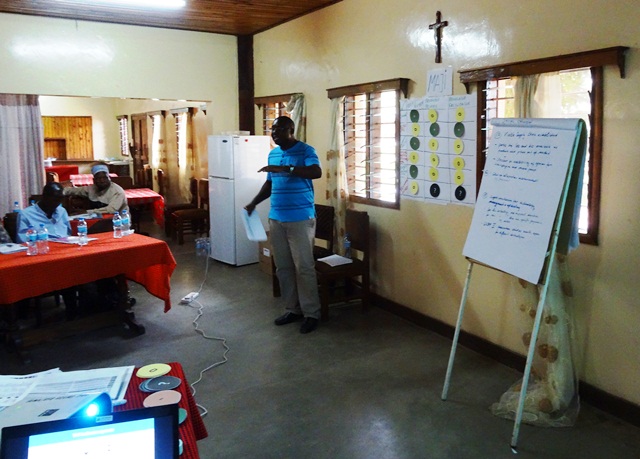
Deputy Vice Chancellor Shabaan Mlacha of the University of Dodoma signed a letter of intent with leaders at the Ohio State University to develop capacity building programs in rural Tanzania for the entrepreneurial sectors surrounding water (food, energy, health, sanitation).
1
Deputy Vice Chancellor Shabaan Mlacha of the University of Dodoma met with team members of the Global Water Initiative at Ohio State University as well as Tanzanian graduate students studying at Ohio State through another capacity building effort based at Sokoine University of Agriculture (Tanzania).

A new initiative at the Ohio State University that takes a systems approach to rural water development is launching pilot projects in Tanzania. Dubbed Wells to Wellness, the effort combines capacity building and tiered water point rehabilitation activities to provide scalable, sustainable systems solutions to water resource issues. In April, the university signed a letter of intent with the University of Dodoma in Tanzania to develop undergraduate programming that will strengthen the workforce in the entrepreneurial sectors surrounding water (food, energy, health, sanitation). The partnership between the two universities follows the announcement of a 55-MW solar array—the largest ever at a university—to be built by U.S.-based Hecate Energy at Dodoma in 2016. The new training and academic programs at the University of Dodoma will support both the budding renewable energy sector in rural Tanzania as well as a water point rehabilitation project also under Wells to Wellness. This effort will initially retrofit 125 inoperable wells as well as support health, sanitation and economic development with a systems approach incorporating a new franchising model for operations and maintenance as well as key collaborations with existing NGOs in Tanzania. Upon successful completion of the 125-well pilot, the Tanzanian government has provisionally committed to funding rehabilitation of thousands of additional wells by scaling up the model.
Continue reading “A New Rural Water Partnership Between The U.S. And Tanzania”

Innovations in Community Based Organisations, in Indonesia

So I’m at the Indonesia International Water Week 2015 and on the second day, the event has been split into six parallel streams:

  1. Sustainable Access to Safe Drinking Water
  2. Community Based Water Supply
  3. Domestic Wastewater Management
  4. Municipal Solid Waste Management and Domestic Wastewater
  5. Water Resources: Sinking Cities / Towards Better Implementation of IWRM
  6. Water Resources: Measuring Progress / Water Infrastructure & Water Resources Management

Continue reading “Innovations in Community Based Organisations, in Indonesia”

RWSN in Indonesia

So this week, I’m lucky enough to have been invited to present at the International Indonesia Water Week in Jakarta. RWSN is a global network, but many of you will have noticed the strong Africa-bias. That’s not necessarily a bad thing, but the challenges of delivering good quality rural water services are to be found everywhere – indeed the Pacific region is the where the biggest disparities between urban and rural are to be found [JMP].
Continue reading “RWSN in Indonesia”

Global Framework for Sharing Water Point Data Launched with Largest Ever Public Data Set

New Approach to Sharing Water Data Promises Improved Water Access around the World

Press Release by Brian Banks, Global Water Challenge

WASHINGTON | May 14, 2015 – Around the world, one in nine people lack access to safe water. While progress is being made, efforts have been limited by challenges in establishing a clear picture of water point access. Despite a growing trend of collecting data on water projects, there has previously been no consistent way to share this information among parties, making it difficult to fully understand the water challenges faced around the world.

Continue reading “Global Framework for Sharing Water Point Data Launched with Largest Ever Public Data Set”

Water taps and information gaps

An interesting blog post that has kicked off some interesting responses

Marc Gunther's avatarNonprofit Chronicles

wf_093014_Whatever_Glass_Hald_680x300If you’ve donated money to a water charity, congratulations. You’ve stepped up to try to solve one of the world’s most pressing problems–the fact that roughly 750 million people do not have access to clean water.

Has your donation made a lasting difference? That’s hard to know.

Big water charities point to numbers that, they say, demonstrate their impact. Since its founding in 2006, charity: water says it has funded 16,138 water projects. Water.org, in its latest annual report, says that in 2013 it completed 174 community-based water projects, constructed 73,081 toilets, established 66,632 household water connections and served 606,012 people with water and sanitation. In 2013-2014, Water Aid says it reached 2 million people with water and 3 million with sanitation.

But the charities, as a rule, do not report on how many of those projects are providing clean water a year, two or five years after…

View original post 2,496 more words

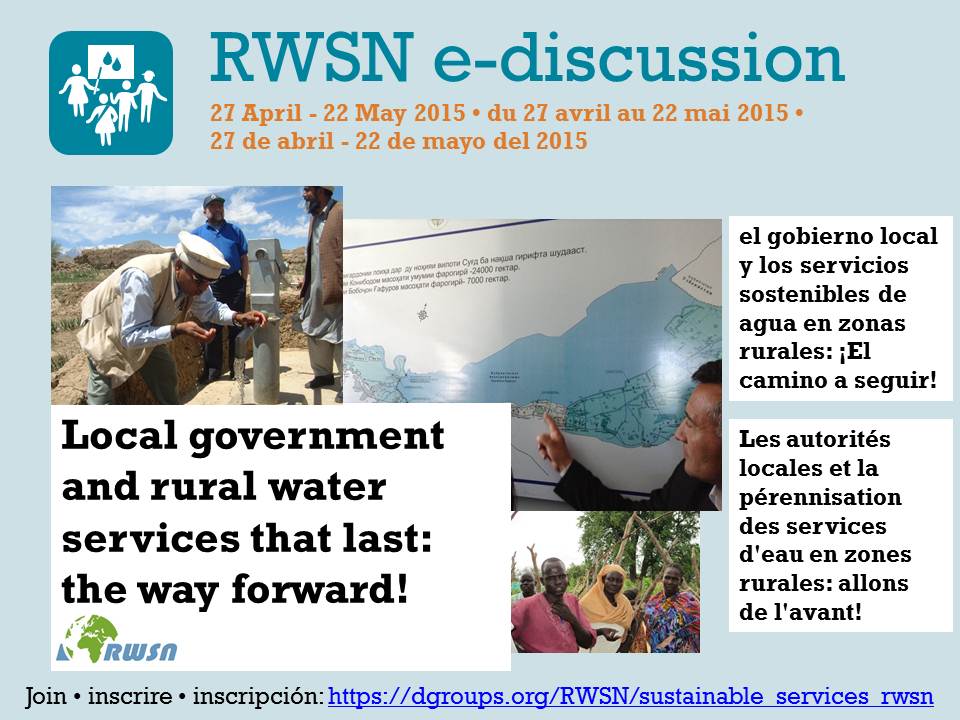
E-DISCUSSION ANNOUNCEMENT: Local government and rural water services

Les autorités locales et la pérennisation des services d’eau en zones rurales

El gobierno local y los servicios sostenibles de agua en zonas rurales

Sign up now: dgroups.org/RWSN/sustainable_services_rwsn

The Rural Water Supply Network would like to invite you to participate in the E-discussion (27 April – 22 May 2015)

• What are the roles and responsibilities of local government in rural water supply?
• How are these roles and responsibilities fulfilled?
• What are the challenges that local government faces in order to undertake these roles and responsibilities?
• What ideas, tools and experiences are there to ensure that local government can take up its roles and responsibilities?
Continue reading “E-DISCUSSION ANNOUNCEMENT: Local government and rural water services”

Roll out of technology applicability tool in Tanzania to assure sustainable WASH services

Lack of proper operation and maintenance (O&M), lack of participatory planning procedures, lack of flexibility to apply different management models for water supplies and inappropriate technology choices are among key issues identified which hindered sustainable WASH services during the Water Sanitation Development Plan (WSDP) Tanzania. The results of the national water point mapping clearly highlights the fact that more than 30% of all water points are not working.

To overcome these issues the leading Ministry of Water (MoW) in Tanzania included various measures in the design of the 2nd phase of the WSDP.

Continue reading “Roll out of technology applicability tool in Tanzania to assure sustainable WASH services”

How to make Self–supply more tangible?

rope pump demo
Rope pump demonstration (A. Olschewski/Skat)

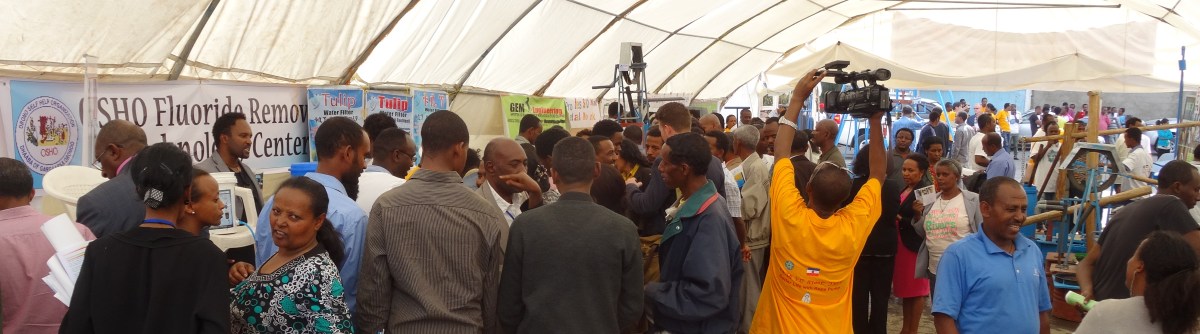
As part of the celebration of the World Water Day 2015 the rural water sector in Ethiopia organized a 3-day event on Self-supply (19th – 21st March) including a trade fair for producers of Self-supply technology and a 2-day seminar with inputs from international and national speakers. The fair hosted more than 20 local suppliers and producers which allowed potential clients to check technologies in detail, to speak to suppliers and compare products for e.g. water lifting, drilling, water treatment.

Suppliers were invited to to market themselves by giving a 3-minutes pitch to the public. A panel of experts gave feedback so that the brave pitchers could improve on their promotion in the future.

In the international seminar on 20th March, experiences from other countries on accelerating Self-supply were shared as well as the information on steps taken so far to roll out Self-supply in Ethiopia including linkages to small scale agriculture and the multiple use concept.

WHO presented results from various studies on water quality analysis of samples from improved and unimproved sources.It became obvious that the concept of improved/unimproved sources is not good for indicator of safe water supply. This perception was so far one of the key challenges addressed to accept Self-supply.

In the future WHO recommends enforcing its concept of Water Safety Plans and clearly promoted household water treatment for any water used for drinking water in rural areas. The Ethiopian water sector will develop ideas on how to establish and follow up water safety plans in Ethiopia which fit to the Self-supply context.

To attract more people similar fairs are planned for other towns in Ethiopia in the near future.

All slides of the international seminar on Self–supply (20th March) and some photos of the fair will be uploaded on the RWSN website.