Nearly 30 years ago I began my first steps into a career in Water, Sanitation and Hygiene (WASH) in Guatemala. In the morning mist, there was the dull clank of the school bell. It was an old bombshell that had been dropped on the village at some point during the thirty-year civil war. On that day it was guiding children to lessons. The clothes of the people, particularly the women, were amazing. Incredibly colourful and ornately woven, and each is distinctive to that community.
Today, my job is a different type of weaving, but no less colourful. In my previous post, I described how we, as RWSN and SuSanA, have been working with the Multilateral Development Banks, bilateral aid agencies, NGOs and researchers to weave a new narrative for rural WASH – one of learning from each other to achieve universal and lasting access.
But success doesn’t come from top-down actions only, there also needs to be a meeting with bottom-up energy, experience and initiative. Thanks to the support from SDC and IDB, through the SIRWASH project, we have had the opportunity to connect and listen to what regional practitioners are interested in and find ways to collaborate.
On 24 October, our partner, Lourdes Valenzuela from Aguatuya/SuSanA Latinoamérica co-hosted an online meeting with fellow WASH networks: “Conversatorio virtual: Escuchando las voces del sector de agua y saneamiento rural en Latinoamérica” (Online Conversation: Listening to the Voices of Rural Water and Sanitation Leaders in Latin America)
This 80-minute session, co-hosted with COLSAR, connected experts from diverse backgrounds to identify current sector demands and innovative approaches for improving rural water and sanitation management.
Themes and Objectives
The session, moderated by Marcelo Encalada from LatinWASH, sought to:
Identify essential knowledge areas and skills for strengthening rural water and sanitation services.
Explore digital tools and resources that could improve access to critical knowledge.
Examine the role of digital platforms such as SuSanA and LatinWASH in promoting sustainable solutions.
Este año celebramos los 30 años de la fundación formal de la Red de Abastecimiento de Agua en Zonas Rurales. Desde unos inicios muy técnicos como grupo de expertos (en su mayoría hombres) la Red de Tecnología de Bombas de Mano- hemos evolucionado hasta convertirnos en una red diversa y vibrante de más de 13.000 personas y 100 organizaciones que trabajan en una amplia gama de temas. En el camino, hemos ganado una reputación de imparcialidad, y nos hemos convertido en un convocante global en el sector del agua rural.
La RWSN no sería lo que es hoy sin las contribuciones y los incansables esfuerzos de muchos de nuestros miembros, organizaciones y personas. Como parte de la celebración del 30º aniversario de la RWSN, estamos llevando a cabo una serie de blogs en rwsn.blog, invitando a nuestros amigos y expertos del sector a compartir sus pensamientos y experiencias en el sector del agua rural.
Esta es una entrada de blog del miembro de la RWSN Joshua Briemberg, con sede en Nicaragua.
Mi carrera en el sector del agua y el saneamiento comenzó en 1993, poco después de que naciera la RWSN. Fue una elección deliberada para mí después de un breve período en la industria petrolera del Reino Unido que siguió a vivir y trabajar durante 4 meses entre 1991 y 1992 en la zona rural de Nicaragua para construir una casa escuela de dos habitaciones. Durante ese tiempo, la diarrea estaba a la orden del día, y de la noche, en una rudimentaria letrina de pozo. Todavía recuerdo que miraba a las hojas de plátano gigantes que se agitaban a la luz de la luna para encontrar una sensación de paz en cierta agonía. En aquella época, luchaba por concentrarme mientras estaba en la universidad en Canadá, entre los estudios de ingeniería química, con una clase de tratamiento del agua que me llamaba la atención, y los estudios de humanidades, intrigado por el debate sobre los derechos del agua y los pueblos de las Primeras Naciones de Canadá.
Una vez terminada mi carrera de ingeniería en 1992, mi verdadera vocación siguió eludiéndose y me trasladé al Reino Unido. Durante mi estancia en Londres, primero como mensajero en bicicleta y luego como ingeniero de salud y seguridad para la construcción de una plataforma petrolífera de 11.000 millones de dólares en el Mar del Norte, la librería Intermediate Technology (que más tarde se convertiría en Practical Action) se convirtió en mi destino favorito y la publicación mensual Waterlines en una temprana inspiración, mientras planeaba volver a Nicaragua para hacer algo, cualquier cosa relacionada con el agua. También recuerdo haber llevado algún que otro paquete como mensajero a una pequeña oficina de WaterAid en un edificio cercano a Green Park. Veinte años más tarde, todavía viviendo en Nicaragua, se me pediría que diseñara y luego dirigiera el primer programa de país de WaterAid en América Latina.
En algún momento, dejé de lado cualquier idea de seguir una formación formal en las aulas de institutos de renombre como el WEDC de la Universidad de Loughborough, donde una vez me reuní con John Pickford, o el IHE de Delft, donde también hice una breve visita. El campo se convertiría en mi aula.
Mi andadura en el mundo del agua y el saneamiento en 1993 empezó de verdad al realizar un estudio sobre la presencia de pesticidas en las aguas subterráneas de las ciudades del histórico cinturón algodonero de Nicaragua en los años setenta. De ahí pasé a un par de trabajos en lo que iba a ser mi campo como ingeniero químico: planes maestros de alcantarillado para Managua y tratamiento de aguas residuales mientras estaba brevemente en Canadá.
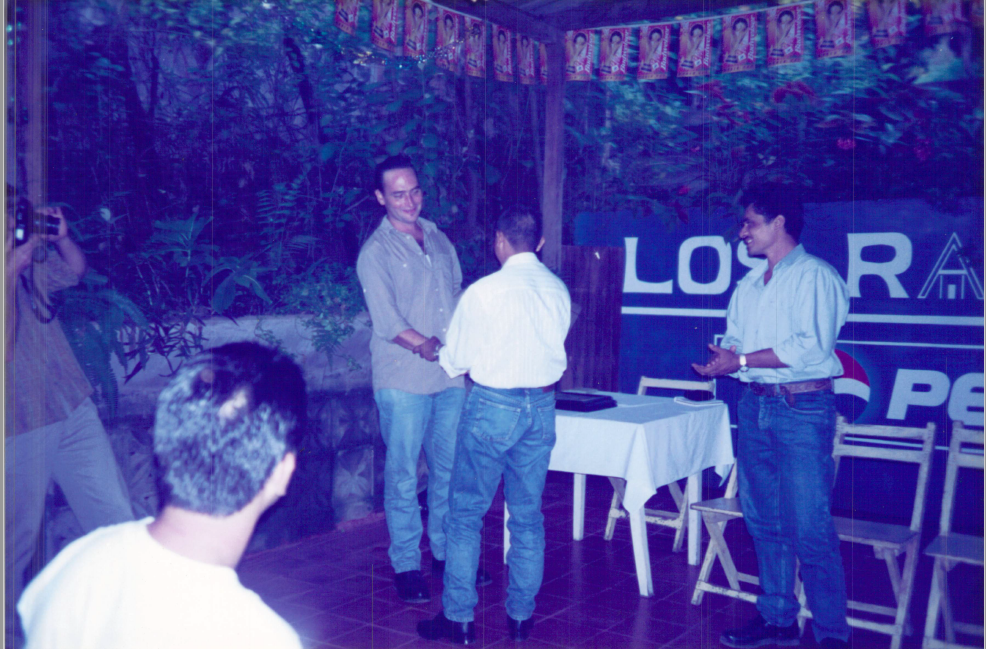
Foto: Clase de graduados de Agua para la Vida
Pero fue entonces, cuando me encontré dirigiendo el primer ciclo de un programa de formación de ingenieros de pueblos para diseñar y construir pequeños sistemas rurales de abastecimiento de agua por gravedad alimentados por manantiales en las montañas del centro-norte, cuando realmente encontré mi vocación: el abastecimiento de agua en zonas rurales. En poco más de 30 años esta operación –Agua para la Vida– ha trabajado con pequeñas comunidades rurales de montaña para establecer más de 100 sistemas de abastecimiento de agua utilizando herramientas de diseño de última generación para optimizar el rendimiento y el coste. Los sistemas de abastecimiento de agua por gravedad alimentados por manantiales de montaña bien diseñados son asombrosamente duraderos con unos costes de funcionamiento muy manejables; el principal reto es la protección de la zona de recarga de la cuenca y garantizar la cohesión de la comunidad y una gestión eficaz.
Cautivado por la alegría de abrir el grifo y tener agua limpia a borbotones después de meses de sudor y esfuerzo, me sentí impulsado a seguir en la búsqueda de un vaso de agua limpia en todas partes.
Una cosa que descubrí durante estos años fue que, mientras diseñábamos para el crecimiento, las comunidades a menudo se reducían en tamaño debido a la migración en busca de mayores oportunidades económicas en otros lugares.
Aproveché los conocimientos aprendidos con las comunidades devastadas por la guerra en la frontera agrícola para trabajar con las comunidades indígenas Miskitu y Mayangna para llevar agua limpia de montaña a la gente a lo largo de un sistema de ríos en las profundidades más lejanas de una de las dos reservas de la biosfera en Nicaragua. El suministro de agua por tubería alimentada por gravedad siguió siendo mi opción por defecto hasta que se agotaron los manantiales.
En mi primera misión de reconocimiento, en 1997, en la aldea de Raiti, en el río Coco (Wangki), que separa Honduras de Nicaragua, me acompañó un hidrogeólogo estadounidense que no hablaba ni español ni la lengua local, el Miskitu. Durante la conversación con los líderes de la comunidad sobre la existencia de fuentes potenciales de manantiales, un líder de la comunidad me dijo que la fuente potencial estaba a unos 15 minutos de distancia mientras que otro dijo que estaba más bien a un día de distancia. Ni que decir tiene que mi hidrogeólogo decidió quedarse atrás y tardamos cerca de 6 horas en llegar al lugar que los aldeanos consideraban una fuente viable.
Desafortunadamente, como casi todas las fuentes de agua superficiales en la región oriental o caribeña de Nicaragua, estaba situada a una altura inferior a la de la comunidad, que era la forma en que las comunidades se protegían contra el riesgo de inundaciones. Y así comenzaron mis primeras experiencias de excavación y perforación de pozos con lo que para entonces se había convertido en un estándar nicaragüense: la bomba de mecate.
Transportando tubos en el Río Coco (2000-2003)
No fue hasta principios de la década de 2000, y con una década de experiencia empírica sobre el terreno, cuando empecé a entrar en contacto con redes como la RWSN, que se convirtieron en referencias esporádicas pero importantes, combinadas con otros focos de inspiración que encontraba en las escasas oportunidades en que salía de comunidades remotas por senderos, caminos de tierra y ríos.
A través de estos contactos, me inspiré para añadir nuevas herramientas a mi caja de herramientas en la búsqueda continua de agua limpia. La recogida de agua de lluvia y el tratamiento en el punto de uso o los filtros se convirtieron en aspectos importantes de mi búsqueda para llegar realmente a la última milla, al tiempo que experimentaba con bombas hidráulicas de ariete en el camino. Además de las tecnologías en sí, enfoques como el Marco de Aplicabilidad de la Tecnología (TAF), la aceleración del autoabastecimiento y el fortalecimiento de los sistemas se han convertido en herramientas esenciales en los últimos diez años de mi viaje.
De estos contactos surgieron no sólo referencias técnicas clave, sino una mayor comprensión de la importancia del contexto en la aplicabilidad de una solución, la complejidad de la sostenibilidad, la importancia de los enfoques basados en la demanda acompañados de sistemas que no son necesariamente exclusivos del sector público, sino que incluyen el papel del sector privado local, el espíritu empresarial, las alianzas y la aceleración de los modelos de autoabastecimiento de la prestación de servicios.
Todavía existe una tensión considerable entre estos dos enfoques del suministro de agua -el fortalecimiento de los sistemas y la aceleración de los modelos de autoabastecimiento-, aunque considero que estos últimos son complementarios y forman parte de los primeros, y a pesar de que en el ámbito del saneamiento las soluciones familiares individuales siguen siendo la norma para la población de las zonas rurales.
Ni que decir tiene que pasé de mis inicios en los sistemas de abastecimiento por gravedad alimentados por manantiales a los pozos de sondeo superficiales y profundos, a la perforación manual y mecánica, a las bombas manuales y a las impulsadas por energías renovables, a la captación de agua de lluvia en los tejados y al tratamiento y almacenamiento de agua en los hogares. También me adentré en el concepto de resiliencia y en los conceptos de usos múltiples y fuentes múltiples o sistemas híbridos, este último todavía menos considerado.
No debe pasar desapercibido que mi búsqueda de agua limpia en Nicaragua se ha visto confrontada y marcada en el camino por un número creciente de huracanes: Mitch en 1998, que me llevó al río Coco para construir sistemas de abastecimiento de agua donde no los había, pero donde las comunidades a lo largo del río habían sido totalmente arrasadas. Félix, en 2007, dejó una franja de destrucción en la costa caribeña nororiental. Y, más recientemente, Eta e Iota, en noviembre de 2020, arrasaron con todos los más de 250 sistemas de captación de agua de lluvia en los tejados, con tanques de ferrocemento de 4.000 litros, que habían sido construidos uno a uno durante 5 años por hombres y mujeres en la comunidad de Wawa Bar.
Training RWH System installers Wawa Boom (2021)
En el camino, también me encontré con algunas contribuciones significativas al abastecimiento de agua en las zonas rurales, incubadas en Nicaragua en el espíritu de su afamado poeta de las letras españolas modernas Rubén Darío: Si la Patria es pequeña, uno grande la sueña. Entre ellas se encuentran la bomba de mecate, el filtron de barro (Filtron) y un clorador en línea de fabricación artesanal (conocido originalmente como CTI-8).
Fueron el tratamiento y el almacenamiento de agua en el hogar y Ron Rivera, de Alfareros por la Paz, los que me iniciaron en el concepto de autoabastecimiento y los enfoques basados en el mercado. Este concepto ha terminado por costarme dos veces mi trabajo con organizaciones “sin ánimo de lucro” que no están dispuestas a socavar su modelo de caridad y su dependencia de un estado permanente de “filantropía humanitaria”.
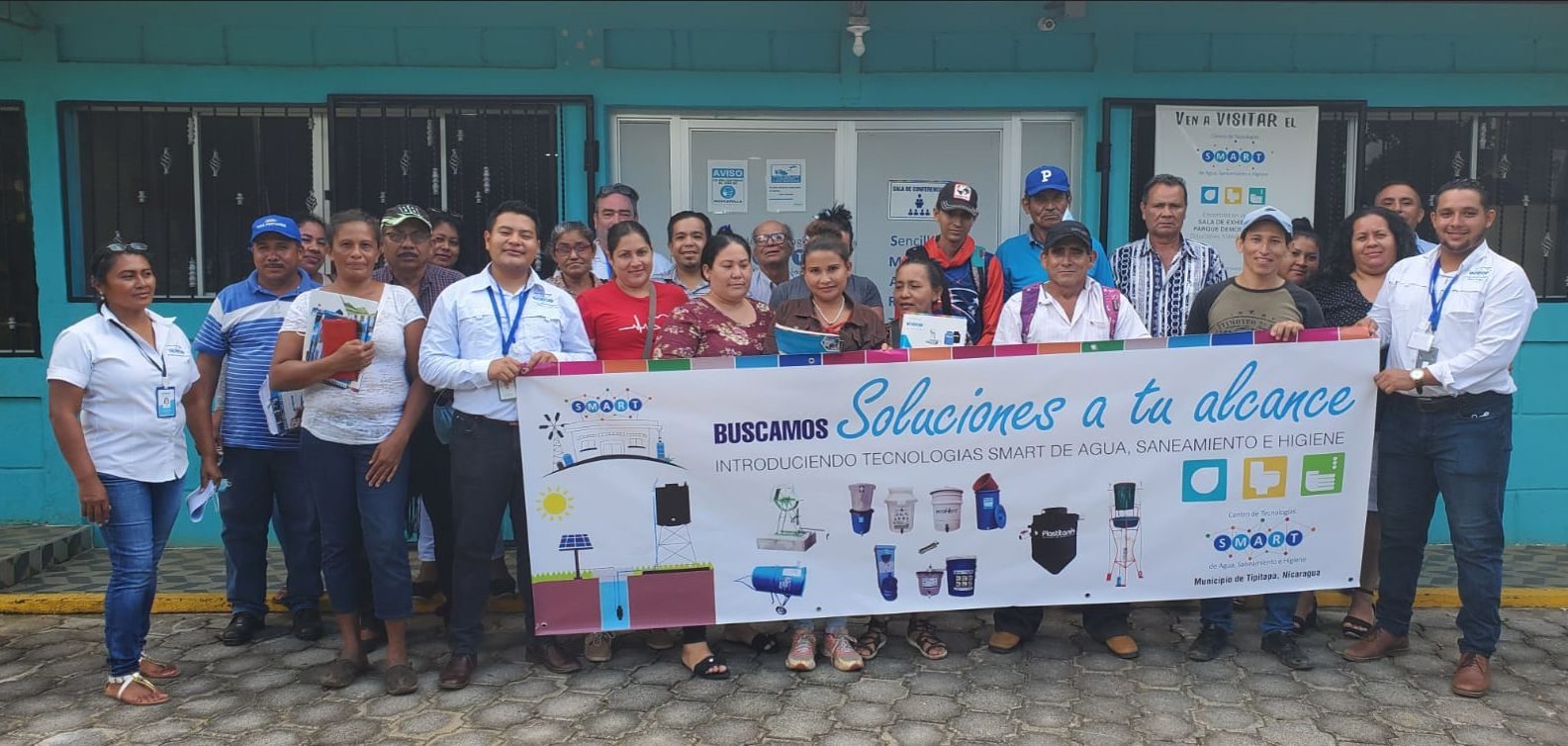
Ahora que mi camino de vida entra en su recta final, mi enfoque es reunir tanto física como virtualmente la mayor cantidad de todas estas grandes iniciativas y las nuevas que surjan, dentro de un marco basado en el contexto y la construcción colectiva de modelos de prestación de servicios adecuados. Mi vehículo desde 2017 es el Centro SMART de Nicaragua: Conectando, asistiendo, acelerando. El Centro SMART fue inspirado en 2015 por Henk Holtslag, a quien conocí en el Foro de la RWSN en Kampala en 2011.
Joshua ha trabajado como profesional en el sector de WASH rural durante más de 30 años, casi en su totalidad en Nicaragua, América Central, con la excepción de un período de 3 años en el que dirigió el desarrollo de un programa en Colombia. Su trabajo le ha llevado desde breves periodos en el sector público y en una empresa privada de consultoría de ingeniería, hasta organizaciones no gubernamentales pequeñas e internacionalmente reconocidas, y agencias de ayuda bilateral. Es el director fundador del Centro de Tecnologías SMART de Agua, Saneamiento e Higiene de Nicaragua, una empresa social que reúne a los sectores público y privado, las instituciones de microfinanciación y el mundo académico para promover los enfoques SMART, incluido el autoabastecimiento para llegar a la última milla. Recientemente ha sido coautor de una nota de campo de la RWSN en la que se hace un balance de los 40 años de historia de la bomba de mecate en Nicaragua.
¿Le ha gustado este blog? ¿Le gustaría compartir su perspectiva sobre el sector del agua rural o su historia como profesional del agua rural? Invitamos a todos los miembros de la RWSN a contribuir a esta serie de blogs del 30º aniversario. Los mejores blogs serán seleccionados para su publicación y traducción. Por favor, consulte las directrices del blog aquí y póngase en contacto con nosotros (ruralwater[at]skat.ch) para obtener más información.Si aprecia el trabajo de la RWSN y desea apoyarnos económicamente, puede hacerlo aquí.
This year we are celebrating 30 years since the Rural Water Supply Network was formally founded. From very technical beginnings as a group of (mostly male) experts – the Handpump Technology Network – we have evolved to be a diverse and vibrant network of over 13,000 people and 100 organisations working on a wide range of topics. Along the way, we have earned a reputation for impartiality, and become a global convener in the rural water sector.
RWSN would not be what it is today without the contributions and tireless efforts of many our members, organisations and people. As part of RWSN’s 30th anniversary celebration, we are running a blog series on rwsn.blog, inviting our friends and experts in the sector to share their thoughts and experiences in the rural water sector.
This is a blog post from RWSN Member Joshua Briemberg, based in Nicaragua.
My career in the water and sanitation sector started in 1993 not long after RWSN was born. It was a deliberate choice for me after a brief stint in the UK oil industry that followed upon living and working during 4-months between 1991 and 1992 in rural Nicaragua to build a two-room school house. During this time diarrhea was often the order of the day, and night, for me in a rudimentary pit latrine. I still remember looking up into giant banana leaves waving in the moonlight to find a sense of peace in certain agony. At the time, I struggled to focus while in university in Canada between studies in chemical engineering with one class in water treatment that caught my attention, and studies in humanities, intrigued by the discussion of water rights and the First Nations people of Canada.
Having finished my engineering degree in 1992, my true calling continued to elude me and I moved to the UK. While in London, first as a bicycle courier and then as a health and safety engineer for the construction of an 11 billion dollar North Sea oil platform, the Intermediate Technology book shop (which later became Practical Action) became my favorite destination and the monthly publication Waterlines an early inspiration, as I planned a return to Nicaragua to do something, anything related to water. I also remember carrying the odd parcel as a courier to a small WaterAid office in a building near Green Park. Twenty years later, still living in Nicaragua I would be asked to design and then lead WaterAid’s first country program in Latin America.
Somewhere along the way, I let fall by the wayside any idea of pursuing further formal training in the halls of renowned institutes like WEDC at the University of Loughborough, where I once met with John Pickford, or IHE in Delft where I also made a short visit. The field was to become my classroom.
My journey in the world of water and sanitation in 1993 started for real by conducting a study of the presence of pesticides in the groundwater supplies for the cities of Nicaragua’s historic cotton-belt of the 1970s. I moved on from there to a couple of jobs in what was meant to be my field as a chemical engineer – sewerage master plans for Managua and wastewater treatment while briefly back in Canada.
Photo: Agua Para la Vida Graduating Class
But it was then, as I found myself heading up the first cycle of a program to train village-engineers to design and build small rural spring-fed gravity-driven water supply systems in the north-central mountains that I truly found my calling: rural water supply. In just over 30 years this operation – Agua para la Vida – has worked with small rural mountainous communities to establish more than 100 water supply systems using state-of-the-art design tools to optimize performance and cost. Well-designed mountain spring-fed gravity-driven water supply systems are amazingly durable with highly manageable operating costs; the main challenge is the protection of the recharge area of the watershed and ensuring community cohesion and effective management.
Captivated by the joy of opening the tap and having clean water gushing out after months of sweat and toil, I was driven to carry on in pursuit of a glass of clean water everywhere.
One thing I found during these years was that while we designed for growth the communities often shrunk in size due to migration in search of greater economic opportunities elsewhere.
I took the skills learned with war-ravaged communities on the agricultural frontier to work with indigenous Miskitu and Mayangna communities to bring clean mountain water to people along a system of rivers in the farthest depths of one of two biosphere reserves in Nicaragua. Gravity-fed piped water supplies continued to be my default option until the springs ran out.
On my first reconnaissance mission in 1997 to the village of Raiti on the Coco River (Wangki) that separates Honduras from Nicaragua, I was accompanied by an American hydrogeologist who spoke neither Spanish nor the local language Miskitu. During the conversation with community leaders about the existence of potential spring sources, one community leader told me that the potential source was about 15 minutes away while another said it was more like a day away. Needless to say my hydrogeologist decided to stay behind and it took us close to 6 hours to reach the place thought by the villagers to be a viable source!
Unfortunately, like almost all surface water sources in the eastern or Caribbean region of Nicaragua, it was located at lower elevations than the community, which was the way the communities would protect themselves against the risk of flooding. And thus began my first experiences with digging and drilling wells with what had become a Nicaraguan standard by then: the rope pump.
Transporting pipes on the Rio Coco (2000-2003)
It was not until the early 2000s, and with a decade of empirical experience in the field, that I began to come in contact with networks such as RWSN which became sporadic but important references combined with other guiding lights of inspiration that I encountered in the rare opportunities when I emerged from remote communities by footpaths, dirt roads, and rivers.
Through these contacts, I was inspired to add new tools to my toolbox in the continued search for clean water. Rainwater harvesting and point-of-use treatment or filters became significant aspects of my search to truly reach the last mile, while also experimenting with hydraulic ram pumps along the way. In addition to technologies themselves, approaches such as the Technology Applicability Framework (TAF), accelerating self-supply, and systems strengthening have become essential tools in the last ten years of my journey.
In addition to RWSN, which I did not formally encounter until 2011 when I attended the RWSN’s 6th International Forum in Kampala, Uganda, I also found inspiration from the HWTS network, the International Rainwater Harvesting Alliance (IRHA), the SMART Centre Group, SuSanA, Agenda for Change, and others. At the local level the Nicaraguan and Central American WASH Networks (RASNIC and RRAS-CA respectively) represented efforts to bring collaboration to the regional, national and local levels.
Out of these contacts came not only key technical references, but a greater understanding of the importance of context in the applicability of a solution, the complexity of sustainability, the importance of demand-based approaches accompanied by systems that are not necessarily exclusive to the public sector but include the role of the local private sector, entrepreneurship, alliances and the acceleration of self-supply models of service delivery.
There is still considerable tension between these two approaches to water supply – systems strengthening and accelerating self-supply models – although I consider the latter to be complementary and part of the former, and despite the fact that in sanitation individual family solutions continue to be the standard for the population in rural areas.
Needless to say, I moved on from my beginnings in spring-fed gravity-driven systems to shallow and deep borehole wells, manual and machine drilling, handpumps and renewable energy-driven pumps, rooftop rainwater catchment, and household water treatment and storage. I also ventured in to the concept of resilience and the concepts of both multiple uses and multiple sources or hybrid systems, the latter still less commonly considered.
It should not go unnoticed that my search for clean water in Nicaragua has been both confronted and marked along the way by an increasing number of hurricanes: Mitch in 1998 that took me to the Coco River to build water supply systems where there had been none but where the communities along the river had been entirely wiped away. Felix in 2007 left a swath of destruction across the northeast Caribbean Coast. And most recently Eta and Iota back-to-back in November 2020 that wiped out all of the more than 250 rooftop rainwater catchment systems with 4,000 litre ferrocement tanks that had been built one by one over 5 years by men and women in the community of Wawa Bar.
Training RWH System installers Wawa Boom (2021)
On this journey, I also came across some significant contributions to rural water supply incubated in Nicaragua in the spirit of its famed poet of modern Spanish letter Ruben Dario: Si la Patria es pequeña, uno grande la sueña. (If the homeland is small, one dreams it to be grand.) These include the rope pump (known in Nicaragua as the bomba de mecate), the clay pot filter (Filtron), and an artisan-made in-line chlorinator (originally known as CTI-8).
It was household water treatment and storage, and Ron Rivera of Potters for Peace that started me on the road to the concept of self-supply and market-based approaches. This concept has ended up twice costing me my job with “non-profit” organizations unwilling to undermine their charity model and dependence on a permanent state of “humanitarian philanthropy”.
Now as my life journey enters its home stretch, my focus is on bringing together both physically and virtually as many of all these great initiatives and new ones as they come along, within a context-based framework and the collective construction of appropriate service delivery models. My vehicle since 2017 is the Nicaragua SMART Centre: Connecting, assisting, accelerating. The SMART Centre was inspired in 2015 by Henk Holtslag whom I first met that the RWSN Forum in Kampala in 2011.
Joshua has worked as a practitioner in the rural WASH sector for over 30 years almost entirely in Nicaragua, Central America with the exception of a 3-year period when he led the development of a program in Colombia. His work has taken him from brief stints in the public sector and with a private engineering consulting firm, to both small and internationally recognized non-governmental organizations, and bilateral aid agencies. He is the founding director of the Nicaragua Centre for SMART Technologies for WASH (Centro de Tecnologías SMART de Agua, Saneamiento e Hygiene), a social enterprise bringing together the public and private sectors, microfinance institutions, and academia to promote SMART approaches including self-supply to reach the last mile. He recently co-authored a RWSN Field Note taking stock of the 40-year history of the rope pump in Nicaragua.
Did you enjoy this blog? Would you like to share your perspective on the rural water sector or your story as a rural water professional? We are inviting all RWSN Members to contribute to this 30th anniversary blog series. The best blogs will be selected for publication. Please see the blog guidelines here and contact us (ruralwater[at]skat.ch) for more information. You are also welcome to support RWSN’s work through our online donation facility. Thank you for your support.
Making water work for women – inspiring stories from around the world
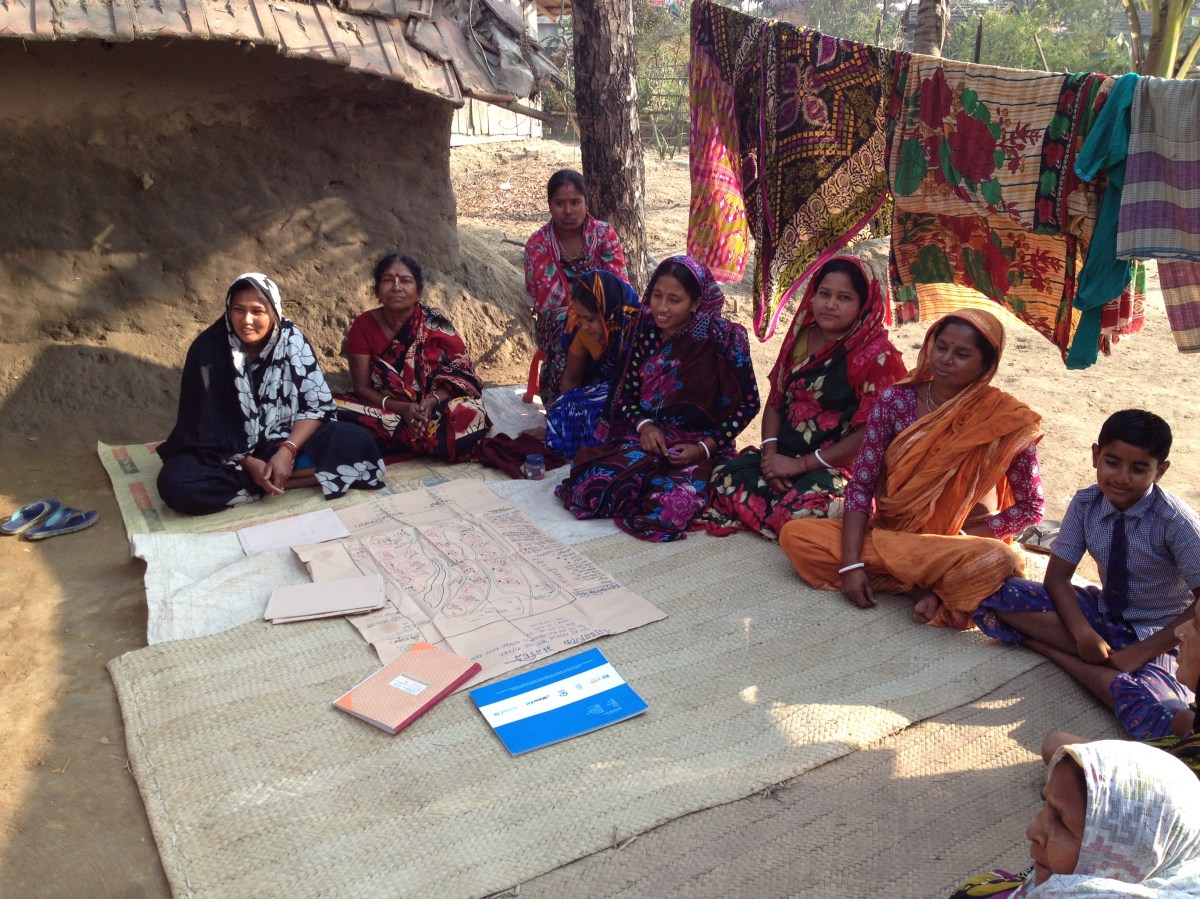
The reality in much of the world today is that collecting water for the home is a job done by women – so gender issues are central to everything we do in rural water supply – self-supply, pump design, borehole siting, tariff collection, water resource management, business models or using ICT to improve service delivery.
In this week’s webinar we have brought together more inspiring stories from Nicaragua, India and the World Bank. We are taking ‘gender’ from being a tokenistic tick-box to a living, vibrant, practical core of every rural water service.
Join the us next Tuesday 23 May – it an opportunity to have your practical and policy questions answered from world class experts.
Did you miss Part 1? Don’t worry. You can watch and listen to the inspiring experiences from Burkina Faso, India, Ethiopia and Bangladesh on the RWSN video channel:
L’eau au service des femmes – des histoires inspirantes
La réalité dans beaucoup d’endroits dans le monde aujourd’hui est que l’approvisionnement en eau pour les besoins domestiques reste un travail porté par les femmes – donc les questions liées au genre sont au coeur de toutes les activités que nous entreprenons dans le secteur de l’eau rurale: auto-approvisionnement, conception des pompes, emplacement des forages, recouvrement des tariffs, gestion des ressources en eau, ou utiliser les TIC pour améliorer les services.
Le webinaire de la semaine permettra d’entendre des histoires intéressantes du Nicaragua, de l’Inde et de la Banque Mondiale. Nous souhaitons passer d’une compréhension de la notion de genre se bornant à cocher une case, pour mettre en avant les aspects vivants, pratiques et essentiels qui font partie de tous les services d’eau ruraux.
Joignez-vous à nous mardi prochain – ce sera l’occasion de poser vos questions sur la pratique et la politique à des experts du domaine.
Vous n’avez pas pu participer à la première partie de ce wébinaire? Vous pouvez écouter des expériences inspirantes du Burkina Faso, de l’Inde, de l’Ethiopie, et du Bangladesh sur la chaine viméo du RWSN:
From the RWSN secretariat we herewith announce the latest webinar of our mini-series 2016, which will take place on 16.11.2016. The title of the event is “A tool for Monitoring the Scaling up of Water and Sanitation Technologies (TAF – Technology Applicability Framework)” and it will focus on the use of the TAF, which has been presented and discussed previously in this Dgroup. The session will take place in English (2-3 PM Central European Time, please check your local time here) and in Spanish (4-5 PM Central European Time, please check your local time here). We are happy to announce the two presenters and the titles of their presentations:
Joshua Briemberg, WaterAid, Nicaragua: TAF as a participative planning and monitoring tool
Younes Hassib, GIZ, Germany: Scaling up sanitation solutions in Afghanistan
After the two presentations, you will have the chance to ask questions and participate in the on-line Q&A session and discussion around this topic.
Please use this link in order to register for the sessions.
Recordings and presentations of previous sessions of this mini-series of webinars are available for download and viewing here.
Of the 780 million people worldwide without an improved water source some 80% live in rural areas. In sub-Saharan countries some 35% of the rural water points are not functioning. A country with a remarkable and sustainable increase in rural water supply is Nicaragua. This country has 6 million people of which some 43% live in rural areas. With development aid an innovative low cost hand pump was introduced in 1987. By 1995 this pump became an integral part of rural water programmes of NGOs and government agencies. Rural water supply coverage between 1987 and 1995 doubled from approximately 27.5% to 54.8%. Of this 27.3%, rope pumps account for 23.6% (85% of the total increase). *
Now, 25 years later the situation is:
Over 70.000 rope pumps on boreholes and hand dug wells. Cost /pump 70-150 US$
Besides handpowered also pedal, horse, engine and wind powered models developed
Some 10 workshops produce the pumps and another 8 outlets sell the pump
10 to 20% of the pumps are used for communal supply, the rest for self supply
Even pumps that are given away in general remain working
The scaling up is also thanks to the government who made it a national standard pump
Most pumps are funded by Government or NGOs, some 30% is paid by private families
Over 90% of the all pumps are working (Evaluation of IRC) ** This high % is explained by its repairability. (Simplicity, Low cost, decentralised production, spares available )
The maintenance consist of replacement of the rope and pistons and oiling bushings
The shift from imported piston pumps like Indian Mark 2 to locally produced rope pumps increased the rural water supply 3 x faster than countries without the ropepump
The number of imported piston pumps has reduced to less than 2% of all hand pumps
The rope pump is now by far the most used technology for rural water supply
In some areas families now get piped systems or get electricity and buy an electric pump but most families will still use the rope pump for cattle watering or irrigation
A market for 200.000 more handpumps (study Water & Sanitation Program, Worldbank)
Even 8.000 $ boreholes of 70 meters deep are equipped with 140 $ rope pumps!
All this goes on since 1998 without any NGO or external advisors involved
A study of effects of water for rural families (5015 families studied) concluded
– a well increases incomes of small farmers with 30%
– a rope pump on that well increases again average incomes with $220/year **
The total investment in these pumps was USD1 million in training etc and some USD8million in pumps. The result is an increase of the GNP of USD100 million since 1990 due to family rope pumps. There is much to improve on both pump quality and installation and some workshops make bad pumps but the pumps work and generate income for producers and users. The development in the rural area is notable and rope pumps are a step on the water ladder.
Nicaragua is an example that, where water levels are less than 50 meters and low cost wells can be made, the rural water supply can increase drastically at investment costs of 5 to 15US$/capita. What is possible in Nicaragua seems possible in many other countries.
Rope pump for Self supply used for domestic use, cattle watering and garden irrigation
Ropepump for Communal supply on 60 mtr deep borehole of 8000US$. Used by 20 families
This rope pump for communal supply was installed near San Isidro in 1998.
It is repaired with basic tools and materials like rubber strips but after 15 years of communal use it still works fine.
A pole model rope pump installed in 1998. This family now has piped water but still uses the rope pump for cattle watering
Taller Modesto in Somotillo. One of the 10 workshops in Nicaragua. He sold 600 pumps Workshops EM and AMEC sold some 20.000 pumps and the workshop Bomesa some 40.000
There is much difference in quality. Pumps with black steel pipes are corroded within 10 years. Models with galvanised pipes last 20 years or more
Where water quality is a problem people use a ceramic pot filter called Filtron. The Filtron factory in Nicaragua has produced over 100.000 filters
References
* Alberts, H. 2004 The rope pump: An example of technology transfer. Waterlines 22(3), 22–25.
* Alberts. H.,Zee. J van der (No date). A multi sectoral approach to sustainable rural water supply in Nicaragua: The role of the rope handpump. Available on www.ropepump.com. www.ropepumps.org










 Rural Water Supply Network - blog