Sharing is Caring: The Emerging Framework for Sharing Water Point Data

Webinar – February 5, 2015 – 11:00am  EST

On behalf of the Water Point Data Exchange, we invite you to join a one hour webinar on Thursday, February 5 at 11:00am EST. This webinar will provide an exciting update on sector-wide efforts to support  the sharing of water point data across diverse stakeholders.

This webinar will provide an exciting update on sector-wide efforts to support the sharing of water point data across diverse stakeholders. Harmonizing this data has the potential to provide unprecedented opportunities for learning from the past and managing water services well into the future.

Starting with a background on the objectives of this initiative, the webinar will also provide an update on the progress made to date and the next steps in the development of the Water Point Data Exchange. Participants will be introduced to the current draft standard and also learn how they can to help shape the standard as this work moves forward.

 Click here to register.


Brian Banks

Director of Strategic Initiatives

Global Environment & Technology Foundation

2900 S. Quincy Street, Suite 375

Arlington, VA 22206

Phone: (703) 379-2713

Email: Brian.Banks@getf.org

a new phase of RWSN is on the way…..

2015 Theme Icons

RWSN is not a formal organisation, more of a shared idea. In 1992, the network was founded as the Handpump Technology Network (HTN) with a narrow focus on…. handpump technology. 22 years on, and this small group of engineers from the Water & Sanitation Program of the World Bank, UNICEF, Skat and the Swiss Agency for Development and Cooperation (SDC) has become a much bigger family.

As of this morning we have 6,301 individual members, 23 RWSN Member Organisations (the newest are Yobe State Rural Water Supply and Sanitation Agency, Nigeria and the German-based NGO, Welthungerhilfe) and we have an active team of thematic leaders from Skat, WaterAid and IRC as well as a tremendously supportive Executive Committee.

So where now?

Continue reading “a new phase of RWSN is on the way…..”

May 8, 2013 Webinar – Removing Barriers to WASH by the RWSN equity and inclusion group

Join the webinar tomorrow

WASHplus's avatarSanitation Updates

The RWSN equity and inclusion group is pleased to announce its latest webinar on Removing Barriers to WASH. If you would like to attend, please inform ShamilaJansz@wateraid.org. For more details, see below:  wateraid-logo

Description: WEDC and WaterAid have developed a new set of ‘Equity and Inclusion in WASH’ learning materials.

We have been collaborating to develop practical training materials for WASH practitioners, to help them analyse and address the problems faced by the most disadvantaged people in accessing WASH services. Extensively field-tested by WaterAid and WEDC in Africa and Asia, the materials are participatory and interactive, and are ideal to facilitate practical collaboration and problem-solving between disabled people and technical service providers. They can be used as stand-alone activities, or as part of a broader training programme. Although rooted in the social model of disability, the scope of the analysis framework has been broadened to encompass exclusion…

View original post 235 more words

Making sanitation and water accessible to people with disabilities in Uganda

by James Kiyimba, WaterAid Uganda

Pascal Emalu is an old man and resident of Agwajua village, Aweelu parish, Morungatuny Sub County of Amuria district which is over 330 km North East of Kampala. He remembers when young, he was very swift and energetic, doing all his household chores with ease. At 63 years now, he finds problems in doing all what he used to do in his youth full stage.

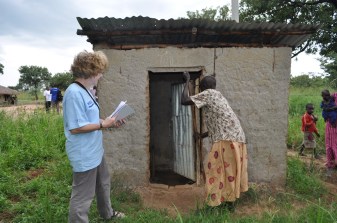
Ijan Janet Norah (old lady) demonstrating to Hazel Johns (WEDC) the challenges she goes through to use a pit latrine Photo: WaterAid / James Kiyimba

“Way back, I could not think of old age as a kind of disability. Now I am vulnerable, I face lots of challenges in squatting to use a latrine,” Pascal says.
Continue reading “Making sanitation and water accessible to people with disabilities in Uganda”

reflections on Everyone, Forever and lifecycle costing in Honduras

Stef Smits's avatarwater services that last

Anyone who works in the water sector cannot have missed the various consultations and debates on the post-2015 goals for water and sanitation, with the official one taking place here, but also good online discussions, such as the one on The Broker online. At the same time, technical proposals have been developed by working groups on water, sanitation and hygiene, as nicely presented here by my colleague Catarina Fonseca. The consensus in both the technical proposals and the discussions around them is the vision of universal coverage. The difference lies in the time frame: can it be achieved in our life time? Or is that just wishful thinking? Over the past year, this blog has paid lots of attention to the “Forever” side of “Everyone, Forever”, as Water For People have so compellingly called it. For the coming period expect more posts here on the…

View original post 1,071 more words

Water is a social problem, not just about health

Water Journalists- Africa's avatarWaterSan Perspective

Chris Mugasha
February 15, 2013

Water scarcity in some parts of Uganda has led to increased domestic violence in homes.

One of the worst affected is Bushenyi district in the southwestern region.

Wills Bashasha- the Bushenyi district chairperson says that the water shortage in the district had led to many women being beaten by their husbands, while others are allegedly raped as they travel far off places to collect water from shallow wells.

He now wants households with iron-roofed houses to construct water harvesting tanks as a measure to reduce on causes of domestic violence in homes.

Bashasha notes that it’s a shame to find people carrying jerry cans of water collected from far off wetlands and swamps despite the fact that such water could have been tapped during the downpour before flowing off to the wetlands.

He explains that the issue of lack of water in some homes has…

View original post 115 more words