From Colombia to Kyrgyz Republic and Uganda: how we help countries adopt state-of-the art information systems for better management of rural water services

How many countries have you worked in where an up-to-date national information system for rural water services is used for decision-making?

SUSANNA SMETS (World Bank/RWSN Sustainable Services) & ANTONIO RODRÍGUEZ SERRANO (World Bank/RWSN Mapping & Monitoring (re-blogged from the World Bank)

How many countries have you worked in where an up-to-date national information system for rural water services is used for decision-making?

How many well-intended monitoring initiatives did you encounter which are no longer being used?

Your answers are likely to be “few” and “many”, as government-led information systems to support planning and decision making for fragmented rural water services are not easy to develop, institutionalize, and sustain.

It is widely recognized that information systems are a key building block to achieve sustainable rural services delivery – a top development priority given that 8 out 10 people without basic water services live in rural areas, leaving 628 million people unserved. The good news is that a customizable, tried and tested solution already exists, so that countries can leap-frog a cumbersome development process and – more importantly – go through a fast learning curve when adopting and institutionalizing the Rural Water and Sanitation information System or “SIASAR” as their national rural sector monitoring and evaluation (M&E) system.

Following the initiative of the governments of Honduras, Nicaragua, and Panama, 11 countries in Latin America and the Caribbean are using the innovative open-data platform “SIASAR”. Different actors are using this tool for decision making, strategic planning, rural water performance monitoring, and for taking appropriate actions to prevent services from deteriorating, ensuring that water keeps flowing from the taps and communities receive timely support. SIASAR has been supported by the World Bank since its inception in 2010. In particular, Global Water Security and Sanitation Partnership (GWSP), a multi-donor trust fund housed within the World Bank’s Water Global Practice, provides funding to SIASAR.

Following the initiative of the governments of Honduras, Nicaragua, and Panama, 11 countries in Latin America and the Caribbean are using the innovative open-data platform “SIASAR”.

With its adaptability and multi-language capability, SIASAR has now been introduced in the Kyrgyz Republic (in Russian and Kyrgyz languages), and a pilot has also been planned in Uganda. Within the context of the Kyrgyz Republic’s national rural water program, supported by the World Bank-supported Sustainable Rural Water Supply and Sanitation Project, SIASAR has now gradually been introduced as the sector’s M&E system, covering data on system status and service provider performance for almost a third of its 1800 remote and mountainous villages. This will help to target investments and achieve the Kyrgyz Government’s vision to reach universal access by 2026.

With support from GWSP and the World Bank’s office in Colombia, the South-South Knowledge Exchange Facility helped bring Kyrgyz and Ugandan delegations together in Colombia. This knowledge exchange allowed them to receive peer-to-peer advice on how to introduce, roll out, and use SIASAR, and to learn about effective policy instruments, regulations, and institutional arrangements for sustainable rural water supply and sanitation service provision.

With support from GWSP and the World Bank’s office in Columbia, the South-South Knowledge Exchange Facility helped bring Kyrgyz and Ugandan delegations together in Colombia.

Specifically, the delegations learned about Colombia’s differentiated policy and regulatory instruments for rural areas, including tariff policies, water quality and environmental regulations, technical standards for water supply and sanitation, financing modalities for investments, and of course the SIASAR information systems for evidence-based decision making. Through field visits, the responsibilities of local and regional governments in rural service delivery in Colombia were better understood. The three-way translation between Spanish, English, and Russian put in place and the excellent collaborative spirit by all parties helped to overcome the communication challenge. These delegates took away important lessons on the adaptation process for SIASAR, such as:

  • SIASAR implementation and scale-up requires dedicated human and financial resources at the national and regional levels, including both sectoral and IT experts.
  • A clear roadmap for SIASAR adoption is necessary, bringing in multiple partners to support implementation. Anchoring in national legislation and fostering linkages with other national statistical information systems is critical.
  • SIASAR can cater analysis to the need of different actors and increases transparency and accountability of service provision.
  • SIASAR has helped to inform and influence investment programs to close the urban-rural service gap, accompanied by a range of measures to support rural service providers.

Depending on where they were in the adoption of SIASAR, the Kyrgyz delegation was keen to grasp the process of institutionalization, while the Ugandans were exposed to the range of capabilities and practical first steps that have now led to a first pilot, supported by the Uganda Integrated Water Management and Development Project (IWMDP).  

Seeing solutions in action can be a great motivation. The knowledge exchange with Colombiastimulated learning and encouraged officials from Kyrgyz and Uganda to try and adopt solutions to their own circumstances. A guide is now available that can help any country go through the process and prepare for the steps of adopting SIASAR.

SIASAR has proven to be an effective tool for improving the monitoring, evaluation, planning, and coordination of water supply and sanitation services in participating countries in Latin America and beyond. Through knowledge exchange activities like this and future GWSP technical assistance, we hope to support more countries in adopting the system and joining the initiative, while we commit to continuous improvement of the capabilities of the system. 

How a radio talk show is promoting WaSH in Northern Uganda

This is a guest blog by Justine Olweny, a Ugandan WASH entrepreneur and resource centre founder. You can find out more about his activities here.

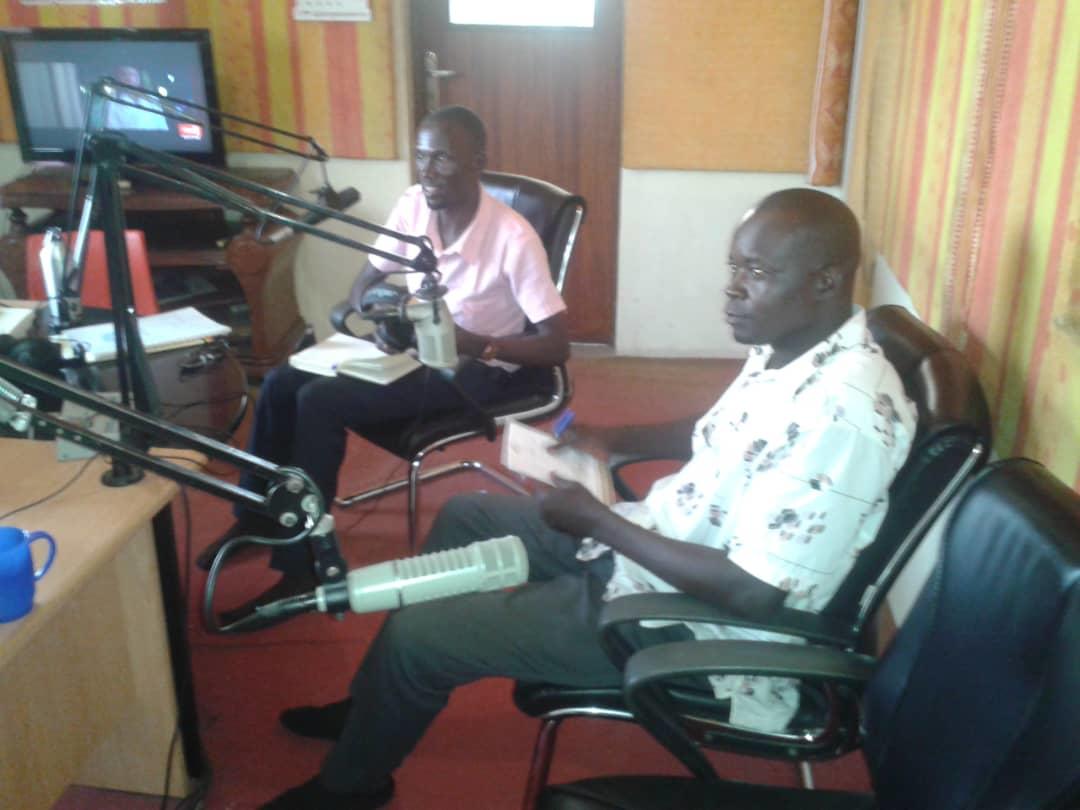
“YOT KOM LONYO” (meaning “Health is wealth”) is a WaSH campaign radio program talk show conducted every Thursday from 16:00–17:00 hours East African Time. It encourages the involvement of local entrepreneurs, school leaders, pupils, politician, district technocrats, and partner representatives on water, sanitation and hygiene (WaSH) promotion discussions. It has promoted the utilisation and ownership of WaSH products among the communities of Kitgum District.

The weekly talk show was started in September, 2018 and has so far covered 7 WaSH topics within 22 episodes.This involves the engagement of eight stakeholders within the region being represented in at least two sessions. This talk show was motivated by the need for community ownership in safe WaSH infrastructures created by difference agencies, including the government.

Mightyfire 91.5FM has a total coverage of about 1,500,000 listeners in Northern Uganda. It has made significant progress in reaching out to the majority of refugees from South Sudan in the local language Acholi, which is spoken by them. The intention was to prepare for the rainy season, which often leads to an increase in the prevalence of waterborne diseases, including cholera, through the production of short radio spots to promote hand-washing with soap before eating and boiling drinking water to avoid illness.

This 6-month partnership between Mightyfire 91.5FM and Water Access Consulting is a pilot project to explore the possibilities of promoting hygiene and sanitation products and services led by the communities of Kitgum District. It was inspired by the webinar From Beneficiaries to Business: Promising findings from customer-centered approaches to sustainable water services.

Achievements:

  • Improved pit toilets (DuraSan and the SaTo pan supported by the “Sanitation as a business” programme of Water for people Uganda) are being constructed by landlords, while demand for improved pit toilets has increased together with the services provided by the pit-emptying gulpers team of the Municipality.
  • The radio programme materials were developed in accordance with the context, with compelling radio programmes that engage listeners in good hygiene practices, and with references to Lifewater mWaSH and UNHCR WaSH manuals.

Learnings:

  • The materials and topics discussed are generated by the audience themselves, for example during a school Q&A session, and during interviews
  • The audience pay a lot of attention to jingles, and they memorise short spot messages instead of the entire radio talk show
  • It is very motivating for both parents, elders and pupils to listen to their recorded debate play over the radio.

What do you think? How can we create more WaSH service demand using media? Do you have any examples of good WaSH campaigns in the media, that have contributed to behavior change in WaSH? Please share your experiences below.

(Photo credit: Water Access Consulting Archive)

The Top 10 RWSN Blog Posts in 2018

The RWSN Blog provided us again with some exciting posts in 2018. From sustainable water resources and community management, to solar-powered water pumping, to (manual) borehole drilling, and to rural water services – the range of topics offers diverse and insightful perspectives on rural water supply issues.

Here are some of the most popular blogs in 2018:

  1. Sustainable water resources management in Sri Lanka: present situation and way forward
  2. Three common myths about solar-powered water pumping
  3. “The borehole is not a madman” 3 reasons why Community Based Management demands a rethink
  4. Manually Drilled Wells: Providing water in Nigeria’s Megacity of Lagos and beyond
  5. Borehole drilling supervision in Malawi: why it is essential, not optional
  6. For rural Tanzanians, water has a social value too
  7. Tracing a path to sustainable rural water services in the Democratic Republic of the Congo
  8. Still barking up the wrong tree? Community management: more problem than solution
  9. Sharing experiences of data flows in water and sanitation – some reflections from AGUASAN Workshop 2018
  10. Achieving Professional and Sustainable Drilling in Madagascar? Yes, we can!

Find more blog posts

Find the newest blog posts here: RWSN Blog

Write your own Blog posts on rural water supply

Feel free to send your text and one or more pictures (if possible) in an e-mail with the subject “RWSN Blog Post” to ruralwater@skat.ch


The Politics of Water 3: Area Mechanics in Malawi

by Naomi Oates, re-posted from University of Sheffield

Competing narratives surround the role of ‘area mechanics’ in Malawi

In November 2017 I started my ‘politics of water’ blog as an outlet to share experiences and findings from my research in rural Malawi on water governance and service sustainability.

The first instalment describes my initial impressions of Balaka District while the second explores the relationship between extension workers and rural communities.

This might have left you wondering – what about everyone else?


Area Mechanics receive hands-on training in water point repairs (Author’s own)

Water services in Malawi are decentralised, at least in theory.  This means two things. Firstly, district councils, together with district water offices, are mandated to develop and monitor water infrastructure in rural areas.

Secondly, communities are expected to maintain and repair their water points with minimal external assistance. For more serious problems, local ‘area mechanics’ are their first port of call, followed by the district water office.

In reality, district water offices are severely under resourced, there are currently few area mechanics, and the effectiveness of community-based management varies considerably. However, where they are present, area mechanics are thought to play an important role in keeping water points functioning.

Area Mechanics: volunteers or entrepreneurs?

So what is an area mechanic? This sounds like a simple question, but the answers are complex and contradictory.

The area mechanics Thoko interviewed in Balaka for her MSc research tended to consider themselves, foremost, as volunteers working for the greater good of the community. After all, they were selected from the local community and have strong social ties with the people they serve. An area mechanic may be a relative, a neighbour or a fellow churchgoer, even the village headman himself. Trustworthiness was emphasised by communities as an important criteria.


This training manual describes area mechanics as ‘artisans in advanced hand pump repair operating on a payment basis’ (GoM 2015)

The depiction of area mechanics as volunteers has been echoed in my own conversations with extension staff and NGO workers, but in combination with another term – entrepreneur. According to national policy, area mechanics are meant to operate as independent businesspersons. They are given training and a few basic tools, after which they are expected to make a small profit to sustain their operations. They are also encouraged to sign written contracts with communities to clarify payment for services.

This model is clearly aimed at economic viability and is meant to incentivise area mechanics by providing them with an income. Arguably, the model has failed to gain traction locally because it ignores the social context in which area mechanics operate.

A third view is that area mechanics are integral to formal water governance arrangements – in other words part of, or plugging a gap in, the government’s extension system. This may not be stated explicitly, but is implicit in the use of government issued ID cards.

To give another example, area mechanics are sometimes (but not always) introduced to communities by a government representative in order to establish their legitimacy. Several of the area mechanics Thoko spoke to wanted their role to be formalised to enable them to negotiate fees with communities, or conversely in the hope of receiving material and financial support from government.

The ambiguity of water mechanics

Despite appearances, none of these narratives is mutually exclusive, and they may be employed at different times depending on the context. As one extension worker explained to me:

“Area mechanics are entrepreneurs by design and should make communities aware of that. They are supposed to have a signed agreement. The area mechanic needs to be paid, a little.”


Area mechanics often prefer working as a team – two heads being better than one! (Author’s own)

He then went on to clarify:

“It is not payment as such but a token of appreciation. It is up to them if they want to work for free. However they shouldn’t deny assistance to a Water Point Committee just because they don’t have money.”

The ambiguity surrounding area mechanics can be confusing and could be viewed as a failure of policy (or its implementation). But, in my view, that conclusion would be overly simplistic and misses the point.

The co-existence of these different narratives, or interpretations of policy, leaves room for negotiation and pragmatism. These are arguably important ingredients for success, especially when adapting policies to local realities. In short, the role of area mechanics in Malawi’s water governance system is not yet set in stone.

In addition to my PhD fieldwork this blog draws on previous work by the authors under the UPGro Hidden Crisis project. Check out our report on the political economy of rural water supplies in Malawi.

RWSN at the UNC Water and Health Conference: Where Science Meets Policy

The Water and Health Conference: Where Science Meets Policy, organized by the Water Institute at the University of North Carolina (UNC), is one of the most important conferences for WaSH professionals. This year the conference has not only explored the interactions between drinking water supply, sanitation, hygiene, water resources and public health, but put also a strong emphasis on rural water supply in developing countries. Researchers, practitioners and policy-makers had the chance to present and lively debate

by Sandra Fuerst and Sean Furey (Skat Foundation)

The Water and Health Conference: Where Science Meets Policy, organized by the Water Institute at the University of North Carolina (UNC), is one of the most important conferences for WaSH professionals. This year the conference has not only explored the interactions between drinking water supply, sanitation, hygiene, water resources and public health, but put also a strong emphasis on rural water supply in developing countries. Researchers, practitioners and policy-makers had the chance to present and lively debate on following topics:

  • Measuring Progress Toward Sustainable Development Goal (SDG) Targets
  • Water Scarcity
  • Rural Water Supply
  • WaSH Equity and Inclusion
  • WaSH in Emergencies

At this year’s conference, the RWSN and its partners have convened two side events, providing water professionals an interactive space for engaging on cutting-edge topics of rural water supply. These sessions translated the “virtual RWSN DGroups into real life discussion groups” as Stef Smits (IRC), the chair of the first side event, phrased it. The participating water experts shared their experiences and developed exciting ideas with their peers for challenging rural water contexts.

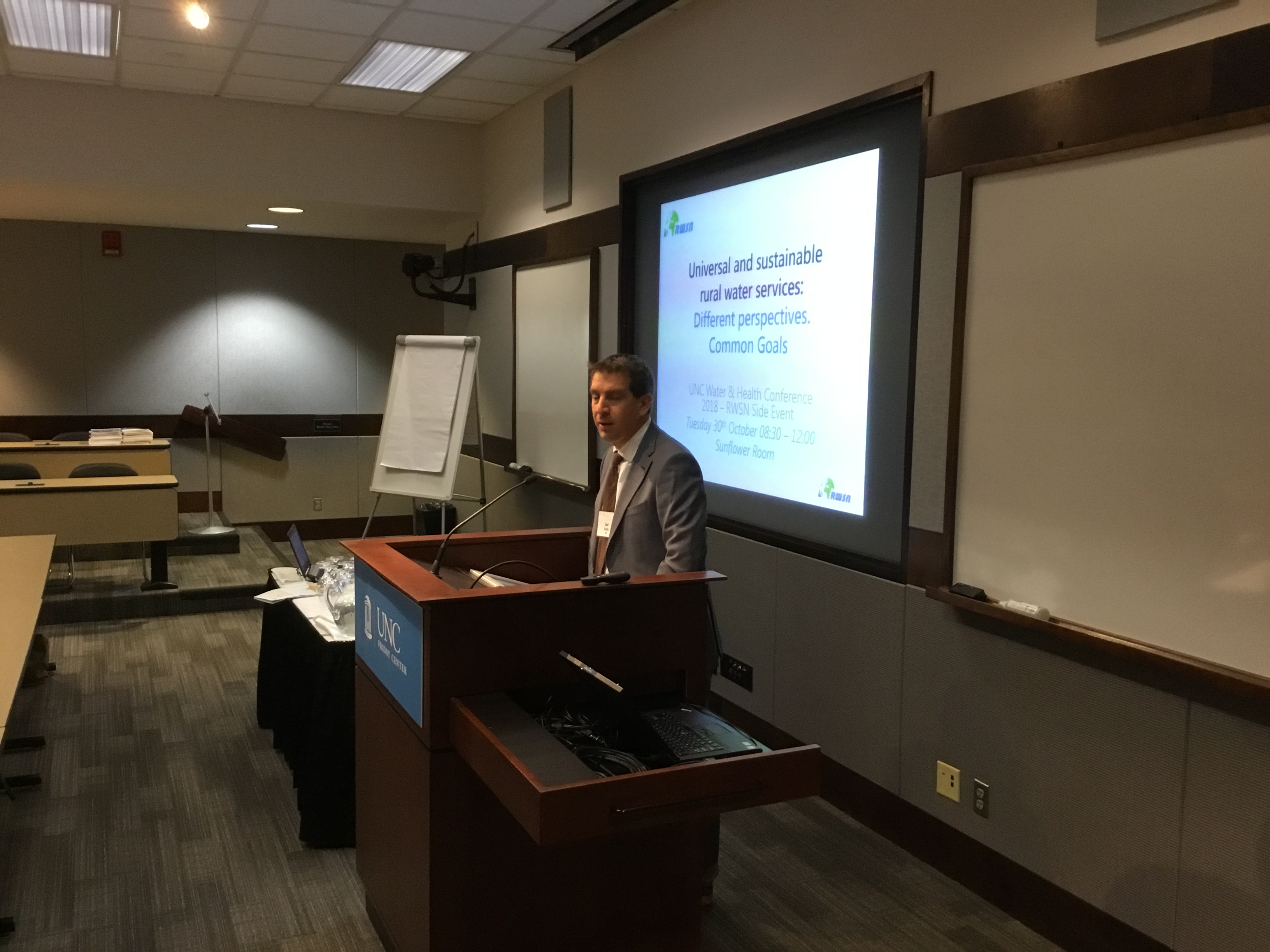
Universal and Sustainable Rural Water Services: Different Perspectives, Common Goals

In the first side event, participants were invited to understand two major concepts to apply them later through group discussions in a case study of an WaSH implementation organisation, HYSAWA, Bangladesh, presented by their Managing Director, Md. Nural Osman.

Md. Nurul Osman (HYSAWA)

Sara Ahrari presented the NGO perspective of how organisations, like Simavi, use monitoring and data systems to promote Social Accountability and the holding duty-bearers to account when it comes to the Human Rights to Water and Sanitation. Miguel Vargas-Ramirez from the World Bank and Ellen Greggio from WaterAid presented then the development partner perspective on how data and monitoring can be used to raise the capacity of governments and service providers to deliver sustainable rural WaSH services, particularly rural water supply. This included on-going work to develop benchmarks for rural water service delivery, which WaterAid is testing in Myanmar.

After the break, Elisabeth Liddle from Cambridge University, and Prof. Rob Hope from Oxford University, gave the research perspective on how data and monitoring is enabling them to generate deeper insights into why rural water supply systems fail and how to develop new ways of making them more sustainable.

After the concepts have been introduced, the participants applied them in smaller groups to the HYSAWA case study in Bangladesh. This case study was presented by HYSAWA (Hygiene, Sanitation and Water Supply) to come up with suggestions and advice on how his organisation can improve the quality and sustainability of their rural WaSH interventions. The audience debated questions around:

  • Who is responsible for monitoring and data collection? Who is accountable and feels responsible for what? Those who design the system?
  • Who is responsible for the service provision of water in rural areas? And who needs to be hold accountable for that?
  • What are the drivers to feeling responsible?
  • What are the services that needs to be done?
  • How do the processes need to be managed?

Stef Smits (IRC)

Stef Smits summarised the debates during this session on three levels:

Who? The answer that communities and local governments should be accountable for the service provision of water in rural areas seemed to be too easy as in fact it is not clear at all. The role of service providers in many contexts is not very well defined, also not in legal terms. Accountability is often spread over several layers. For example, minor operation and maintenance (O&M) services can be done on community level, while major O&M services can be provided through public services. Then the levels of accountability also need to be differentiated between service provider and service authority. This first differentiation will help to define who is responsible for what and will help the service authority to hold the service provider accountable. As soon as the roles of different stakeholders are clearly defined, it can be defined more specifically who needs to collect the data. The collection of data then needs to be spread over different levels, from household, community, service provider to authority level.

What? The debate started around the functionality of rural water supply devices and has shown that there is not a simple answer of ‘yes’ or ‘no’ to functionality. Functionality needs to be distinguished between functional devices and functional services (i.e. O&M services). This led to the question how functionality should be measured and which other indicators should be taken into account. Should we bring water quality in as an indicator? Clearly, financial indicators are necessary. As the trend to use indicators and monitoring tools is increasing among service providers and governments in rural areas, it becomes increasingly necessary to define clear indicators for universal rural water services. Based on that development, we can start to understand rural water as a systemic issue.

How? The identified need to define clear indicators on different levels, raised the question of how the process of developing monitoring and evaluation (M&E) systems should be managed. Even though governments were identified to lead this process, NGOs could support to trigger it. However, if a NGO has developed a working M&E systems, it cannot be simply handed over from a NGO to the government, without a well-planned transition phase. It also needs to be taken into account who “the government” is and on which level the government operates. Data and M&E systems will at the end always need a sector development approach.

Pipe Dream or Possible: Reaching the Furthest Behind First in the WASH Sector? – RWSN Side Event 2

The second side event was convened by RWSN (Simavi, Wateraid) with London School of Hygiene & Tropical Medicine and World Vision. During this session, the participants developed human-centred solutions for “Reaching the Furthest Behind First” and “Leaving No One Behind” in the WASH sector.

I7.jpg

The participants worked in several groups on different case studies of extremely vulnerable people (i.e. disabled pregnant child) that are exposed to extreme hazards in their environment (i.e. arsenic contamination of groundwater).

In several steps, the participants developed possible solutions based on their field of expertise: In a first step, they illustrated the social, cultural, physical, political and legal barriers that the imaginary persona faced, regarding their social inclusion. Then they created inspirational ideas of possible solutions to these barriers. The different options were heavily discussed before choosing one or more solutions. To illustrate the actions and stakeholders needed to implement these solutions, a story board was created by each group. Finally, the persona, storyboard and possible solution were presented in pitches to all participants.

IMG_20181101_111922-v2


The two side events have been great examples of how the RWSN works as its best: “Taking concrete examples and bring them together with key concepts from research and practice. This is the richness that RWSN provides: Linking practical questions with conceptional frameworks (Stef Smits)”.

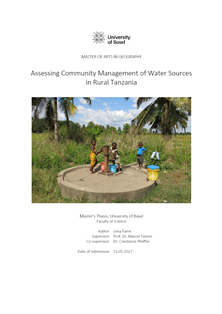
For rural Tanzanians, water has a social value too

by Lena Farré, recent Post-Graduate from University of Basel, Switzerland, summarises the findings of her Masters degree thesis

This exploratory case study carried out in the Kilombero Valley in southwestern Tanzania shows the mechanisms and challenges communities of a rural village face while seeking water access and maintaining their water pumps. The Tanzanian Government and non-governmental organizations follow a Demand Responsive Approach (DRA). According to the water source providers, communities should demand, own, and maintain their water sources as well as contribute to implementing costs in cash or labour. This participatory approach has been criticised to shift the states responsibility to provide water service towards the community level. To design better policies for interventions that will ensure a sustainable and equitable water provision, it is necessary to understand how communities themselves perceive and deal with this implemented community management system. Here, three key findings are presented, which must be taken stronger into consideration when formulating recommendations for practitioners, since they have been found in other case studies as well.

1.      Women bear the most time and physical strength consuming tasks

While men mostly get the leading position within a water source committee, the role of the secretary or treasurer is mainly given to women. Women are responsible for the house-to-house monthly fee collection from the families using the water sources. Most social conflicts between the committees and the water source users are linked to the monetary contribution. This results in women being directly exposed to these conflicts and therefore less willing to participate actively in the committees.

2.      Mutual mistrust and low transparency

The vulnerable livelihood of the community makes water source users and committee member mistrust each other concerning the payment or safe guarding of the maintenance fees. The need for a sudden financial resource, was mentioned as a reason why water source users doubted that committee members put the entire collected amount of cash onto a bank account. Furthermore, the ability of the committees to control and record the payments of the water source users are restricted due to different reasons: A lack of administrative and accounting skills and remoteness of widely dispersed settlements challenges communication flows. The organization of meetings between water source committees and water users is therefore also difficult. This low transparency fuels mutual mistrust.

3.       Social mechanisms to equalize water access exists

Sanctions such as imposed fines or denied access are assumed to push users to pay their monthly fees. However, they were rarely applied. The committee members often grant exemptions after evaluating the socio-economic situations of the water users. Conflicts between the committees and the users occurred if a household is assumed to be able to pay but refuses it. Private water sources within the community caused conflicts as well. Households who purchased a private one feel under pressure to share it with their neighbours. The system of sanctioning community members for not contributing the payment fees or getting a private water source correspond to market rules. However, water is perceived as a free good by many people. Hence, denying water access to a fellow member of the community transgresses cultural norms and behaviour. Sharing water and preventing someone from getting a private water source, are social mechanisms to equalize water access on the village level.

Behaviour based on the social value of water need to be acknowledged

If a sustainable water source management shall be achieved – community mechanisms have to be understood and acknowledged. Sharing water, conflict avoidance and other behaviour which equalizes access amongst the community members can be seen as obstacles towards the community management of water sources within a Demand Responsive Approach. However, it is suggested to evaluate these social structures positively, allowing the poorest of the community to access water. The government’s responsibility to provide water access and to accomplish the Human Right to Water for its citizens should nevertheless not be denied.

The study showed that the potential of collectively managing water sources based on a barely existing consumer culture must be questioned. Additionally, it is recommended to focus more on the understanding of the social values that water has within a rural community. How they look like in more detail within a rural, Tanzanian community is presented in the study.

CM_in_Tanzania

Download the Thesis report from the RWSN website

Have you recent done research on rural water supply and would like it featured through RWSN? Contact the Secretariat for details.

Ops Talks: Total Cost of Services

re-blogged with thanks from Water for Good

sub·si·dy

A sum of money granted by the state or a public body to help an industry or business keep the price of a commodity or service low

— Oxford English Dictionary

Rural Water Services ARE Subsidized

Even the United States has subsidies for rural water services. This doesn’t make something unsustainable. However, it does create a critical need for clarity of the total cost of the services, how it is funded, and how it will continue to be funded. There also needs to be a good definition of what the costs are (CapEx vs OpEx vs CapManEx). Thankfully our friends at IRC have laid this out here.

Vers des services d’eau durables en milieu rural en République Démocratique du Congo

par Gian Melloni, Maria Livia De Rubeis et Kristina Nilsson du Consortium WASH RDC

En 2013, l’idée que les communautés rurales payent pour les services en eau était relativement nouvelle en RDC : dans le secteur WASH il y avait le sentiment que le contexte était trop fragile pour que la gestion communautaire des services WASH ruraux soit efficace. Mais, avec des taux d’accès à l’eau très limités, une population en rapide croissance et des infrastructures hydriques très peu fonctionnelles, quelque chose devait bien changer.

Lorsque le Consortium WASH RDC a été inauguré la même année, il n’y avait pas beaucoup d’expériences passées dans le pays qui pourraient témoigner de la capacité et volonté des communautés rurales à payer pour l’eau. L’ambition du Consortium WASH RDC était donc élevée : cinq ONG internationales lançant un programme de six ans en appui aux communautés locales pour la gestion financièrement viable des services WASH dans la RDC rurale. Financé par UK-Aid, le Consortium WASH RDC réunit les compétences de son agence lead Concern Worldwide et d’ACF, ACTED, CRS et Solidarités International pour assister plus de 600 communautés rurales et 640000 personnes dans sept provinces du pays.

Cinq ans plus tard, avec une multitude de données désormais à notre disposition, nous avons voulu répondre à certaines questions clés : dans quelle mesure les communautés rurales appuyées par le Consortium réussissent-elles à gérer les services hydriques d’une manière financièrement autonome? Et qu’est-ce qui fait le succès d’une communauté?

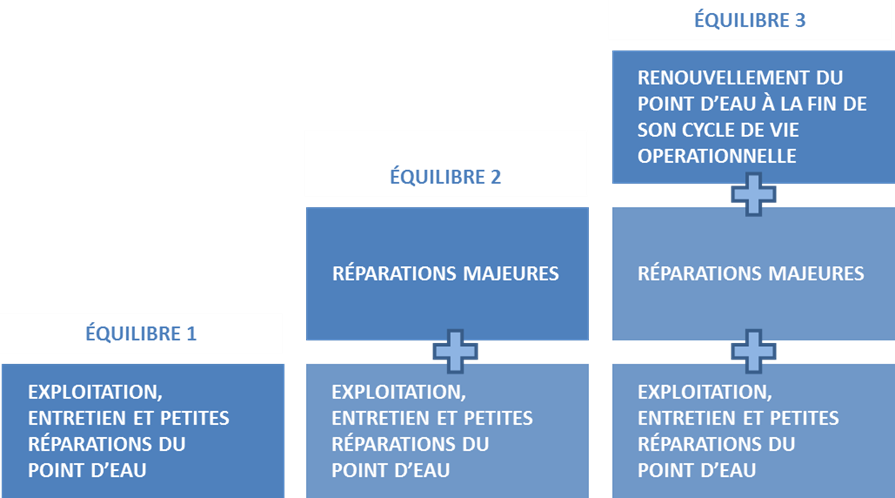
Le Consortium WASH RDC a développé une méthodologie inspirée des « Life-Cycle Costs » de l’IRC, que nous avons appelé «l’Approche Economique». Nous aidons les communautés à développer des compétences managériales, financières et techniques pour que leurs infrastructures WASH restent fonctionnelles longtemps après la construction, en identifiant trois niveaux progressifs de succès (ou « Equilibres ») dans la couverture des coûts liés aux points d’eau au fil du temps :

RDC1
Figure 1. Les trois Equilibres utilisés par le Consortium WASH RDC

Notre objectif est que les communautés réunissent suffisamment de fonds pour couvrir au minimum les coûts de l’Equilibre 1, avec les communautés les plus engagées atteignant l’Equilibre 2 ou 3. Tels fonds sont collectés et gérés par des comités élus par les communautés et formés par le Consortium WASH RDC. Pour créer les conditions pour la réussite et éviter toute logique de « don gratuit », nous clarifions aux communautés dès le début que nous les appuyons avec l’installation du point d’eau seulement si elles démontrent leurs engagement et capacité à prendre en charge les coûts de gestion du point d’eau.

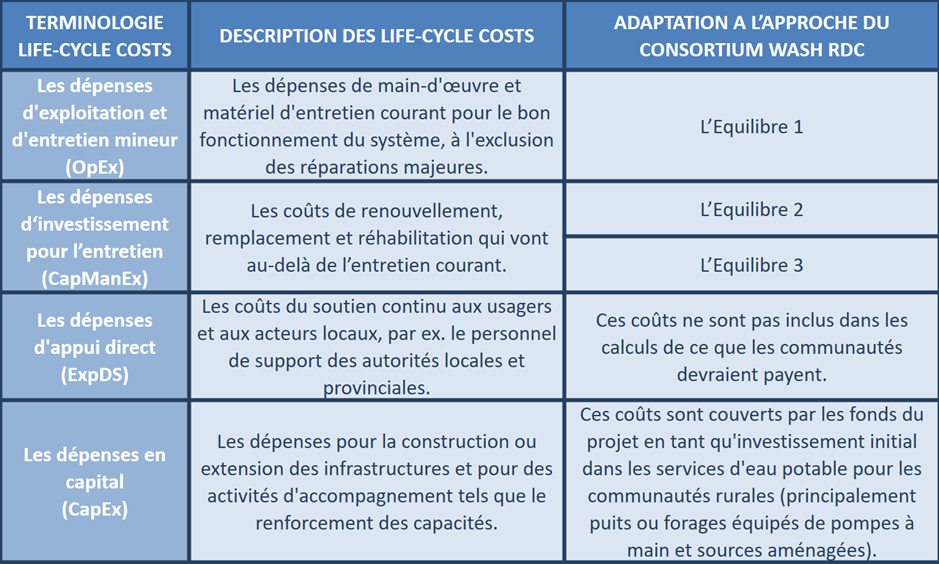
Les trois Equilibres d’Approche Economique ne correspondent pas exactement aux catégories des « Life-Cycle Costs », et certaines modifications ont été apportées en fonction du contexte de la RDC rurale. Le tableau ci-dessous montre une approximative conversion de ces principes en les Equilibres du Consortium WASH RDC :

RDC2
Figure 2. L’adaptation des « Life-Cycle Costs » par le Consortium WASH RDC

Et cette Approche Economique, fonctionne-t-elle? Au bout de cinq ans, nos données montrent qu’elle peut fonctionner même dans des contextes difficiles : jusqu’à présent, environ deux tiers des petites communautés rurales appuyées par le Consortium WASH RDC ont réussi à atteindre un certain degré d’autonomie financière et de pérennité. C’est-à-dire, elles ont atteint au moins l’Equilibre 1. Compte tenu des défis auxquels ces communautés (généralement d’autour de 1000 personnes) sont confrontées dans cet environnement, il s’agit d’un résultat provisoire encourageant.

Nous avons identifié des modèles opérationnels qui aident les comités WASH à atteindre ces Equilibres. Les comités qui ont choisi des sources de revenus diversifiées, en associant les contributions des ménages et les activités génératrices de revenus, réussissent nettement mieux que les comités qui ne comptent que sur les contributions des ménages. Les communautés souvent apprécient ce modèle et voient l’investissement dans des activités génératrices de revenus comme un moyen de protection contre le risque de détournement de fonds. Dans l’ensemble, les activités génératrices de revenus semblent bien s’intégrer dans la gestion communautaire des services WASH dans la RDC rurale.

Dans un contexte si fragile, une grande majorité des communautés décident d’identifier des personnes ou des groupes particulièrement vulnérables et de leur offrir l’exemption du paiement des frais communautaires d’eau. Les communautés qui adoptent cette pratique ne parviennent pas moins à atteindre l’autonomie financière que les communautés qui n’offrent pas d’exemptions. Il s’agit d’une constatation importante en particulier dans une prospective de développement sensible aux besoins des plus pauvres, soulignant que l’accès équitable à l’eau n’est pas en contradiction avec la pratique de payer pour l’eau ou avec le but de la pérennité des services.

Egalement, les communautés qui choisissent de rémunérer certains membres du comité d’eau semblent renforcer leur réussite dans l’atteinte des Equilibres d’autonomie financière les plus élevés. Par exemple, certaines communautés paient un petit montant à la personne qui enregistre les usagers ou qui s’occupe de la collecte des frais d’eau. Alors que jusqu’à présent seulement une minorité de communautés a adopté un tel système de rémunération, leur succès dans l’atteinte des Equilibres 2 et 3 suggère qu’une forme de gestion semi-professionnalisée peut devenir plus efficace que le pur bénévolat.

Tout cela montre que les acteurs de développement, même dans des contextes difficiles, peuvent et doivent concevoir des interventions WASH visant des services à long terme qui puissent aller au-delà des résultats immédiats. Egalement, les décideurs peuvent bien adopter le principe de non-gratuité du service hydrique, tout en conciliant la viabilité financière avec des politiques d’inclusion et en faveur des plus pauvres. A travers le Consortium WASH RDC, nous avons appris la leçon que les communautés rurales en RDC sont prêtes à s’engager pour surmonter leurs difficultés et à développer des capacités en gestion durable des services d’eau. Cela ne se produit pas facilement ou par hasard, mais grâce à une programmation soigneusement conçue et mise en œuvre qui valorise les communautés locales.


Photo : Un comité de gestion d’eau à Manono, Tanganyika, RDC, montre les cahiers comptables qu’il utilise pour suivre les coûts et les revenus du point d’eau communautaire. Source: Consortium WASH RDC, 2016.


Le Consortium WASH RDC est un programme de Concern Worldwide avec la participation d’ACF , ACTED , CRS et Solidarités International, financé par UK-Aid. Veuillez trouver plus d’infos en français et en anglais sur consortiumwashrdc.net. Gian Melloni est le directeur du Consortium WASH RDC et vous pouvez le contacter à gian.melloni@concern.net. Maria Livia De Rubeis est la responsable de communication, plaidoyer et apprentissage. Kristina Nilsson est la responsable du suivi et évaluation. Les opinions exprimées par les auteurs pourraient ne pas refléter les opinions de Concern Worldwide ou des autres organisations citées.

Tracing a path to sustainable rural water services in the Democratic Republic of the Congo

by Gian Melloni, Maria Livia De Rubeis, and  Kristina Nilsson of the DRC WASH Consortium 

In 2013, the idea of rural communities paying for water services was relatively new in DRC: there was a belief in the WASH sector that this context was too fragile for community management of WASH services to be possible.Yet with extremely low access rates, a fast-growing population, and especially poor functionality of water infrastructure, something needed to change.

When the DRC WASH Consortium started that same year, there was no past experience in the country which could confirm rural communities’ willingness or ability to pay for water. The DRC WASH Consortium’s ambitions were high: five INGOs launching a six year programme to support local communities in managing and financially sustaining WASH services in rural DRC. Funded by UK-aid, the DRC WASH Consortium gathered the know-how of lead agency Concern Worldwide with ACF, ACTED, CRS, and Solidarités International to work with more than 600 rural communities and 640,000 people across seven provinces.

Five years later, with a wealth of project data at our disposal, we wanted to answer some key questions: To what extent do Consortium-assisted rural communities succeed in managing their water services in a financially self-sufficient way? And what makes a community successful?

The DRC WASH Consortium developed a methodology inspired by IRC’s Life-Cycle Costs, which we call the “Economic Approach”. We support communities in developing managerial, financial and technical skills to keep their WASH infrastructure functioning long after construction, identifying three progressive levels of success in covering the costs associated with water points over time:

Figure 1 DRC
Figure 1. The three Levels used by the DRC WASH Consortium

The objective is that communities raise sufficient funds to cover Level 1 costs as a minimum, with the most committed communities reaching Levels 2 and 3. These funds are collected and managed by elected committees, trained by the DRC WASH Consortium. To lay the foundations for this success and to avoid expectations of handouts, we’ve said from the start: we will support communities by installing water points only if they prove their commitment and ability to take care of water point management costs afterwards.

Our three Economic Approach Levels do not exactly match with the Life-Cycle Costs categories, and some modifications have been made according to the context in rural DRC. Here you can see an approximate conversion table showing how the DRC WASH Consortium adapted these principles:

Figure 2 DRC
Figure 2. Adaptation of the Life-cycle costs by the DRC WASH Consortium.

And does this Economic Approach work? After five years, our program data shows it can, even in this difficult context: so far, about two thirds of the small rural communities assisted by the DRC WASH Consortium have succeeded in achieving a degree of financial self-sufficiency and sustainability –that is to say, have reached at least Level 1. Given the challenges these communities (typically of only around 1,000 people) in this fragile environment face, this is an encouraging provisional result.

We’ve identified some operational models which support WASH committees in reaching these Levels. Committees that have chosen diversified revenue streams, combining household collections with revenue-generating activities, are markedly more successful than committees relying only on collections. This approach is often welcomed by communities who see investments in revenue-generating activities as a means to protect finances against misappropriations. Overall, revenue-generating activities seem to fit well with community management of WASH services in rural DRC.

In such a fragile context, most communities choose to identify people or groups who may be particularly vulnerable and offer them exemptions from paying community water fees. Communities who do so are no less successful in reaching the Levels of financial self-sufficiency than communities who do not offer exemptions. This is an important finding particularly in light of pro-poor and needs-based principles of development, underlining that aiming for equitable access isn’t at odds with the practice of paying for water or the goal of sustainable services.

Communities opting to remunerate some water management committee members also seem to improve their success in reaching higher Levels of financial self-sufficiency. For example, some communities pay a minimal amount to someone who keeps records of water users or who collects payments. While so far a minority of communities have opted for these remuneration systems, their success in reaching especially Levels 2 and 3 suggests some form of semi-professionalised management can be more effective than pure volunteerism.

Overall, this shows that development actors even in difficult contexts can and should design WASH interventions to focus on longer-term services, looking beyond just immediate achievements. It shows policy-makers can embrace water service payments by users even while balancing financial viability of services with pro-poor and inclusive policies. We have learned through the DRC WASH Consortium that rural communities in DRC are willing to invest to overcome challenges and can develop the capacities to manage water services in a sustainable manner. This doesn’t come easily or by chance, but through carefully designed and implemented programming which empowers local communities.


Feature photo: A WASH management committee in Manono, Tanganyika province, DRC, looks at the financial records they keep to monitor costs and revenues for managing their community water point. Source: DRC WASH Consortium, 2016


The DRC WASH Consortium is a programme of Concern Worldwide in consortium with ACF, ACTED, CRS, and Solidarités International, and funded by UK-aid. More information – in both French and English – can be found at consortiumwashrdc.net. Gian Melloni is the Director of the DRC WASH Consortium and can be reached at gian.melloni (at) concern.net. Maria Livia De Rubeis is the Communication, Advocacy and Learning Manager. Kristina Nilsson is the Monitoring and Evaluation Manager. The views expressed by the authors may not reflect the views of Concern Worldwide or of any of the organisations mentioned.

UN-Water report: SDG6 on Water and Sanitation will not be achieved by 2030 at current rates of progress

UN-Water has released a new report on Water and Sanitation ahead of the High-level Political Forum for Sustanainable Development (HLPF) which presents, for each target, the latest data available for the Sustainable Development Goal (SDG) 6 global indicators. The report seeks to inform discussions among Member States during the HLPF (9 July -18 July 2018) in New York. The HLPF Forum will review progress especially on G6, G7, G11, G12, G15 and G17; you can see the Official Programme here.

The key message of this report is that the world will miss the SDG6 targets by 2030 at current rates of progress. It also highlights that only 50 percent of countries have comparable baseline estimates for most SDG 6 global indicators, making it difficult to track progress. It is essential to “harmonize methods and standards”, and establish a common understanding of how to assess Means of Implementation (MoI) across SDG 6. In addition to this report, UN-Water has also set up a webpage with examples of countries sharing their experiences.

RWSN had provided some comments on the draft report which was made available by UN-Water earlier this year. By and large these comments still hold – you can find out about what we said here and our take on how the report addresses sustainability of services, accountability, self-supply, capacity development, water and energy, groundwater and public participation.

So, what does the final report say? It compiles data and information available on the SDG6 Targets, including:

  • Target 6.1: Achieve access  to  safe  and  affordable  drinking  water: There are still 844 million people who lack access to basic water services, and 2.1 billion people who lack water that is accessible, available when needed and free from contamination. The report highlights that extending access to safe drinking water for all is a “huge challenge” that will not be achieved if there is no increase in “investment from governments and other sources” and a “strengthening in institutional arrangements” for managing and regulating drinking water.
  • Target 6.2: Achieve access to sanitation and hygiene and end open defecation: There are still 2.3 billion people who lack access to basic sanitation services, and 4.5 billion people who lack safely managed sanitation services. Only 27 per cent of the population in least developed countries has access to soap and water for handwashing. Extending universal access to sanitation and hygiene won’t be achieved if there is not an increase in “investment and a strengthening of the capacity of local and national authorities” for managing and regulating sanitation systems.
  • Target 6.3: Improve water quality, wastewater treatment and safe reuse: Freshwater pollution is prevalent and increasing in many parts of Latin America, Africa and Asia. The lack of water quality monitoring in many parts of the world does not allow for an exact global estimate of water pollution.
  • Target 6.4: Increase water-use efficiency and ensure freshwater supplies: Nowadays more than 2 billion people live in countries experiencing high water stress. The agriculture sector is the largest user of freshwater; it uses 70 per cent of global water withdrawals. In the report, some techniques to save water have been presented like “increasing productivity of food crops”, “improving water management practices and technologies”, “growing fewer water intensive crops in water scarce regions”, “reducing food loss and waste”, and “importing food grown from water rich countries”.
  • Target 6.5: Implement integrated   water   resources   management   (IWRM)   including    transboundary    cooperation: While all countries have at least started implementing various aspects of IWRM, only modest progress has been made in terms of implementing a fully integrated approach. The average national proportion of transboundary basins covered by an operational arrangement is only 59 per cent.
  • Target 6.6: Protect and restore water-related ecosystems: current baseline data of the indicator “do not allow for a proper picture of the state of freshwater ecosystems”, which is why further detailed data including “quantitative, geospatial and qualitative” data are necessary.

The report also looks at the targets related to the means of implementation of SDG6:

  • Target 6.a: Expand international cooperation and capacity-building: 80 per cent of Member States have insufficient finance to meet national WASH targets. The current indicator based on ODA (Official Development Assistance) does not reflect all elements of the target. That is why it is necessary to complement with additional information relating to “capacity development, human resources and other elements”.
  • Target 6.b: Support stakeholder participation: In order to empower marginalized groups and sustainable service delivery, “local communities have to participate in water and sanitation management”. But even if the current indicator monitors the existence of policies and procedures for local community participation, it does not show if “the participation is genuine or meaningful”. This links to the recent report published by our partners End Water Poverty,  Coalition Eau, Watershed Empowering Citizens Consortium, the Water Supply and Sanitation Collaborative Council (WSSCC) and with the support of Sanitation and Water for All (SWA), on accountability mechanisms for SDG6, and which was the focus of a recent RWSN webinar in English and Spanish.

In conclusion, the UN-Water report focuses on the enablers of the SDG6, highlighting that:

  • “Inequalities must be eliminated”. It is important to have data in order to identify disadvantage and provide services to groups like women, children, poor, indigenous people and rural communities.  You can find some recent RWSN webinars on Making Water Work for Women, and Making Rights Real for rural communities here.
  • “Private financing, promoting blended finance and microfinance” should be developed in order to optimize domestic and public finance. You can see a recent RWSN webinar on “grown up” finance for rural water here.

Photo credit: World Bank