
Blog by Euphresia Luseka, RWSN Leave No One Behind theme co-Lead
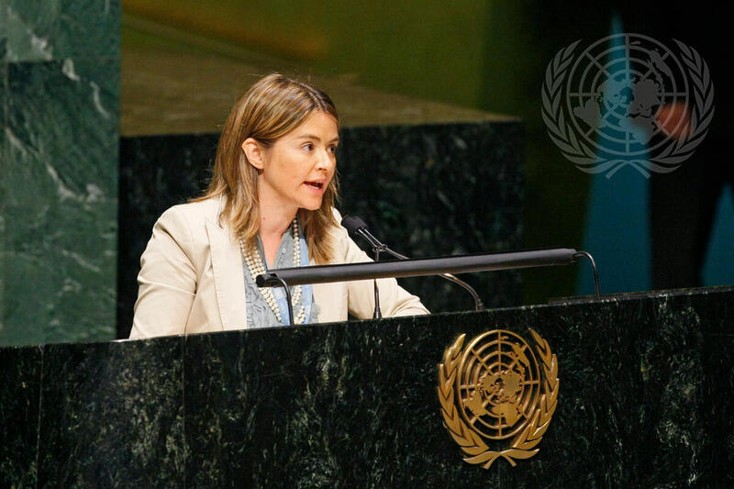
Featured photo: Catarina de Albuquerque, then United Nations Special Rapporteur on Human Right to Safe Drinking Water and Sanitation, addressing the United Nations General Assembly on 27 July 2011. Source: United Nations.
On July 28, 2010, the United Nations General Assembly adopted Resolution 64/292[i], recognising access to safe drinking water and sanitation as a fundamental human right. More than a symbolic declaration, the resolution marked a significant shift in global development policy, affirming that water and sanitation are not simply public services or economic commodities, but essential prerequisites for human dignity, public health, gender equality, and sustainable development.[ii]
16 years later, the Human Right to Water and Sanitation (HRWS) stands at a pivotal moment. Progress toward SDG6 has slowed, Official Development Assistance (ODA) is under pressure, and climate change is intensifying water insecurity across regions already struggling with fragile infrastructure[iii]. Against this backdrop, a growing narrative suggests that the promise of the right has failed to translate into meaningful change.[iv]
That conclusion overlooks an important reality.
The strongest argument for the Human Right to Water and Sanitation is not found in international declarations, but in the measurable progress achieved since its recognition in 2010.
The past 16 years have produced measurable progress in expanding access to safe water and sanitation, strengthening legal protections, and improving public service delivery.[v] While universal access remains out of reach, the evidence demonstrates that where governments have embedded the right in domestic law, invested in resilient infrastructure, and strengthened public institutions, the results have been transformative.[vi]
Building on 16 years of Progress
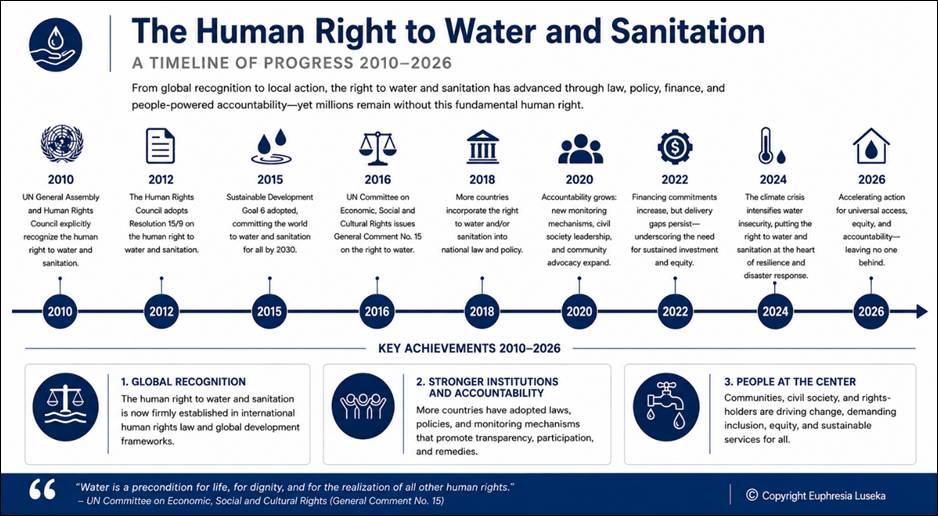
As illustrated in the figure below, the record since 2010 offers compelling evidence that rights-based governance can deliver tangible development outcomes when supported by political commitment, sound institutions, and sustained investment. Across countries and regions, the recognition of water and sanitation as a human right has influenced constitutional reforms, shaped public policy, strengthened accountability, and accelerated investments in essential services.
The expansion of water and sanitation services over the past two decades is unprecedented in scale. According to the WHO/UNICEF Joint Monitoring Programme (JMP), more than 2.2 billion people have gained access to safely managed drinking water services, while 2.8 billion people have gained access to safely managed sanitation. 5 During the same period, the number of people practicing open defecation declined dramatically; from more than 1.3 billion at the turn of the century to an estimated 350 million today.5 These gains have contributed to lower rates of waterborne disease, improved child survival, and better health and education outcomes, particularly for women and girls.
While these advances cannot be attributed to Resolution 64/292 alone, the recognition of water and sanitation as a human right helped reshape the global policy landscape.1 It reinforced political commitments, informed national legislation, and strengthened accountability by establishing access to water and sanitation as a public obligation rather than a discretionary service.
The influence of the resolution is perhaps most evident in domestic legal reform. Although the resolution itself is not legally binding, it has served as an important normative foundation for constitutional and legislative change in many countries. Kenya’s, Uruguay’s, Ecuador’s, Bolivia’s and South Africa’s Constitution explicitly guarantees the right to sufficient water, providing citizens with a legal basis to challenge unjustified service disconnections and demand government accountability.7 In India, the Supreme Court has interpreted the constitutional right to life to encompass access to safe drinking water, expanding legal protections for vulnerable communities.8 Across Latin America, countries including Costa Rica, Colombia, Mexico, Paraguay, Peru and Brazil have strengthened constitutional and statutory provisions that prioritise water for domestic use over competing commercial interests.6 Similar developments have occurred in Europe. Slovenia amended its Constitution in 2016 to recognise access to drinking water as a fundamental right, while the European Union’s revised Drinking Water Directive requires Member States to improve access to water, particularly for vulnerable and marginalised groups.
Legal recognition, however, has proven most effective when accompanied by capable public institutions.
The experience of the Phnom Penh Water Supply Authority in Cambodia illustrates what is possible when governance reforms accompany infrastructure investment. Once characterised by high water losses, weak financial management, and widespread corruption, the utility transformed itself into one of the world’s leading public water providers through universal metering, improved operational efficiency, transparent management, and progressive tariff structures.6 Today, Phnom Penh enjoys near-universal urban water coverage while protecting affordability for low-income households.
A similarly instructive example comes from eThekwini Municipality in Durban, South Africa.[vii] Through its Free Basic Water policy, the municipality guarantees vulnerable households a minimum allocation of water free of charge, financed through increasing block tariffs that require higher-volume consumers to pay proportionately more.8 The model demonstrates that equity and financial sustainability need not be competing objectives. Well-designed pricing systems can simultaneously protect vulnerable households, recover operating costs, and expand access.
Taken together, these experiences underscore an important lesson. The Human Right to Water and Sanitation does not deliver results simply because it exists as an international norm; its true value lies in its ability to shape domestic institutions, guide public investment, and strengthen accountability. The unfinished nature of the global agenda should therefore not obscure the considerable progress already achieved or the practical lessons it offers for accelerating universal access.
The Unfinished Agenda
Recognising progress is not the same as declaring victory. Despite significant advances over the past 16 years, universal access to safe water and sanitation remains one of the world’s most pressing development challenges. More than 2.1 billion people still lack safely managed drinking water at home, while 3.4 billion do not have access to safely managed sanitation.5 These gaps are not simply the result of technical constraints; they reflect persistent weaknesses in law, finance, infrastructure, and governance.
Continue reading “A Few Drips Shouldn’t Close the Tap: The 16th Anniversary of the Human Right to Water and Sanitation”
