By Bethlehem Mengistu (Agenda for Change), Kerstin Danert (Ask for Water)
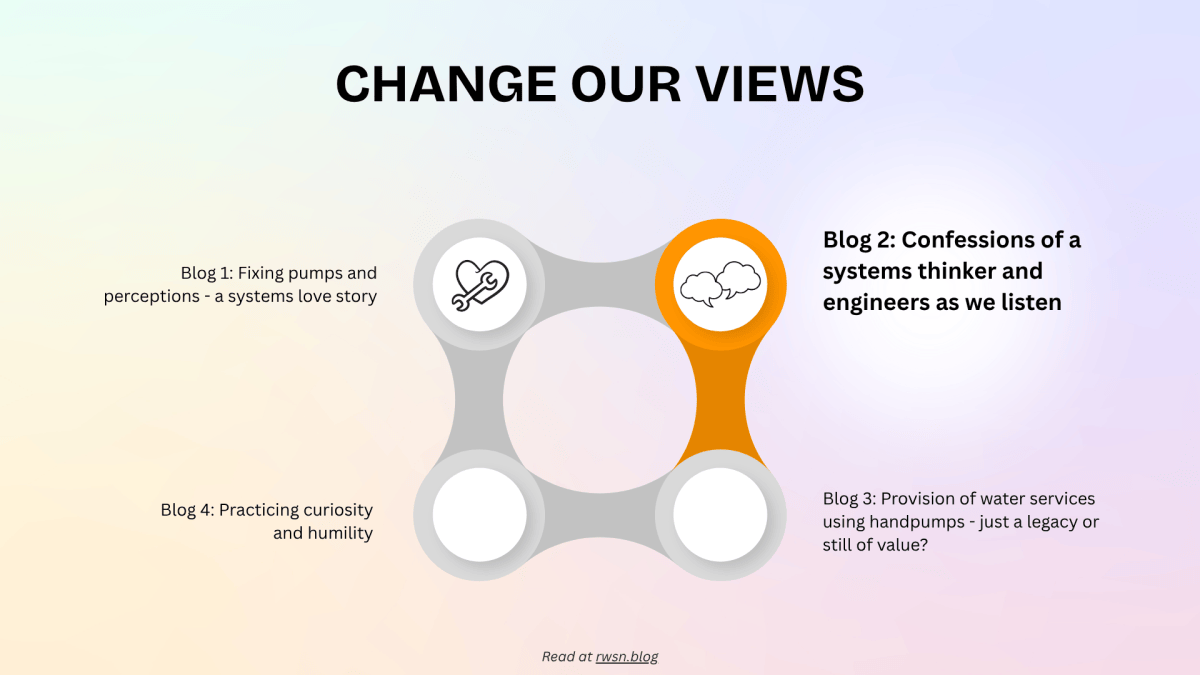
Whether the starting point is a broken pump or a fragmented WASH system, one truth connects Stop the Rot and Agenda for Change: you cannot deliver safe, sustainable water services without both construction quality and resilient systems. Both platforms involve partners in government, civil society, funding agencies, the private sector and academia; both are striving to improve rural water supply services, and yet they are different. This is our second joint blog
BREAKING DOWN BARRIERS
Bethlehem: When we talk about breaking down barriers, I think one of the biggest ones is still a perceived divide between “the engineers” and “the systems people.” Too often, engineering quality is treated as a stand-alone issue, while systems strengthening is seen as something abstract that sits above the technical work. But in reality, the two can’t be separated.
So here’s my challenge back to you both, as engineers: if you know what good construction looks like, and you see the same mistakes repeated year after year, what will it take for you to push beyond the borehole and also work on changing the policies, budgets, and accountability that make quality the norm instead of the exception?
Because unless engineering expertise connects to governance, financing, and long-term service delivery, we will keep fixing the same broken pumps without fixing the reasons they break.
TACKLING COMPLEX ISSUES
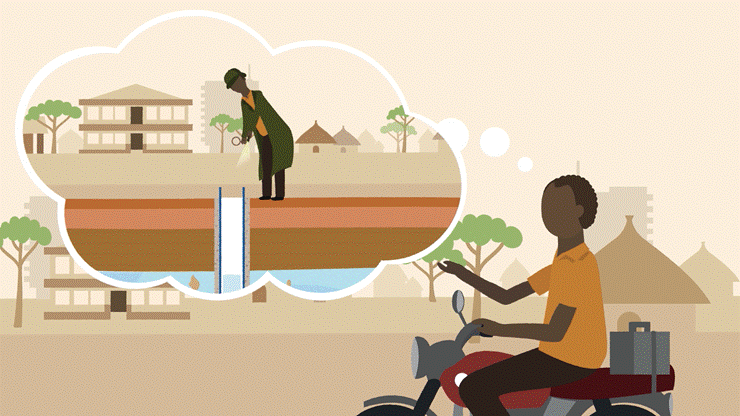
Kerstin: This is exactly what Stop the Rot is trying to do, building on years of the efforts and experiences within Rural Water Supply Network (RWSN). Stop the Rot is trying to tackle a complex issue. Let me take a related long-running example to explain. Boreholes fail for a variety of reasons. RWSN, as a partnership of organisations, has worked to understand the drilling sector in a number of countries, before it developed international technical guidelines to unpack borehole siting, costing and pricing, procurement and contract management and drilling supervision. Recognizing that these topics needed to also be explained succinctly, a series in four short animated videos were produced. Training courses in a number of countries were also run, alongside putting all of the training materials into the public domain.
But this was not enough to change sector practices.
So a guidance note was developed to set out how organisations could raise drilling professionalism. Building on this, online courses gave the opportunity to stakeholders to engage with policy and project issues laid out in the guidance note. The courses were run three times, attended by several hundred people from all over the world, and brought many issues to light. We even have a film that shares some of the stories of change from those taking the courses.
So, over the years, a small group of engineers and hydrogeologists working for different organisations have tried to reach out. Some organisations, including The Water Project, WaterAid and UNICEF, as well as committed individuals have made improvements to the way that they work. However, I am not convinced there is enough change – especially at national level to ensure that high quality boreholes are consistently built.
So we have tried, over two decades, with limited funding, to reach far beyond engineering. I say reach out, because the term “systems” was not being used when RWSN started trying to raise drilling professionalism. With Stop the Rot we are looking more at handpumps, while not forgetting boreholes.
Bethlehem: And that’s exactly the point, Kerstin. You have described decades of dedicated, thoughtful work, pushing from the technical side into the system. However, the truth is that until governments, donors, and implementing agencies view drilling professionalism as essential to sustainable services, rather than a nice-to-have, we may continue to go in circles.
The fact that RWSN and partners have had to produce international guidelines, videos, training courses, and online courses to promote drilling supervision and procurement practices conveys the depth of the problem. It’s not a lack of knowledge; we know what good looks like. The issue is a mix of structural resistance and deep-rooted inertia, an implicit norm of low standards and short-term fixes that continues to undermine progress.
Every failed borehole or poor quality handpump is as much a governance failure as it is a technical one. Quality construction and long-term service delivery are system-wide responsibilities. And if we truly want to stop the rot, we need everyone (all the actors), the engineers, yes, but also ministers, accountants, and planners, taking shared ownership of that reality.
So here’s my question back to you, and to all of us in the sector: If we agree that quality is a systems issue, how do we step more fully into that space? How do we bridge the perceived divide and ensure that engineering expertise informs not just designs and specs, but also budgets, policies, and long-term planning? We won’t fix the system alone, but we do have a vital role in shaping it, together.
PRIORITIZATION AND COLLABORATION
Kerstin: I have not seen the root of the problem as a divide up to now, but rather as one of a lack of prioritisation in some organisations – at the highest levels – to get the basics right as Catherine put it in our first blog. Perhaps the framing of a divide, and of barriers can bring about a breakthrough. Please help us to figure out what else is needed to ensure that, for example: that budgets consistently include professional drilling supervision; that policies ensure that rapidly corroding parts are no longer installed in aggressive groundwater; that policies support supply chains to be robust enough to ensure quality components land in the hands of drillers and mechanics; that long term planning supports effective groundwater resources management?
Bethlehem: The real problem may not be a divide, but a lack of prioritization. We have let both approaches exist side by side for too long. Instead of treating engineering excellence and systems strengthening as separate, we should see them as working together to achieve reliable, lasting water services.
We already have the evidence we need. Years of guidance, training, and technical innovation have shown us what works. Systems thinking explains why success is not always consistent. The real gap is not knowledge, but turning it into practice, incentives, and accountability.
What we need now is not just more collaboration, but a new approach from everyone. Engineers stepping more deliberately into policy and finance discussions. Systems experts engaging more deeply with the technical details that affect long-term service. And leaders in government, donor groups, and organizations treating ‘getting the basics right’ as essential, not optional.
In the end, quality is not just a technical detail. It is the result of the whole system working well.
That is how we stop the rot. Not by choosing between systems or engineering, but by finally refusing to separate them.