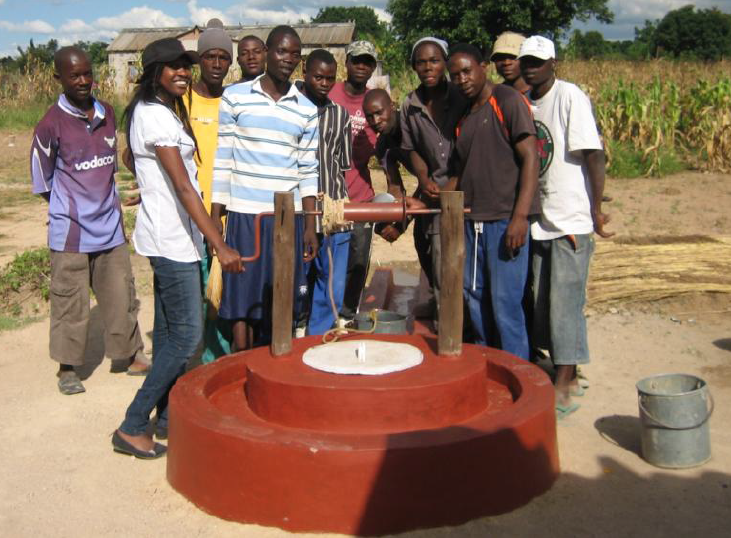
Mohammad Ibrahim June 04, 2016 The Nigerian Turkish International College NTIC has constructed over 90 hand pumps and electric motorized boreholes in many villages, hamlets and schools within Kaduna state in Nigeria the last four years of its existence. Davud Sagir, the director for the college in Kaduna says that the benefiting communities include Kauya […]
Author: RWSN Secretariat
Southern Africa: Record Drought Leaves over 41.4 Million People Food Insecure — WaterSan Perspective
WaterSan Perspective June 30, 2016 An estimated 41 million people – 23 per cent – of the 181 million rural population in the Southern African Development Community (SADC) are food insecure, and out of this figure, more than 21 million are in urgent need of assistance. This is according to the latest Vulnerability Assessment Results […]
via Southern Africa: Record Drought Leaves over 41.4 Million People Food Insecure — WaterSan Perspective
Water, Spillovers and Free Riding: the economics of pump functionality in Tanzania
by Rossa O’Keeffe-O’Donovan, Economics PhD Candidate, University of Pennsylvania.
Which factors predict the functionality of hand pumps? Do communities free ride on their neighbors’ water sources? Are there positive spillover effects in the maintenance of nearby pumps? And what does this all mean for practitioners? This post gives an overview of my ongoing Economics PhD research, which tries to answer these questions.
Note: this research is still in progress, and I am seeking survey responses to complement my quantitative work, and help understand and interpret my results. If you have knowledge of how decisions are made in the installation and/or maintenance of hand pumps, please take this 8 minute survey here: bit.ly/PumpSurvey
RWSN Discussion – Groundwater Regulation/La réglementation des eaux souterraines 27Jun/juin – 17 Jul/jul
Discussion and Webinar – Groundwater Regulation – 27th June to 17th July 2016
Much remains to be learned about groundwater regulation. Zambia is a case in point: with the enactment of the Water Resources Management Act in 2012, the new Water Resources Management Authority (WARMA) is currently developing regulations (statutory instruments) that cover the licencing of drillers and consultants, permitting and groundwater protection. Once these are passed into law, for the first time in the country’s history, groundwater will be regulated.
Water Crisis – Spotlight on Ethiopia’s Boricha district — WaterSan Perspective
Zelalem Genemo in Hawassa Ethiopia June 13, 2016 In Boricha district of Ethiopia, women and children walk up to five hours to collect water from shallow and unprotected ponds which they share with animals. Sometimes water in these ponds is contaminated as rainwater washes wastes from surrounding areas into the sources. Often, children are left […]
via Water Crisis – Spotlight on Ethiopia’s Boricha district — WaterSan Perspective
‘Water Everywhere but Not a Drop to Drink’: Nigeria’s Eleme People Cry Out — WaterSan Perspective
Christian Chibuzo Maduka May 26, 2016 Eleme town is one of the various towns inhabited by the Eleme people of Ogoniland, the indigenous peoples that inhabit the Niger Delta region of Southeast Nigeria. The Eleme people live in ten village-clusters situated in Eleme Local Government Area (ELGA) of Rivers State, around 20 km East of […]
via ‘Water Everywhere but Not a Drop to Drink’: Nigeria’s Eleme People Cry Out — WaterSan Perspective
Make Bottled Water Available and Affordable
Guest Blog by Francis Mujuni, WASH Specialist@MCID

Uganda with a population of 37 million people an annual population growth rate of 3.2% makes it one of the fastest growing countries in Africa (UBOS 2014)[1]. With such rate of growth compounded by high levels of poverty the country is unable to provide its people the required social amenities to live healthy and productive lives. With a per capita annual income of less than US$600, Uganda is still one of the world’s poorest countries where a quarter of its population lives on less than $1.25 a day[2]. Poor sanitation and lack of safe water costs Uganda an equivalent of $177 million a year. Total health expenditure as a percentage of GDP was in 2013 was about 9.8% with $21 million spent on healthcare due to poor sanitation and $147 lost due to premature death[3].
Continue reading “Make Bottled Water Available and Affordable”
Submission deadline extended to 6th May / Date finale pour la soumission des contributions étendue jusqu’au 6 mai
Dear all,
The deadline for the Open Call for submissions to the RWSN Forum (Abidjan, Côte d’Ivoire, 29/11-02/12/2016 – https://rwsn7.net/) has been extended by one week, due to high demand and to a number of authors having difficulties with uploading their submissions, or having misunderstood the instructions about submitting full papers rather than just abstracts. The deadline is now Friday, May 6th to submit one or more of the following through our online platform (https://www.conference-service.com/RWSN7/welcome.cgi):
• A short paper (up to 2,000 words): FULL PAPER to be submitted using the attached form;
• A long paper (up to 6,000 words) FULL PAPER to be submitted using the attached form;
• A poster (at this stage, if the final poster is not yet available, a summary can be submitted, with the final poster to be submitted by 1 September)
• A short film (at this stage, if the final film is not yet available, a summary can be submitted, with the final film to be submitted by 1 September)
• A photography or illustration.
To get an idea of the type of content presented at an RWSN Forum, you can find everything from the last one on the website of the 6th RWSN Forum, 2011: https://rwsnforum.wordpress.com/programme/
Thank you for your interest in the RWSN Forum and we hope you will be able to share your experience and stories with us and others around the world.
***
Chers tous,
La date butoir pour l’Appel Ouvert à contributions pour le Forum RWSN (Abidjan, Côte d’Ivoire, 29/11-02/12/2016 – https://rwsn7-fr.net/) a été étendu d’une semaine, dû à une forte demande et au nombre important d’auteurs qui ont eu des difficultés à télécharger leur contributions, ou qui avait mal compris les instructions liées à la soumission d’articles complets et pas seulement des résumés/ abstracts. La date butoir pour la soumission des types de contributions ci-dessous est maintenant le vendredi 6 mai, toujours à travers notre plateforme en ligne (https://www.conference-service.com/RWSN7/welcome.cgi):
• Un article court (maximum 2000 mots): ARTICLE ENTIER devant être soumis en complétant le formulaire ci-joint;
• Un article long (maximum 6000 mots): ARTICLE ENTIER devant être soumis en complétant le formulaire ci-joint;
• Un poster (à ce stade, si le poster final n’est pas prêt, un résumé peut être soumis, et le poster final soumis avant le 1 septembre)
• Un court-métrage (à ce stade, si le court-métrage final n’est pas prêt, un résumé peut être soumis, et le court-métrage final soumis avant le 1 septembre)
• Une photographie ou illustration.
Pour avoir un idée sur le type de sujets qui peuvent être présentés à un Forum RWSN, vous pouvez retrouver le programme entier du dernier Forum sur le site du 6ème Forum RWSN en 2011: https://rwsnforum.wordpress.com/programme/
Merci de votre intérêt pour le Forum RWSN et nous espérons que vous serez en mesure de partager votre expérience et vos histoires avec nous et le reste du monde.
RWSN Update – April 2016
The RWSN quarterly newsletter – April 2016
If you are having trouble reading this then download the more readable PDF version: ENGLISH / FRANÇAIS. Pour les francophones – Si vous souhaitez recevoir le bulletin trimestriel en français, veuillez nous écrire un e-mail à ruralwater @ skat.ch intitulé Bulletin Trimestriel en français.
WORD FROM THE CHAIR
| Dear RWSN members and friends, dear colleagues,
Knowledge sharing and learning is critical to establishing and delivering water services that last. Advances in communications technology have made this easier than ever at a global scale. I hope that you have taken advantages of RWSN’s online discussions, webinars and publications – and we know from the feedback that you have given us, that you do value these exchanges. However, even with such powerful online tools, nothing beats meeting people face-to-face. It is an opportunity to strengthen links with past and current collaborators, and hopefully find new partners for the work ahead. That is why the RWSN Forum is such an exciting opportunity for sharing. The agenda is set by you, the members, and the contributions that you have submitted. Complemented by regional pre-events in Peru and Thailand, the 7th RWSN Forum in November will be a truly global event – and it brings together people with a common purpose, which is expressed clearly in the RWSN Vision: “of a world in which all rural people have access to a sustainable and reliable water supply which can be effectively managed to provide sufficient, affordable and safe water within a reasonable distance of the home.” At the last Forum, way back in 2011, delegates agreed on the 10 Kampala Commitments. The 7th Forum, this year, gives us an opportunity to reflect on these, the progress we have made, what needs to be done, and what we have learned. Do we still hold to the same principles, or has thinking and experience taken us in a new direction? Be part of this conversation and I look forward to welcoming you to Abidjan on 29 November. |
Ton Schouten, Chair
Learning in the rural water supply sector – a complexity perspective
by Felix Knipschild, reblogged from IRC
How can I conceptualise and model learning in the rural water supply system in Uganda?
This is the challenge I’ll be working on for the next 5 months at IRC. I’m a student at Delft University of Technology, following the master Systems Engineering, Policy Analysis and Management. At my faculty, we learn to look at the intersections between technical systems and social systems and design for complex systems.
Continue reading “Learning in the rural water supply sector – a complexity perspective”