Handpump standardisation in sub-Saharan Africa: Seeking a champion

by Jess MacArthur, IDE Bangladesh

Download now
Download the new RWSN Publication “Handpump standardisation in sub-Saharan African”

As a millennial, I have to admit: I really enjoy technology and innovation. I love to read innovation blogs and to dissect innovation theory. So just over two years ago as I began researching how innovation intersects development in the world of handpumps, I felt a bit stumped. An estimated 184 million people in sub-Saharan Africa (SSA) today rely on handpumps for their domestic water and many of these use designs that were developed before I was born. Yes, that makes me young and maybe that make you feel old. But mostly, it made me sit back and think. Is this beneficial or is this concerning? At the time I was helping Water4 navigate the policy-sphere around new handpump integration.  I wanted to know why certain handpumps have more dominance in certain areas and how innovators can pilot in the sector with both evolutionary and revolutionary designs.

Continue reading “Handpump standardisation in sub-Saharan Africa: Seeking a champion”

MEMBER NOTICE BOARD/PANNEAU D’AFFICHAGE DES MEMBRES: December 2014

Improve International: Guidelines for Resolution of Problems with Water Systems

Resolution is the process of addressing problems with water systems or toilets. Such problems are often identified during monitoring or evaluation after a project. Resolution reflects the concept that the organizations that are made aware that water systems or toilets they built aren’t working are responsible for doing something. Read more in the Guidelines for Resolution of Problems with Water Systems (Executive Summary) and Guidelines for Resolution of Problems with Water Systems (full report).

Improve International: Lignes directrices pour la résolution des problèmes des systèmes d’eau

Résoudre est le processus d’aborder les problèmes des systèmes d’eau ou des toilettes. De tels problèmes sont souvent identifiés lors du suivi ou de l’évaluation après le projet. Résoudre reflète le concept que les organisations qui se rendent compte que les systèmes d’eau ou les toilettes qu’elles ont construit ne fonctionnement pas sont responsables de faire quelque chose pour y remédier. Plus d’information dans Lignes directrices pour la résolution des problèmes des systèmes d’eau (résumé exécutif) et Lignes directrices pour la résolution des problèmes avec les systèmes d’eau (rapport complet).


Water for People: monitoring innovation for “Everyone Forever”

Metered hand-pumps: Privately operated hand pumps as a way to improve sustainability and service delivery

To encourage private sector engagement in the management of water points, Water For People and Appropriate Technology Centre, Uganda are testing a meter for hand pumps. This product has been introduced to entrepreneurs with the expectation that they will prove to be better managers of water points than the current committees.

Water For People Core Indicators and Monitoring Process

This piece outlines how Water For People currently conducts district-wide community and household-level monitoring in all Everyone Forever districts at least once per year. Data is typically collected by teams consisting of our staff and local government officials.

Water for People: suivre l’innovation pour “Pour chacun, pour toujours”

Des pompes manuelles avec compteur: des pompes manuelles opérées manuellement comme façon d’améliorer la durabilité et la fourniture de services

Pour encourager l’engagement du secteur privé dans la gestion des points d’eau, Water For People et Appropriate Technology Centre, Ouganda sont en train de tester un compteur pour les pompes manuelles. Ce produit a été introduit aux entrepreneurs avec l’espoir qu’ils seront de meilleurs gestionnaires de points d’eau que les comités actuels.

Principaux indicateurs et processus de monitoring de Water For People

Ce document met en exergue comment Water For People met en œuvre actuellement au moins une fois par an un monitoring à l’échelle des ménages et des communautés au sein des districts du projet « Pour chacun, pour toujours ». Les données sont en général collectées par des équipes composées par le personnel du projet et celui du gouvernement local.


Poldaw Designs: Call for Project Partners: New Handpump for Deep Wells

“In various regions there is a need for a Public Domain handpump for very deep boreholes with Static Water Level (SWL) 60m to 100m. Existing public domain handpumps are often unreliable at these depths.

Poldaw Designs with WaterAid have developed a solution. Prototypes have been successfully field-tested in various countries for 3 years, and the results have been assessed by a Skat expert engineer. Before releasing into the Public Domain as a proven design, a final validation programme is needed, testing on at least 20 boreholes with Static Water Level in the range 60m to 100m.

We are urgently seeking a partner (or partners) operating in the field, to provide suitable sites and to work with us on installing and monitoring the pumps. Funding partners are also welcomed to share in this valuable project.

 If your organisation operates in areas with water levels in the range 60 to 100m, and you are interested in participating, then we would like to hear from you.”

For more information, please contact:  Paul Dawson pdsundew @ btinternet.com or Sandy Polak tapolak @ aol.com Poldaw Designs, UK. (Poldaw Designs is a not-for-profit division of Neale Consulting Engineers

Poldaw Designs: Appel à des partenaires: Nouvelles pompes manuelles pour des puits profonds

“Dans de nombreuses régions, il y a le besoin d’une pompe manuelle du domaine publique pour les forages très profonds avec un niveau statique de l’eau de 60 à 100m. Les pompes existantes du domaine public sont souvent peu fiables à ces profondeurs.

Poldaw et WaterAid ont développé une solution. Des prototypes ont été restés avec succès sur le terrain dans différents pays pendant 3 ans et les résultats ont été évalués par un ingénieur expert de Skat. Avant de le sortir dans le domaine public comme design ayant fait ses preuves, un dernier programme de validation est nécessaire, avec test sur au moins 20 forages avec un niveau statique variant entre 60 et 100m.

Nous cherchons de toute urgence un ou plusieurs partenaires opérant sur le terrain pour nous fournir des sites appropriés et travailler avec nous pour installer et suivre les pompes. Des partenaires financiers sont aussi les bienvenus pour faire partie de ce projet de valeur.

Si votre organisation opère dans ces régions avec des niveaux d’eau oscillant entre 60 et 100m et que vous êtes intéressés de participer, alors nous serons ravis d’en savoir plus. »

Pour plus d’information, contacter : Paul Dawson pdsundew @ btinternet.com ou Sandy Polak tapolak @ aol.com Poldaw Designs, UK. (Poldaw Designs n’est pas une division à but non lucrative de Neale Consulting Engineers)


WEDC: WEDC Conference 2015

The 38th WEDC International Conference will be held on 27–31 July 2015, Loughborough University, UK. The call for abstracts will be launched soon on the WEDC Conference website.

WEDC: Conférence WEDC 2015

La 38ème conférence internationale de WEDC se tiendra du 27 au 31 juillet 2015 à l’université de Loughborough au Royaume Uni. L’appel à proposition pour les articles sera lancé bientôt sur le site de la conférence WEDC .


UNC: Water Safety Planning Distance Learning Course

The Water Institute at UNC now offers a distance learning course on Water Safety Plans (WSPs) aimed at those in the water industry with management, engineering, or operational responsibilities.  Water Safety Plans represent a new approach to managing risks of water system failure that was developed by the World Health Organization and field-tested in the UK, Australia, Iceland, Nepal, and Uganda. Registration for the course is now open. To register or for additional information, email us: waterinstituteteaching@unc.edu or visit the Water Safety Plans distance learning webpage.


Skat/WaterAid/Waterlines: Writing for WASH courses

In the run-up to the 7th RWSN Forum in 2016 (see below), we are looking to organise more RWSN “Writing for WASH” courses. The format is flexible and can be run over 2 or 3 days. Since 2012, Skat and WaterAid have run courses in London, Kampala, Dar Es Salaam, Monrovia, Madagascar, Bangladesh and Kiev. We are looking for host organisations, so if you would be interested in developing the writing and presentation skills of your staff or partners then please contact the RWSN Secretariat (sean.furey @ skat.ch)

Skat/WaterAid/Waterlines: Ecriture pour les cours WASH

Dans la preparation du 7ème forum du RWSN en 2016 (cf ci-dessous), nous planifions de réaliser plus de cours RWSN « Ecrire pour le WASH ». Le format est flexible et peut être tenu sur 2-3 jours. Depuis 2012, Skat et WaterAid ont effectué des cours à Londres, Kampala, Dar Es Salaam, Monrovia, Madagascar, Bangladesh et Kiev. Nous sommes à la recherche d’organisations hôtes. Alors si vous êtes intéressés dans le développement de l’écriture et des compétences en présentation de votre personnel ou de vos partenaires, alors merci de contacter le secrétariat du RWSN (sean.furey @ skat.ch)

a new phase of RWSN is on the way…..

2015 Theme Icons

RWSN is not a formal organisation, more of a shared idea. In 1992, the network was founded as the Handpump Technology Network (HTN) with a narrow focus on…. handpump technology. 22 years on, and this small group of engineers from the Water & Sanitation Program of the World Bank, UNICEF, Skat and the Swiss Agency for Development and Cooperation (SDC) has become a much bigger family.

As of this morning we have 6,301 individual members, 23 RWSN Member Organisations (the newest are Yobe State Rural Water Supply and Sanitation Agency, Nigeria and the German-based NGO, Welthungerhilfe) and we have an active team of thematic leaders from Skat, WaterAid and IRC as well as a tremendously supportive Executive Committee.

So where now?

Continue reading “a new phase of RWSN is on the way…..”

World Water Day – Is the Hand-pump dead?

WS13_Eritrea_25
Broken India Mk II in Eritrea (Skat)

In this short blog series on the successes of India Mark II, Afridev and Bush Pumps, however the challenges and set-backs that were encountered by these designs shouldn’t be discounted. Nor should it be overlooked that there are also successful proprietary designs, and self supply options like the EMAS Pump and the Rope Pump. However it is worth highlighting the heroic efforts of those people from all the different countries and organisations and what they achieved for rural water supplies worldwide.

In today’s debate, the humble hand-pump gets the part the villain: the rusting carcass in the corner of too many villages, or the subject of frightening statistics about how many are probably not in use at any one time, and how long they are out of service for. Many of the problems, framed in that weaselly catch-all “sustainability” have remained – doggedly – since the 1970s and before: pump manufacturing quality is often poor, boreholes are drilled badly, supply chains for spare parts fail, pump mechanic skills are lost, not enough money is collected to pay for the maintenance and replacement costs.

Continue reading “World Water Day – Is the Hand-pump dead?”

How three handpumps revolutionised Rural Water Supplies: the Zimbabwe Bush Pump

The Bush Pump has been serving the people of Zimbabwe for 80 years.How Three Handpumps Revolutionised Rural Water Supplies

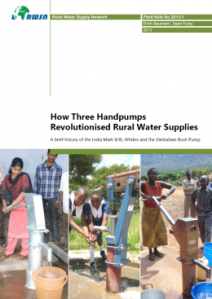
In the new publication “How Three Handpumps Revolutionised Rural Water Supplies” from RWSN, Erich Baumann explains how three handpumps, the India Mark II, the Afridev, and the Zimbabwe Bush Pump were developed and Sean Furey explores what lessons can be learned for scaling up WASH technologies today.

Unlike other handpumps used across the world, the Bush Pump has a long history. It was born in Zimbabwe in 1933, and designed by Tommy Murgatroyd, a Government Water Supply Officer in Matabeleland. Murgatroyd established the basic components of all later Bush Pumps – a wooden block, a strong pump stand and heavy-duty components.
Continue reading “How three handpumps revolutionised Rural Water Supplies: the Zimbabwe Bush Pump”

How three handpumps revolutionised Rural Water Supplies: the Afridev

1980 to 1990 was the International Decade of Water Supply and Sanitation and the greatest hand-pump project began.How Three Handpumps Revolutionised Rural Water Supply

In the new publication “How Three Handpumps Revolutionised Rural Water Supplies” from RWSN, Erich Baumann explains how three handpumps, the India Mark II, the Afridev, and the Zimbabwe Bush Pump were developed and Sean Furey explores what lessons can be learned for scaling up WASH technologies today.

As part of that UNDP and the World Bank established a joint Water & Sanitation Program (WSP, which still exists as part of the World Bank) and one of its flagship projects was the Hand-pump Project, led by Saul Arlosoroff, which rigorously tested all the hand-pumps around the world that they could get their hands on. Their final report “Community Water Supply: the Hand pump Option” (1987) is still the defining text in hand-pump literature.

The hand-pump project also defined Village Level Operation & Maintenance (VLOM), the concept of making hand-pumps easier to maintain by the users so that minor breakdowns could be repaired quickly.  The India Mark II was not a VLOM pump because it required specialist tools and some skill and strength to make repairs to the pump cylinder down in the borehole. This was addressed through a design revision, imaginatively called the India Mark III. However the hand-pump team throught they could still do better and so two handpump design projects began.

Continue reading “How three handpumps revolutionised Rural Water Supplies: the Afridev”

How three handpumps revolutionised Rural Water Supplies: the India Mark II

How Three Handpumps Revolutionised Rural Water Supply1974: UNICEF reviewed their water supply programme in India. The results were shocking: of the tens of thousands of wells drilled over the previous seven years, 75% were not supplying water.

In the new publication “How Three Handpumps Revolutionised Rural Water Supplies” from RWSN, Erich Baumann explains how three handpumps, the India Mark II, the Afridev, and the Zimbabwe Bush Pump were developed and Sean Furey explores what lessons can be learned for scaling up WASH technologies today.

In the mid 1960s, drought ravaged India, and the Government of India asked UNICEF for help with improving access to water through borehole drilling. In the following years, the emergency drilling campaign evolved into a broader national programme to improve rural water supplies, but the attention was focused on the drilling and the boreholes. No one gave the hand-pumps that went on them much thought. That all changed in 1974.

Continue reading “How three handpumps revolutionised Rural Water Supplies: the India Mark II”