
The importance of learning from project evaluations can’t be over-emphasised
Category: Sustainable Services
Defender or Prius? When it comes to WASH technologies, are we asking the wrong questions?

In her latest blog post “What’s wrong with a free car?”, Susan Davis of Improve International argues that giving away cars for free would not solve mobility problems for those on low incomes and that likewise, with WASH projects, giving away a capital asset does not help a ‘beneficiary’ if it leaves them with crippling running costs that they can’t afford. In planning WASH services we need to consider lifecycle costs.
There are also parallels in terms of technology choice: do you buy an old Land Rover, which will be unreliable but many things can be fixed by the owner (My neighbour and I changed a head gasket and a cracked cylinder head on my 20-year-old Defender, and I spent many happy – and unhappy – hours tinkering), or do you buy a Toyota Prius that will be ultra-efficient and reliable, but when it does break will cost and fortune and needs specialist skills and materials.
What should water users in say, Nicaragua or South Sudan, choose for their pump? Would they be better with a handpump that is precision-manufactured out of the very best materials to make it as reliable as possible, or a Rope Pump or an EMAS pump that can be made cheaply from readily available materials, and can be easily fixed by the user if it goes wrong.
It may seem to perverse to compare the two situations where millions everyday around the world do not have access to safe water, let alone a vehicle. But I found Susan’s comparison a helpful one in explaining the value of a topic like lifecycle costing that at first glance can seem intangible and academic. In the WASHtech project we, along with our project partners IRC, WaterAid, Cranfield, KNUST and Netwas, have embedded the findings of WASHCost from day one so that the assessment of the applicability of new WASH technologies tries to get the whole picture.
What lifecycle costing does is that it shows us that there are better questions to questions to ask than just “which technology is better”. Instead: for any given context, which approach to supplying a water service is the most financially sustainable? What are all the costs involved, not just the CapEx and OpEx? If water users and Government can be provided with that information, in a way that is clear and understandable, then they have a fighting chance of getting a system that works, and continues to work.
Remote water monitoring – no more excuses?
A thoughtful piece from Harold Lockwood, working with IRC on the Triple S project

By Harold Lockwood
Recently I have been on a continent-hopping tour through a different range of meetings and events, from which I have seen a pattern emerging, or at least a series of questions in my own mind, as I carry out my work in the WASH sector at an international level.
View original post 1,316 more words
Celebrating Improvements #5: Best Practices in International Development
Congratulations to Improve International for being such a passionate advocate for better monitoring and evaluation in the WASH sector
Alice in waterland: a fantasy
in case you missed it from a couple of weeks ago, when the RWSN editor was out of the country…

This story is fictional. Any resemblance to real situations or persons is pure coincidence.
When Alice stepped through the mirroring water surface into waterland, the first creature she came across was a rabbit, wearing a UN-blue jacket, looking frantically at its watch.
“It is nearly time. Only three more years to go till 2015. So little time left. We won’t make it. We must hurry up.”, it mumbled to itself.
“Hey Mr. Rabbit”, said Alice, “what is all the hurry about? What must be done before 2015?”.
View original post 1,427 more words
Learning about Monitoring & Evaluation
Sustainable water services take ‘Water & Health’ Conference by storm
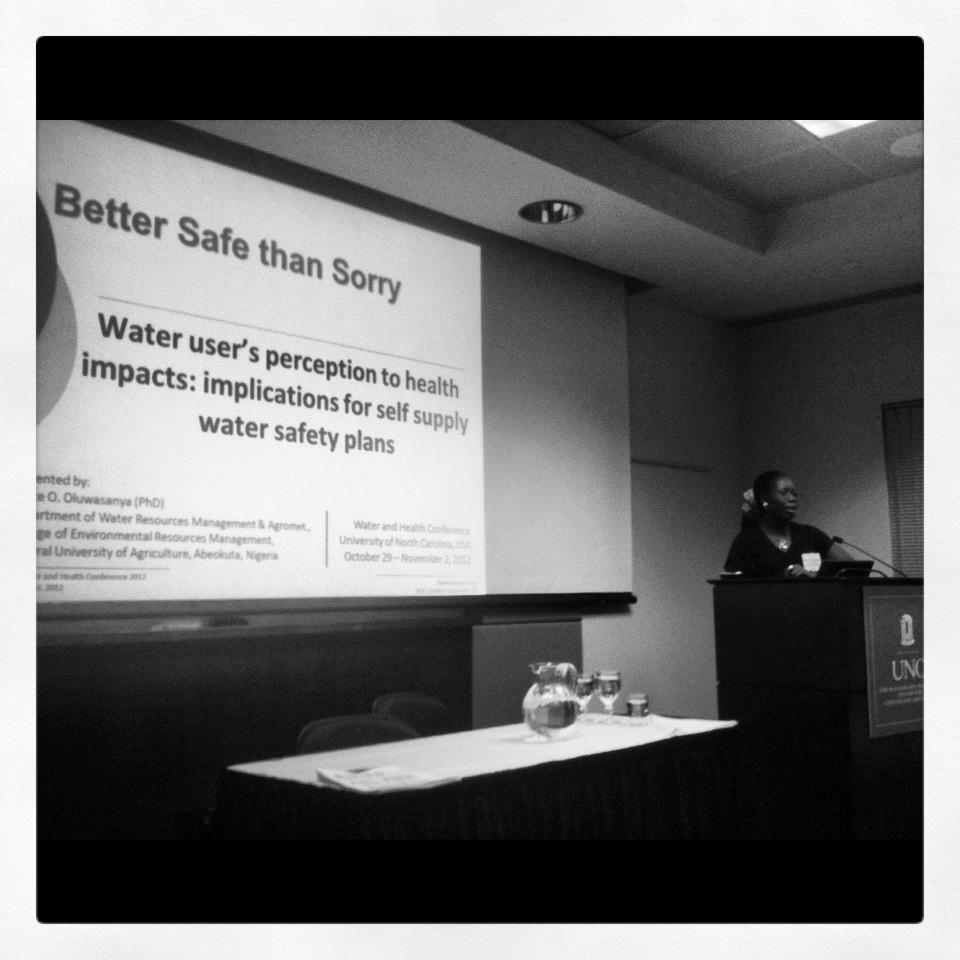
I was lucky enough to attend this year’s Water & Health Conference at the University of North Carolina. I was even luckier to make it as the skirts of Hurricane Sandy swept up the Atlantic coast before crashing into the American North East.
It was a great opportunity to meet, face-to-face, many RWSN members who have been communicating with online and meet a whole bunch of new people. It was really inspiring to hear their stories and find out more about their organisations and research. Here are just some of my highlights from the event:
Continue reading “Sustainable water services take ‘Water & Health’ Conference by storm”

